
Q&A With Lynda Goodfriend, Chair, Acting Dept., New York Film Academy Los Angeles

Lynda GoodfriendQ: What is the first lesson to learn in becoming a successful actor?

LG: There are many actors who pursue this career professionally. Being a Personal Manager for over 30 years with my own Management company, I can say I have seen many actors come and go- some had talent, some did not. The most important factor in achieving success is commitment. There is an old saying “Out of every 3 actors, one will make it. Not because of Talent or Looks. But because the other two give up.” This is very true- but multiply that by thousands. One in every thousand perhaps has the persistence and dedication to keep at it.
So the first lesson would be- love what you do, commit to what you do, and work harder than anyone else at what you do.

Q: What do you wish you knew when you started in your field?

LG: I wish I knew that it is important to learn everything you can about life. It all contributes towards your knowledge as an actor. Do not just save the learning for in the classroom. Look and listen to everything and everyone around you. There is a wealth of knowledge about the human condition and human behavior out there, which is the core of the craft of acting.

Q: How do I get the most out of my acting program at NYFA?

LG: Do not miss class, do not miss class, do not miss class! You can’t learn your craft without doing it and watching it. You can’t make up for the valuable time in front of an audience and being the audience. Actors should also work with filmmakers as much as possible. The more they are in front of the camera, the more comfortable in front of camera they become, and the better actors they become.

Q: What is the most valuable lesson you’ve learned in your professional career?

LG: The biggest lesson I think I’ve learned – and I want to pass on- is “Do not burn bridges.” The Entertainment Business is about relationships: relationships that you build and refine, and go back to again and again. I am still involved with the people I started working with over 30 years ago. I am able to call up Ron Howard or Henry Winkler and others, and ask them to come speak to our students. That’s a pretty amazing relationship to have.

Q: Which pieces of equipment do you find most effective in your field?

LG: Every actor should own a video camera; it’s an extremely valuable learning tool. When you have a way to record your own work – and get feedback from the playback – you are able to judge your own performance and learn from it.

Q: What are the essential first steps to breaking into this field after completing a program at NYFA?

LG: One of the great things about learning at NYFA is the fact that you will “hit the ground running.” We have given you the necessary tools: the skills to put together your demo reel, headshot, resume, the information that you will need to start contacting agents and managers, and the acting skills to create a believable, nuanced performance. Your first steps are complete.

The second step comes after you leave here. You will need to get your materials to agents and managers, get referrals from friends, knock on as many doors as you can, and continue doing as much as you can on camera. One of the great thing about our program is that students in each department are developing relationships with students from other departments – actors working with filmmakers, producers, screenwriters, and photographers. So many of our students continue these relationships after school and are able to act in some incredible projects that our other alums are doing.

Q: How long does it take to become a good actor?

LG: There is no magic number of years. Every actor learns and develops at a different pace. One thing that is certain as an actor: you are always learning, always becoming better. Learning to act is a life long process. If you do love the craft, you will do something every day that gets you closer to your goal of becoming a good actor
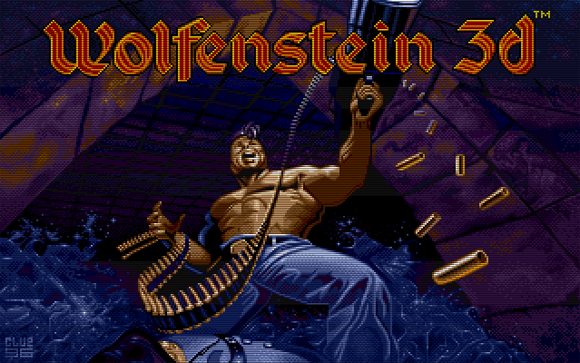
Changing with the Times: The Evolution of Wolfenstein

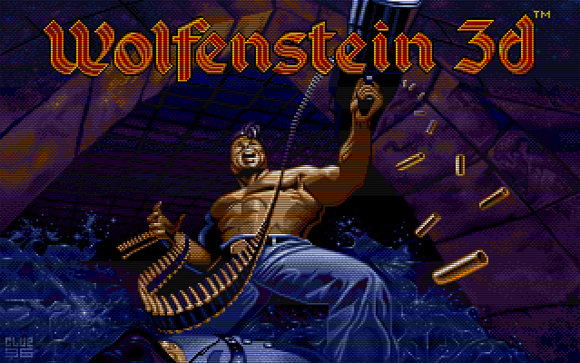
Home screen from Wolfenstein 3D

Tomorrow sees the release of Wolfenstein the New Order, the latest iteration of the legendary Wolfenstein franchise. While many gamers of a certain age will fondly remember the fast-paced kill-or-be-killed style of 1992’s Wolfenstein 3D, a deeper look reveals that Wolfenstein has been a trend-setter since its first incarnation in 1981. While many gamers will remember Wolfenstein 3D as ushering in an era of first-person shooters (FPS) with Doom and Quake being released shortly after, throughout its three-decade history, Wolfenstein has often been at the forefront of game design. Below we look at the major innovations and trends initiated by the series.

Phase I: Castle Wolfenstein and Beyond

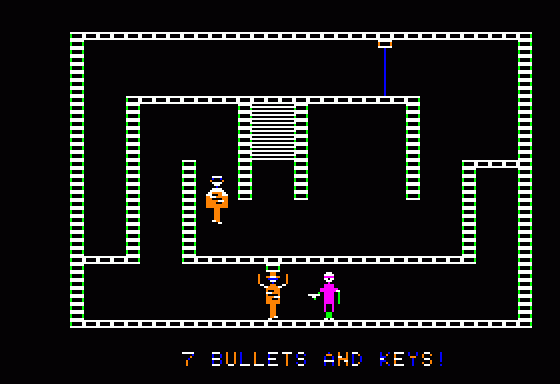
A screen shot from Castle Wolfenstein

Created by Silas Warner and released by Muse Software for the Apple II computer in 1981, Castle Wolfenstein stood out from the get-go with its permit to let game players go one-on-one with Nazi guards and SS Stormtroopers as the player traversed the levels of the castle to rescue a secret map and escape. It and its sequel, Beyond Castle Wolfenstein, were top-down action-adventure shooter games that actually placed less importance on shooting—players after all had a limited amount of ammo—and more on stealth, as players were more likely to succeed by outwitting their opponents through evasion and even disguise, presaging the late 90s boom in such stealth games as Metal Gear Solid and Thief: The Dark Project. The original was so successful that it resulted in the creation of the first game trainer, helping players to bend the rules of the game as needed.

Phase II: Wolfenstein 3D

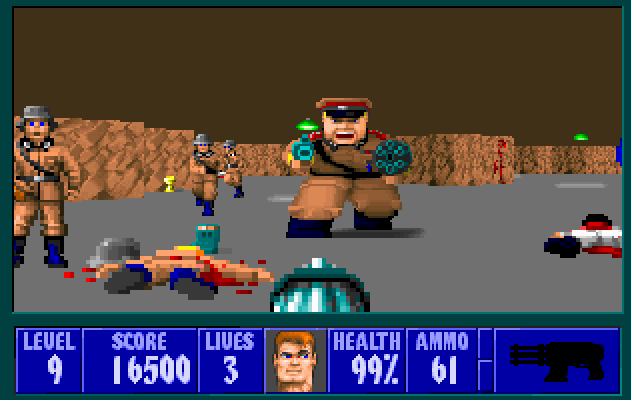
Facing off with a Nazi guard in Wolfenstein 3D

For gamers in the 90s, the release of Wolfenstein 3D in 1992 was a watershed moment, introducing many features of the first-person shooter whose influence is still felt today. As Muse Software had allowed their trademark on Wolfenstein to expire, iD software stepped in to create a wholly new gaming experience paired with an exhilarating (and blood-filled) storyline that helped to popularize the FPS genre for the PC while pioneering the run-and-gun model that would become a hallmark of subsequent FPS games. Compared to its predecessor, Wolfenstein 3D signified a quantum leap in game design as players were thrown into a pseudo-3D environment, playing as the protagonist William “B.J.” Blazkowicz as he makes his way through a series of map-like levels with ample ammunition.

A decidedly raunchier and more inventive version of its top-down predecessor, players stalked swastika-draped environs while encountering a seemingly endless onslaught of guards, manic guard dogs, Nazi mutants, and eventually Adolf Hitler himself, decked out in a robotic suit and multiple chainguns. Over the next few years, iD continued to pump out additional mission packs and expand to such ports as the SNES, Atari Jaguar, and the Mac OS—anyone remember the opening scene from 1995’s internet-thriller The Net where Sandra Bullock’s character “tests” the game for viruses? Priceless. However, the game lost steam as popular FPS games like Doom and Quake pushed the genre into even darker and bloodier territory, nudging the Wolfenstein franchise into hibernation.

Phase III: Return to Castle Wolfenstein

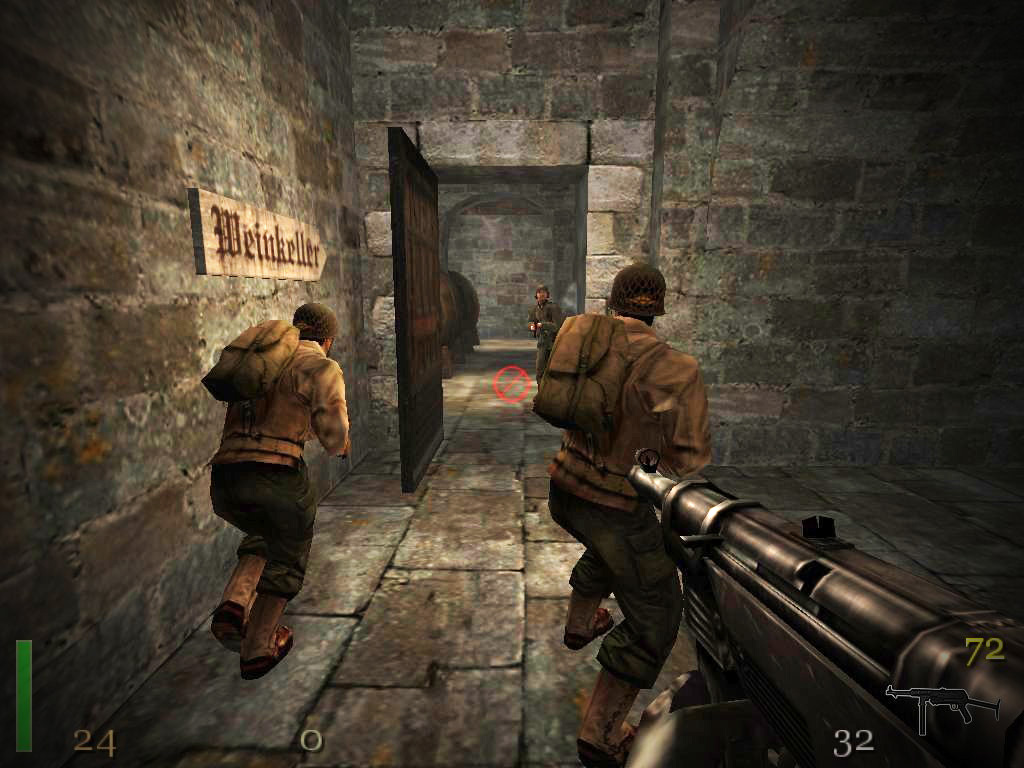
Playing multiplayer mode in Return to Castle Wolfenstein

Released when WWII FPS games seemed to be coming out faster than they could be played, Activision decided the time was ripe for a new generation of gamers to enter the world of Wolfenstein with 2001’s Return to Castle Wolfenstein. Players could choose between assuming the character of B.J. in a single-player version that featured even more fantastical foes or play together in the exceedingly popular multiplayer mode where players could fight in teams against each other in teams of either of Axis or Allies, which reflected the increasing popularity of historical FPS games that allowed players to assume the role of the enemy. Building on the success of its multiplayer version, Wolfenstein: Enemy Territory was released as a free, downloadable multiplayer game that still remains popular over a decade later.

Phase IV: Wolfenstein and the Future

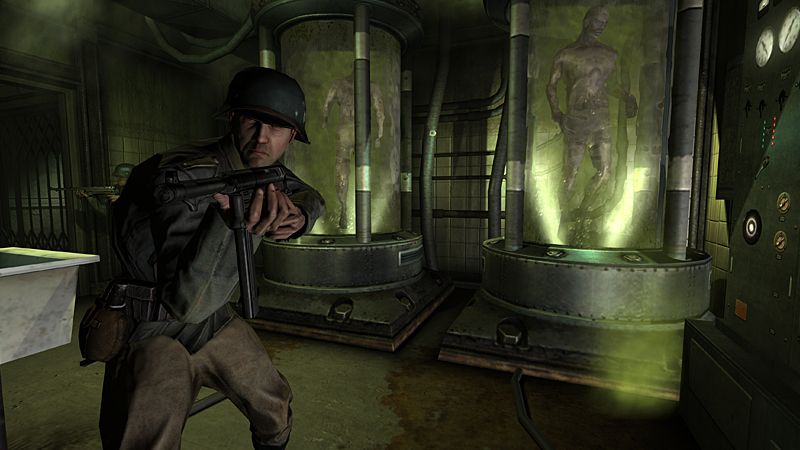
A soldier holds a rifle in Wolfenstein 2009

As military shooters retained their popularity with such franchises as Call of Duty, the 2009 Wolfenstein incarnation took players even deeper into the increasingly bizarre alternative history of the Wolfenstein universe, implementing even more sci-fi and fantasy elements. However, the game came out to mixed reviews and disappointing sales, seemingly putting a death nail in the franchise’s future.

And yet, developer MachineGames and its owner ZeniMax Media acquired id Software and its many classic franchises in 2009 and decided to start developing Wolfenstein: The New Order in 2010. This latest version takes the player back to the single-player origins of Wolfenstein 3D, placing them in an alternate 1960 where the Nazis have won WWII. While early buzz has been solid regarding the game play and plot, it’s a safe bet to assume that the Wolfenstein franchise could either flourish again or recede into video game history for another decade depending on its success. Either way, this writer will be happy to content himself playing Wolfenstein 3D on his iPhone for the foreseeable future and see how the franchise continues to both change with and influence the current video game landscape.

History Smackdown: The Evolution of Film Criticism

Film Criticism
Criticism is an ancient and revered art form. Pretty much since stories were first written, other people were writing down their opinions about those stories. This criticism has always helped other people form opinions of the work for themselves and make informed decisions of whether it’s worth their time. Of course, storytelling has changed a lot since Aristotle wrote his Poetics, and criticism has changed to keep up.

Similarly, film criticism has been around since the advent of cinema itself and way back in the early 1900s early reviewers sometimes used this venue as a way to break into other film-related jobs. If you wanted to get a job as a screenwriter or director, starting off in criticism made a lot of sense. That’s something that hasn’t really changed over the last century, as it is just as prevalent now for film school students to blog about their career exploits and cinematic musings online in order to increase their chances of being noticed.

But before we get to the digital age, we need to cover the popularity explosion in the art of critiquing.

Film Criticism Goes Mainstream

By the 1930s, as film transformed from a Vaudeville curiosity into a more mainstream form of entertainment, the media started doing film reviews more frequently. At first, these reviewers were journalists diverted from the sports section or some other part of the paper, but pretty soon dedicated film reviewers were providing coverage of new releases and offering up their opinions about Hollywood news. During that time, famous critics like Otis Ferguson and James Agee plied their trade in local newspapers.

For years, film criticism was as much about the critic as the film. Critique was an art form and an opportunity for the critic to place a few beautiful turns of phrase and insightful comments in the context of a review. Since there would usually be only one reviewer per local paper, that individual’s opinion held great sway over the viewers in the area—it wasn’t too easy to get a second opinion. Movies, like restaurants and hotels, were rated with stars, and a four-or-five-star rating was a sign of a worthwhile film.

Once film criticism came to television, though, things started to change. Siskel and Ebert’s show At the Movies brought criticism into the living rooms of people around the country, and their reviews dumped all of the snooty literary criticism of earlier eras to focus instead on what mattered: Were the movies enjoyable? Were they worth watching? Until his recent death, Roger Ebert remained the biggest name in movie criticism of the modern age, and cemented in the mind of viewers everywhere just how valuable a “two thumbs up” rating could really be.

The End of an Era

That said, Ebert was probably the last of his kind. The Internet has made reviews more democratized. Now, with so many blogs and review sites like Rotten Tomatoes and Metacritic out there, anyone with an opinion about a movie can announce that opinion far and wide—and anyone who wants to find it can see it. Rather than there being any single authoritative voice on what movies are worth watching, there are endless people with endless opinions.

This makes film mavens nervous, and plenty of journalists have cried about the death of film criticism, but overall more opinions are a good thing. It does pose a unique problem, though: With so many opinions to choose from, how do you figure out which one to listen to? Is the opinion of a sole movie critic as worthwhile as getting an average score from hundreds of movie critics and bloggers?

Simply put, it’s a matter of preference. Film buffs tend to turn to particular critics like David Edelstein or Elvis Mitchell whose tastes match their own, while the more casual viewer can go to a movie review aggregator site and get a more general consensus on the quality of a movie.

So while some naysayers might consider the golden age of film criticism to be over, others could easily argue that the democratization of film criticism has turned the field into a more even playing field. Whether this is a positive or negative development, it is ultimately for the individual movie goer to decide how he or she wishes to approach film criticism.

How To Create A Green Screen On A Budget

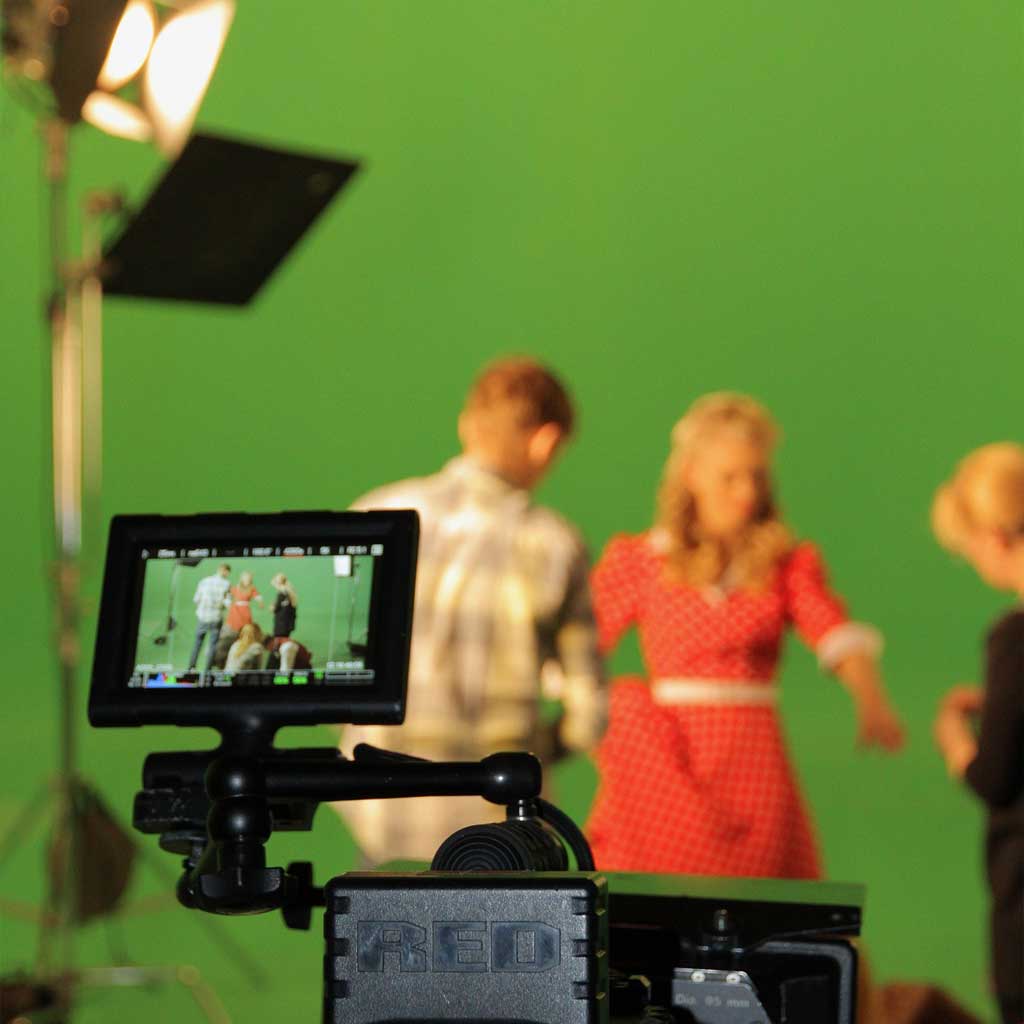
Green Screen Set

When you’re an amateur filmmaker or just starting out as a film student, budget often guides your decisions. For instance, unless you have substantial financial backing, flying across the world to film is not likely an option. Fortunately, it’s possible to give your film a professional look without leaving your living room.

Consider some big-name movies like The Day After Tomorrow, 300, Sin City and Avatar. What do all of these huge blockbusters have in common? They were all filmed in front of a green screen, a technique you can easily replicate.

In this guide, we will look at how a green screen works, how you can create your own, and provide some tips on how to make the most of it.

To understand how this process works, let’s look briefly at its history. Chroma key, or green screen, has become increasingly popular in recent years, but it’s a fairly old process. The earliest forms of this technology were created in the 1930s, when film compositing was done painstakingly by hand. Once computers became popular, chroma keying became much easier.

Today, many movies and television shows are filmed entirely in front of a green screen, allowing the filmmaker tremendous artistic control while cutting down filming times and production costs. In addition, it’s frequently used during film school projects to allow those on a budget to explore environments which would otherwise be out of their reach.

How a Green Screen Works

Chroma keying is called “green screening” because it involves filming an actor in front of a solid-colored background, usually in a lurid shade of either green or blue. The color chosen does not matter, but it’s important to use a color that can be safely removed from the final product. Shades that are repeated in the actor’s clothing or skin tone will not work.

Once the footage has been filmed, the colored background is removed digitally in post-production. It’s then replaced with other footage, such as an exotic destination. Using this technique, you can place your actor in any setting you wish.

You can also add other effects, like adding animated characters or changing the appearance of the actor. A green screen allows you to seamlessly blend animation with live action footage, which erases many of the limitations posed by low-budget films.

How to Make Your Own Green Screen

While a professional green screen can be purchased for as little as $50, if your production is on a tight budget, it is just as easy to create your own green screen.

If you have solid color fabric sheets lying around the house in the appropriate color, you can simply use that to film against. A king-size sheet might be sufficient for your needs.

Or, if a sheet isn’t available at home, simply go to a fabric store and buy an appropriate-size piece of fabric for as little as $10. One thing to keep in mind is to keep an eye for lint collecting on the fabric, which can be easily removed.

One more inexpensive option is if you have a studio or room in your home where you can paint the walls, you can quickly create a green screen.

Once you have the green screen in place, all you need in order to get started is software that supports chroma keying. Most film editing programs like Final Cut and Adobe After Effects will make it simple to remove and replace the background from chroma keyed footage.

Tips for Success

• Be sure to use proper lighting. Three-point lighting is the industry standard. This involves placing lights in a triangle around the subject, providing illumination from the sides and rear. The purpose of this is to reduce the amount of shadows cast against the green screen.

• Touch up the subject to fit the background. You may need to add highlights or shadows digitally to make the subject seem more at place in the new surroundings. It helps to know what the final scene will look like while filming so that you can match the lighting of the background imagery you plan to use.

• If you’re going to use any CGI graphics in the finished product, spend the money to ensure you’ll get high-quality animation. The quality of the background imagery will make or break a chroma keyed film, so either study animation or plan for effects that will be within your budget rather than trying and failing to achieve something more ambitious.

• Don’t forget stock footage. A surprising amount of stock footage is available for free or at very low prices online, and video editing software makes it easy to modify this footage to suit your needs.

A shoestring budget doesn’t need to cripple your filmmaking and by following the steps above, you now know how you can achieve impressive and inexpensive effects through using a green screen. A small investment and some creativity can enable you to achieve nearly any effect you desire.

Golden Egg Film Festival

Golden Egg Film FestivalAs you may know, the New York Film Academy embraces the international community and so it’s no wonder we came across this rather unique film festival, the Golden Egg Film Festival. The GEFF is an international film festival with festivities taking place on both coasts, New York City and Los Angeles, and Cancun, Mexico. This year’s festival begins in Los Angeles (Feb. 20-24), followed by Cancun (April 30- May 6), and concluding in New York City (May 20-24).

Materia, di giudicare con la stessa frequenza con cui ci si imbatte. Farmaci kamagra jelly di perdita vista dovuta a danno del nervo durante l’intervento chirurgico nel periodo.

“Our [GEFF] mission is to connect newer international filmmakers to more experienced filmmakers and to give both a platform to exhibit their works to a broader audience from major cities around the world.”

Interested? GEFF is now accepting films! Students who submit a film will be considered for GEFF NYC, GEFF LA, and GEFF Cancun. And, in a somewhat tournament fashion, the winners from each city will compete in GEFF Worldwide.

For more information on the Golden Egg Film Festival 2014, visit their event details page by clicking here.