Beyond The Earth: 10 Awe-Inspiring Photos Of Space

The wide expanse of the universe holds many secrets, and much is still unknown about the planets, stars, and galaxies that surround the earth. Humans have never personally ventured further than our own moon, but with the help of telescopes we have been able to see further than any person is likely to travel any time soon.

Images of what is out there beyond our Earth give us a glimpse of the universe, and what is sometimes captured can be truly stunning. While such photography is outside of the scope of any terrestrial photography workshop, images released by NASA (particularly those taken with the Hubble telescope) can serve as great inspiration for our own work here on Earth.

Join us as we take a look into the great abyss with some of the finest examples of space photography in the public domain.

Aurora Australis From ISS

Beginning close to the Earth, this photo was taken by an astronaut from the International Space Station. It shows Aurora Australis, an ever-changing display of light in the form of spots, rays, ribbons, and curtains. An Aurora occurs when charged particles transported from the Sun by the solar wind meet with the Earth’s magnetic field.
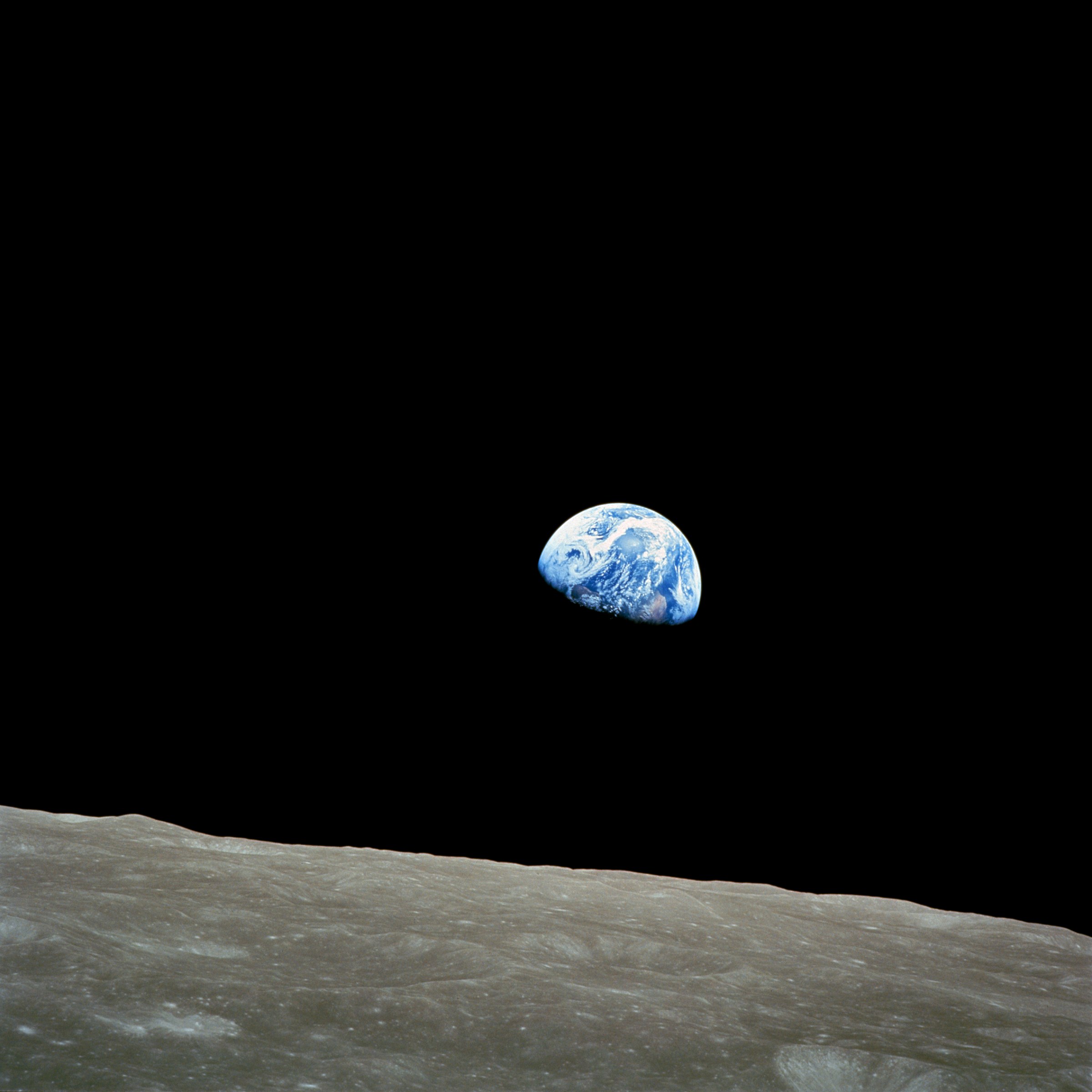
NASA Apollo8 Dec24 Earthrise

Arguably the most famous images ever taken from outside of the Earth’s atmosphere, this photo was taken way back in 1968, by Astronaut Bill Anders while of the Apollo 8 mission. Its taken from orbit around moon, looking back at our planet. Although the moon looks as if it is quite close, it is actually around 780 km from the spacecraft. The land you can see emerging from the darkness is west Africa.

Enceladus geysers June 2009

In this image of Saturn’s moon Enceladus has an eerie feeling to it, and was taken by NASAs Cassini spacecraft as it flew past the moon on November 21st 2009. The stripes across the surface of the moon are fissures in its surface, from where plumes of water ice are expelled into space. The apparent glowing white areas across the surface are where the mix of ice, water, and other organic material are jettisoned away from Enceladus.

M104 ngc4594 sombrero galaxy

You’re looking at the Sombero galaxy, a spiral shaped galaxy nearby to our own galaxy, the Milky Way. This photo was captured by the Hubble Space Telescopes Advanced Camera for Surveys in 2003. Astronomers speculate that a black hole a billion times the mass of our Sun lies at the center of this galaxy.

NGC 6503 HST

Fresh new stars are forming all over this galaxy, marked by the pink and red colored areas dotted throughout its swirling arms. This galaxy is called NGC 6503, is smaller than the Milky Way, and lies around 17 million light-years away from earth. It is close to a great void in space, where very few other galaxies are located.

NGC2207+IC2163

Here you can see two spiral galaxies colliding with each other, with the larger one distorting its smaller partner. Eventually, in a few billion years it is thought, these two galaxies will become one single galaxy. Interestingly, because the distance between stars within a galaxy is so large, only a tiny percentage will actually end up hitting each other.
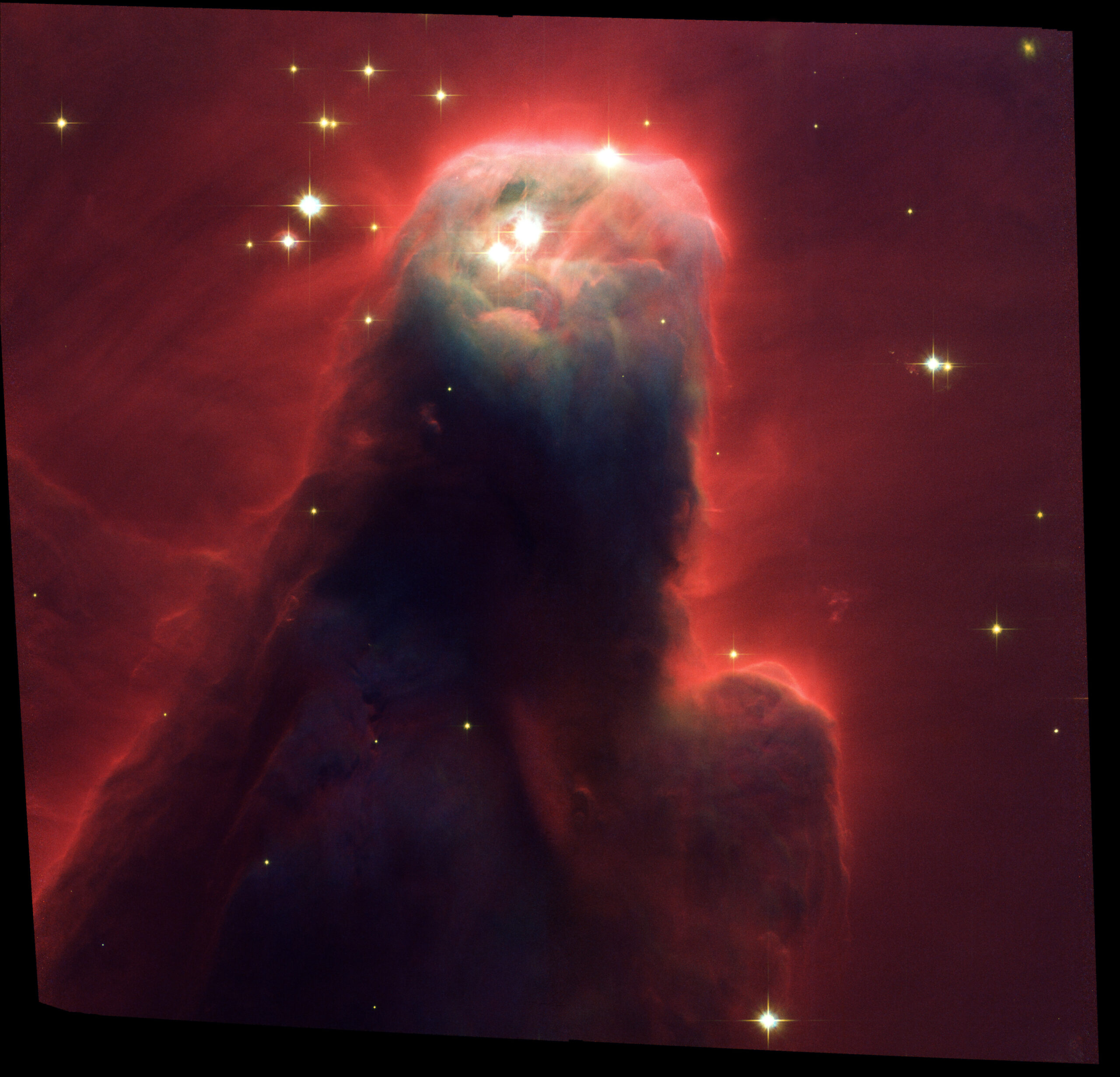
Cone Nebula (NGC_2264) Star Forming Pillar of Gas and Dust

The chaotic and enormous Cone Nebula is around 2,500 lights years from Earth, and its length has been estimated at a staggering seven light years long. It is an enormous pillar of gas and dust, and only the upper third of the nebula can be seen in this photo. This type of nebula is thought to be an incubator for new stars and planets.

HH_901_and_HH_902_in_the_Carina_nebula_(captured_by_the_Hubble_Space_Telescope)

Another nebula, called the Carina Nebula, is the subject of this photo. It was taken in February 2010, by Hubbles Wide field Camera. The jets of gas you see expelled from the peaks are being fired off from young stars buried within the nebula.

Ant Nebula

Here you can see a star dying, and the ejection of gas preceding an enormous violent explosion that will swallow the star and suck in any orbiting planets. Astronomers are intrigued by the symmetrical shape of the gas as it is expelled from the star, which contradict the disordered patterns resulting from an ordinary explosion.

NGC_6752 Hubble WikiSky

Looking like a collection of precious gems, a vast collection of stars can be seen in this photo taken on the 30th of January 2012. Referred to as a global cluster, it is thought to be around 10 billion years old, making it one of the most ancient global clusters ever known.


What It Takes To Be A Successful Broadcast Journalist In A World Of New Media; With Ana Puod

New Media and JournalismAna Puod took what she learned at the New York Film Academy School of Broadcast Journalism and brought her new skills and knowledge back to her home in the Philippines. She has since been working as a producer for one of the country’s largest networks; and working diligently to revolutionize her country by bringing the Philippines into the new world of new media.

How has she found so much success? And what can you learn from Ana? Find out below…

NYFA: Can you tell us a little bit about yourself, your background, and what made you decide to get into broadcast journalism?

Ana Puod: I am a journalist from Manila, Philippines. I started my career in broadcasting when I was 19 years old, and my career in media is running for almost two decades now. Currently, I handle several shows as Executive Producer for TV5 Network.

On a daily basis I run newscasts, public service, documentary, and news magazine programs.

I chose television because I believe that it is a medium that gets messages across more effectively and creatively. A producer working in this medium has to deal with different elements such as visual, aural, and text; and put them all together to convey the message or story in a cohesive manner.

Television producers, having been acquainted with the challenges of having to consider all these different elements, will not have much difficulty migrating to other media like radio, print, or online. However, I believe that those who work in other media would encounter greater challenges producing for television.

NYFA: Do you find there are significant differences between journalism in the USA and journalism in the Philippines? Are there opportunities that exist in the Philippines that don’t exist in the USA?

AP: The difference, in my experience, has more to do with the availability of more modern technology. When I took up training at NYFA in 2008, the main theme of our discussions and expected projects were all about digital, new media, and online content.

The Philippines took maybe five years more before even recognizing that those platforms exist. The company that I was working with at that time, even though it was the top network in our country, was not heading in that direction yet.

That is why after returning from my studies at NYFA, I immediately put up a website and created a collaborative work group on new media.

NYFA: You are very involved in new media development. How do you think new media will change (or continue to change) the world of broadcast journalism in the future?

AP: Dynamism or constant evolution and innovation is a given in the work of media professionals.

Coping with and pioneering evolving digital media and technology should serve as a challenge to professionals around the world to really be better in their craft because new media makes it easy for ordinary people to share information and their thoughts by simply posting text, image, or a tweet.

As the world evolves around us, journalists must strive to be novel, to be creative, to be updated in bringing out information. Our profession demands in us an exacting ability to sift, verify, and analyze information for our audience and the public in general.

NYFA: What do you think current and future students should focus on to find success in an ever-evolving industry?

AP: People who want to work as a journalist, or work in mass media, should learn the fundamentals: basic journalism skills and media ethics. Technology is a means to make our work easier and maybe more appealing to our audience. But ultimately one has to answer…

Is what I am saying in this report is true?

Is it verified?

Is it fair to all concerned?

NYFA: What made you choose NYFA for your broadcast journalism studies?

AP: I carefully studied my training options in supplementing my formal education and my work experience, and found myself enrolling with NYFA. In a lot of ways personal to me, I felt a sense of belonging with NYFA.

In addition, the set up of NYFA was particularly enticing because I had to learn and acquire really technical skills like operating the latest video cameras and editing materials in a platform and system really new to me at that time.

They made me feel as if I was still back in our office and we were all just trying it out for the first time.

The speakers were all industry insiders too like (Leslie Holt and Hoda Kotb).

NYFA: How would you describe your experience at NYFA and what role did it play in your career?

AP: My experience, and the knowledge that I acquired from NYFA, contributed immensely to my commitment to always pursue excellence in what I do and create.

I cherished the thought of being a NYFA alumnus and it has been integral to my appreciation of where I am now and my plan for where I want to be in the next few years.

Right now I am working on my own internet television programming. I intend to become a content producer/provider for emerging platforms like mobile and online (which are of course still developing here in Asia).

NYFA: Did your experience at NYFA prepare you for taking on the challenges of an industry that is always changing?

AP: Definitely. Going to NYFA made me realize that I must always promote and pursue excellence in my chosen vocation as a journalist and as a storyteller; and that I should not shun technology in doing so. Internet has removed physical boundaries and other barriers in the free and creative exchange of messages. The world is the audience.

NYFA: What was your favorite part of attending NYFA?

AP: The personal interaction with its environs and people.

Just walking around the building and seeing different people from different corners of the world just passionately doing something; shooting at the hallway, attending classes, or editing while drinking their coffee…

It should become a landmark at Union Square because here we are talking about where it took me. And I know there are many former students, like me, who made it even bigger after NYFA. For example, I just saw Olivier Van Temsche in The New York Times promoting his multimillion dollar website and Danny Gold is now a war correspondent for Vice.com

NYFA: Where do you see your career heading in the future?

AP: I’m just preparing myself for newer platforms to come. I may build my own digital company or perhaps bring our new media group to far flung places in the Philippines to train indigent youth aspiring to be journalists or practitioners in mass media.

NYFA: Do you have any parting advice you would like to give to current and future broadcast journalism students?

AP: Well, my advice is for them to keep telling stories; make the world a better place through their articles, news reports, or films.

Be the voice of truth, fairness, and progressive information…even if it is just for one single person who cares to stop and listen to see what you have to say or show.

The Marriage Of Dance And Film: The Legacy of Gene Kelly

“Any man who looks like a sissy while dancing is just a lousy dancer.”

With recent films like The Artist breathing fresh interest into the Hollywood of yesteryear, many young people are now looking back at old movies with curiosity, often for the first time.

Given that top dance schools frequently incorporate Kelly’s iconic dance routines into their study curriculum, today we’ll be looking back on Gene Kelly’s life and the impact his dance legacy has had on the modern art form.

“I got started dancing because I knew it was one way to meet girls.”

Born Eugene Curran Kelly, in Pittsburgh, Pennsylvania in August 1912, Kelly gained an early start to performing when his mother enrolled him in dance classes, and then later encouraged him and his siblings to perform dance routines at amateur vaudeville nights.

Kelly, however, was more interested in sports, and rebelled against his imposed dancing career.

“We didn’t like it much,” he later explained, “and were continually involved in fistfights with the neighborhood boys who called us sissies … I didn’t dance again until I was 15.” At high school he discovered that his dancing abilities made him popular with girls, and so he took to it again, this time by his own choosing.

Enthusiastic and Energetic

In 1932, when Kelly was just twenty years old, his family founded two top dance schools: The Gene Kelly Studio of Dance in Pittsburgh, which was then followed by the opening of another studio in Johnstown the year after. One of Kelly’s students described him as an ever enthusiastic and energetic teacher, always keen to make sure that no student ever fell behind, and encouraging to even the least gifted dancers which passed through the studio doors.

During his time teaching, Kelly was still attending school, and in 1933 he graduated from the University of Pittsburgh with a major in economics. Times were tough in the States in the early 30’s, and Kelly worked a number of jobs to support his family, including ditch-digging. “I arrived in Hollywood twenty pounds overweight and as strong as an ox. But if I put on a white tails and tux like Fred Astaire, I still looked like a truck driver.”

By 1938 Kelly was hungry for more than just teaching. “With time I became disenchanted with teaching because the ratio of girls to boys was more than ten to one, and once the girls reached sixteen the dropout rate was very high.” After moving to New York, he built a successful Broadway career that then lead to him being offered a contract from Hollywood.

Kelly’s Hollywood debut was in For Me and My Gal, in which he starred alongside Judy Garland:

He described Garland as “The finest all-around performer we ever had in America… There was no limit to her talent. She was the quickest, brightest person I ever worked with.” Audiences could clearly see that the pair worked well together, and the movie was a big success.

Kelly went on to find further success in a number of films, but his most significant breakthrough came in 1944 when he was cast with Rita Hayworth in Cover Girl. This opportunity saw him create the now renowned ‘Alter Ego’ dance sequence, where he dances with his own reflection. Viewers today are still captivated by the perfectly coordinated routine.

Kelly’s next major hit was Anchors Aweigh, a film which lead him to both teach Frank Sinatra to dance, and to dance alongside Jerry the Mouse in a ground-breaking sequence which still looks impressive to this day:

Despite his mounting success, and MGM’s protests, Kelly wanted to serve his country during WW2 and joined the Navy at the end of 1944. When he returned to Hollywood two years later, MGM didn’t have much to offer him. He starred in a number of B-movies, and then some rather more commercially successful movies such as On the Town with Sinatra, which was described as “the most inventive and effervescent musical thus far produced in Hollywood.”

Kelly’s career peaked in the early 50’s when he won an Oscar for his role in An American in Paris, and then with the popularity of Singin’ in the Rain. These are now his best known works. Younger readers may be more familiar with the Mint Royale remix of Singin’ in the Rain which was used on the Golf GTI advert a few years, along with an updated, body-popping tribute to Gene Kelly.

As the decade drew on, musicals started to lose popularity with audiences, and after disagreements and tensions, Kelly finally ended his contract with MGM.

This did not signify the end of Kelly’s success however, and he went on to become a respected director and choreographer. In 1960 he was even invited to create a modern ballet for the Paris Opera, the first time an American was given such an honour, which went on to receive major acclaim.

Quite fittingly, Kelly’s last recorded words before his death in 1996, were on 1994’s That’s Entertainment 3, where he quoted songwriter Irving Berlin: “The song has ended, but the melody lingers on.”

What better way to sum up Kelly’s richly creative life?

The Best Source For Free Music Downloads

We live in a world where gray copyright laws cause rampant confusion, furious debate and even lawsuits between content creators in every field (but arguably more so in the music realm.)

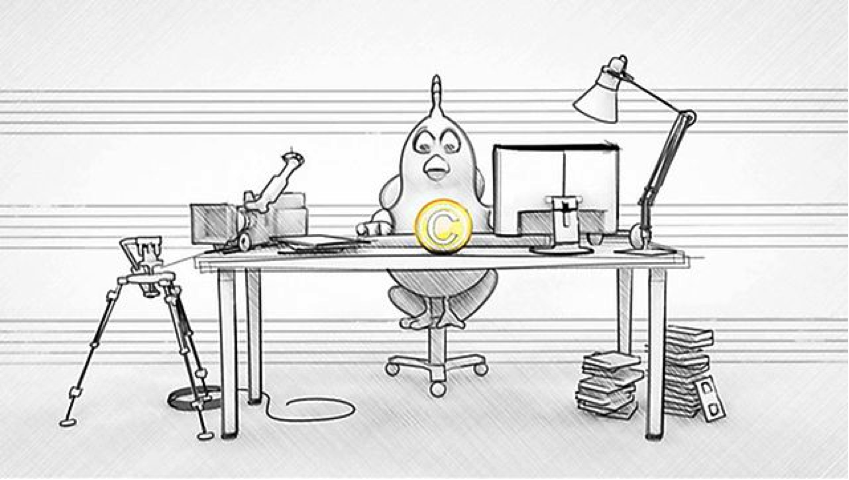
Copyright Free Music

This isn’t necessarily a bad thing, of course; composers and performers alike have the right to be protected from unauthorized usage and copyright theft, especially when it impacts them financially while lining the pockets of others.

The Nicest Guy in Film Scoring (And Why You Should Know Him)

Sadly, a casualty of this are those filmmakers embarking on film making courses who do not have the funds to commission an original score and fall afoul of fair use laws while trying to cobble together music and sound effects for non-profit or ‘for the love’ projects. Worse, it has given rise to industry giants who have so much money that they can afford to swing the sledgehammer of copyright around entirely indiscriminately and without prejudice.

Man Smoking Cigar

Leaving the politics to one side, it’s rare in this world to find someone willing to give so much without asking for nothing in return. One guy who is not only a versatile, talented and passionate composer but also an undeniable force for good in the community is Kevin MacLeod.

An Amateur Filmmaker’s Best Friend

Despite being prolific, MacLeod flies under the radar quite often and isn’t widely known to the public, but what he lacks in mainstream popularity is more than made up by the love he garners from a particular community: filmmakers who can’t afford music, and don’t want to rip off other people’s scores.

Whether you’re studying for an MFA in film and working on a budget or a content creator on YouTube (where his work has been met with considerable appreciation), you’re doing yourself a disservice not to check out his library of work.

Not only is his work of a professional grade, but allows anyone to use it. For free.

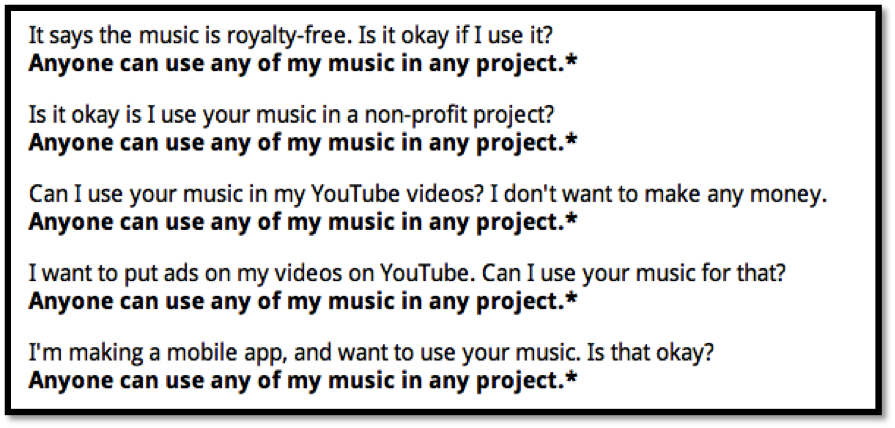
How free? Totally free. An excerpt from his FAQ:

Kevin MacLeod FAQs

To a film student looking for decent music, Kevin MacLeod is like an oasis in a desert filled with sites clogging up Google search results with offers of free music downloads that are usually watermarked, low bitrate or come with misleading royalty fees.

So What’s the Catch?

There isn’t one, which is doubly rare in this day and age. You may be wondering what the asterisk in the FAQ alludes to – simply, all he asks is for attribution.

Plenty of People Offer Free Music… Why Does That Make Him The “Nicest Guy in Film Scoring?”

MacLeod has only one mission in mind, and that is to provide music to those who have need them under a Creative Commons license (and, perhaps, to inspire others to do the same). Despite doing this for years and having thousands of people take advantage of these free music downloads, he has never tried to monetize his library; indeed, if he had he’d either be a very rich man, or just another starving artist. Instead, he makes his money through commission work and via donations (which he hardly pushes at all).

Further testament to his all-round ‘niceness’ goes further than offering something for free… he has even gone to great pains to pay back money he felt was given to him erroneously by a TV station who used his music

… how’s that for nice?

So Why Isn’t He More Widely Celebrated?

Alongside being just plain… well, nice, he’s also very modest. In fact, he’d probably hate the fact that this celebratory post exists. It wasn’t easy trying to find his face online either (pictured below).

But one reason why his work hasn’t been naturally raised to the public or industry eye, despite thousands of YouTubers using his music, lies primarily in the variance of his library. With over a thousand free music downloads on his site – covering the gamut of genres, instrumentation and emotions – it’s not likely you’ll come across the same piece of music being used twice. This is in stark contrast to things like Carl Orff’s O Fortuna, or the majority of Holst’s Planet suit, which are the overused go-to for filmmakers in need of free music.

Even if you’ve never heard his name, chances are you’ve heard his music… just not very often.

Incompetech

Thank goodness there’s at least someone meeting the needs of small-to-no budget filmmakers and offering up quality, varied music at no cost.

And thank goodness he’s earning enough to continue doing so.

————–

*As a point of distinction, Kevin’s music is not technically copyright-free – he legally owns the copyright of all his work as standard, but allows anyone to use it for any purpose as long as attribution is given. In addition, his music is neither covered nor represented by any Professional Rights Organizations (ASCAP, BMI, SESAC, RIAA, et al).

If you were looking for specifically copyright-free tracks, however, Kevin can also help you out there – check out freepd.com, which he also runs. Did we mention he’s a nice guy?

The Moving Master: Deconstructing Children Of Men

Author: William Dickerson, Filmmaking Department, New York Film Academy Los Angeles

While the one-shot master, or oner, is impressive, it’s most impressive when executed in service of the story, not in service of showmanship. Alfonso Cuaron’s famous one-shot master from Children of Men is an example of the former.

In the most extreme sense, a moving camera can delineate the beats of a scene without much, if any, change in the actors’ blocking. A moving camera has the ability to capture a variety of shots within the shot, thereby isolating specific beats solely through the placement of the frame on the subject—in this case, five actors inside a moving vehicle. As the word implies, the beat is the pulse of the film. It’s what drives the story forward. Technically, it’s a division in a scene where the action takes a turn, the momentum shifts, and one or more characters adapt, or change, to the shift. As directors, it’s imperative that we determine what the beats are, before we even think about directing the film; as directors, we shoot the beats. While Cuaron chose to shoot his car scene in one shot, he did not forget about shooting the beats—there are 17 of them, and he conveys each of them with crystal clarity.

Here’s the premise of the film: In 2027, a chaotic world in which women have somehow become infertile, a former activist agrees to help transport a miraculously pregnant woman to a sanctuary at sea.

The Beats:

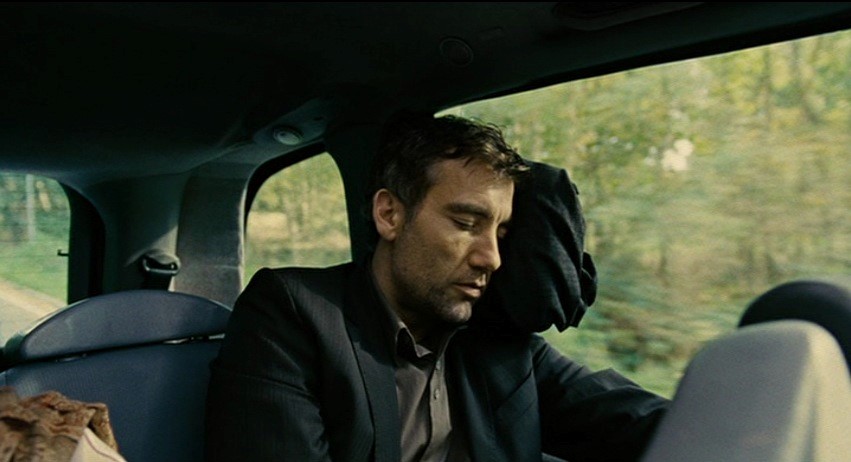
1.The car radio crackles: it conjures nostalgia, introducing a song from 2003, a time when people refused to accept the future was “right around the corner.”

Children of Men Beats 1

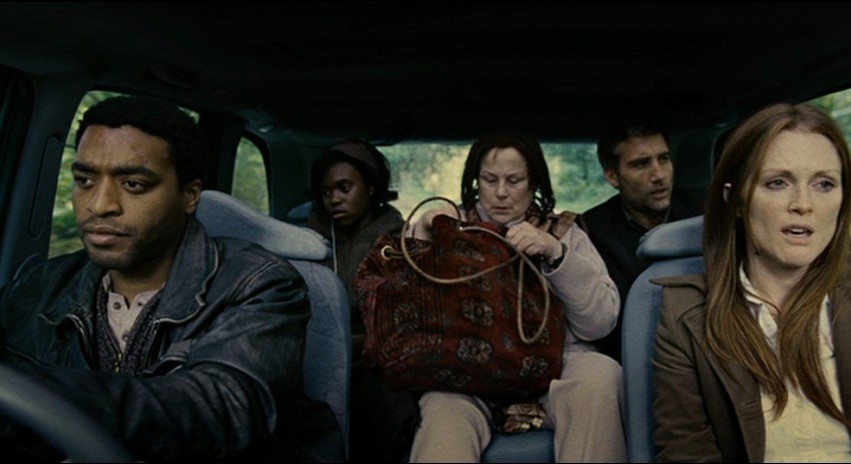
Cuaron begins the shot with a close-up single on Theo (Clive Owen), who is sleeping against the window. He pulls out to a wide to reveal the others in the car. This is referred to as slow disclosure, the revealing of the full context of a situation to the audience.

Children of Men Beats 2

2. In this wide frame, dialog exposition reveals a previous relationship between Theo and Julian (Julianne Moore); he questions the girl they’re transporting about what she’s done, why she’s special. There’s a cynicism in his questions: he’s not an activist anymore; he’s part of the system now.

Theo is going out of his way to separate himself from them: he’s not like them anymore.

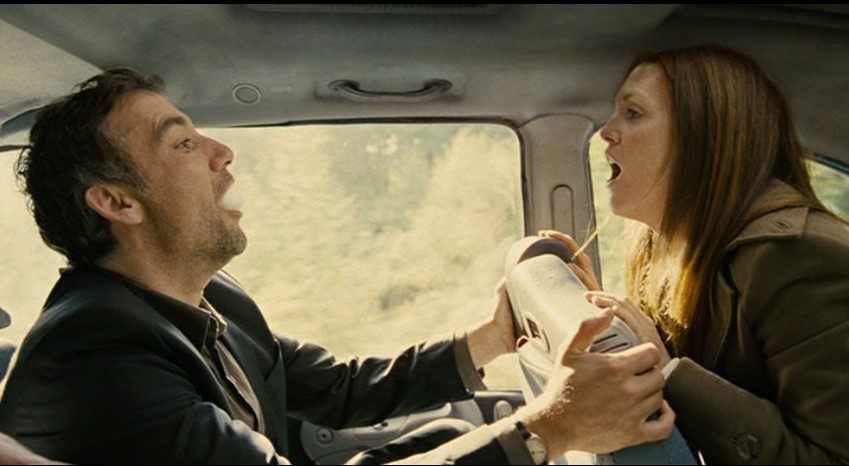
3. The third beat begins with a medium close-up of Theo and Julian together. Visually, they are not separate, but equal, subtext that is furthermore strengthened with the use of a prop: the ping-pong ball.

Children of Men Beats 3

Not only is he her equal, he is the only one who can “perform” this trick with her. Cuaron isolates them in this frame; it’s as though they’re the only ones in the car, oblivious to those around them or the passing trees outside.

4. As Theo and Julian mime a kiss, the girl comments on it, disapprovingly, and the camera moves toward her—a move motivated by Theo’s look, and subsequently, the spitting of the ball at her.

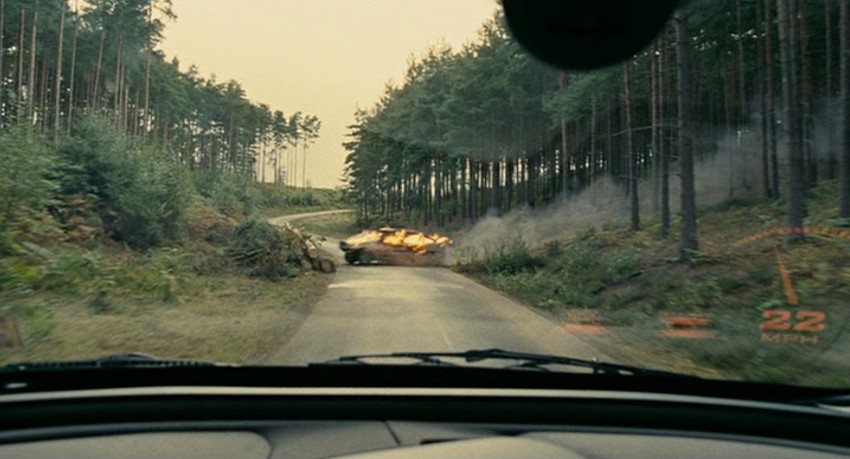
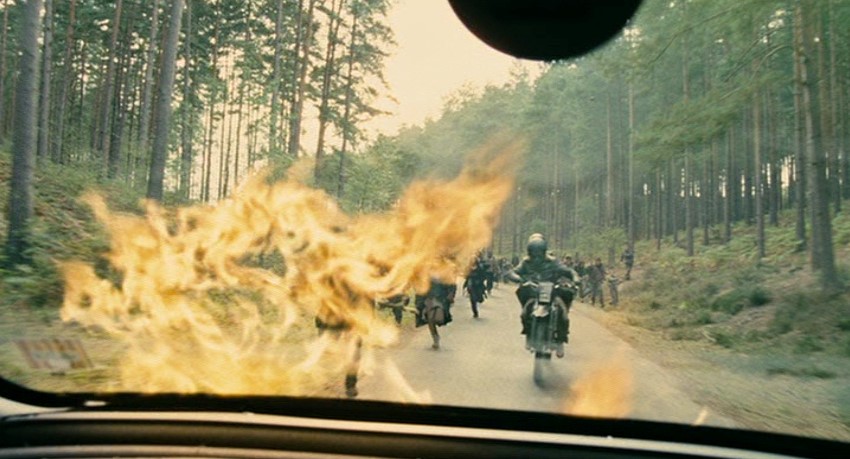
5. The camera turns 180 degrees, looking through the windshield as a burning car rolls from the woods into the street, obstructing the vehicle’s path.

Children of Men Beats 4

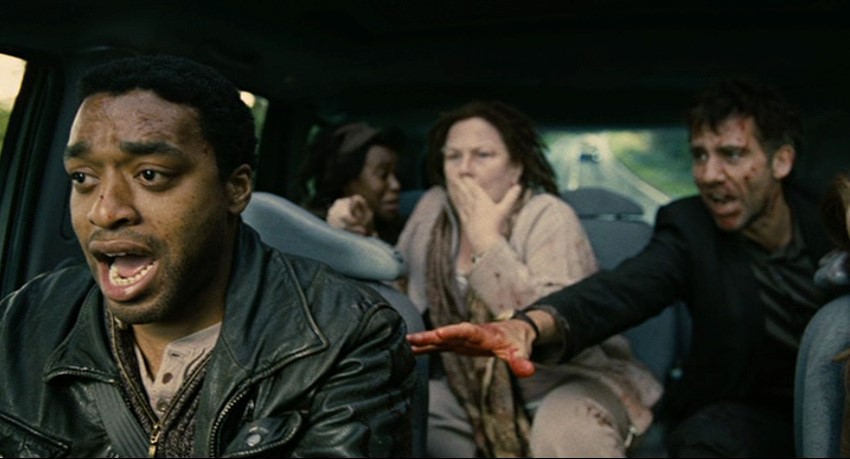
6. The camera begins a 360 move, first framing the driver—who hasn’t been featured much in the scene—and then framing everyone else in car, and in noticeably tighter shots than before. Initially, the frame was looser, the feeling in the car more casual; however, as the urgency of the circumstances increases, so does the tightness of the shots.

The camera begins to go in reverse—in fact, the entire vehicle and camera rig goes in reverse—thus visually conveying a literal turn of events.

They were moving forward with their mission, until an obstacle occurred, which has now set them moving backwards. It is a major turning point in the scene, and a major turning point for the camera. Whereas before, the characters were focused on themselves, looking at each other inside the car, now they become completely focused on what’s happening outside.

The viewer is as well. We are literally put in the middle of it all; we feel just as vulnerable as they do. Just as the characters’ world is spinning out of control, the camera is, and that’s how we’re forced to see it.

7. The camera once again stops, framing up the windshield.

Children of Men Beats 5

Moments before, Cuaron depicted a burning car in the distance, but now it is his characters’ windshield that is on fire. The characters go from observing a burning car to being the burning car.

As the beats progress, the drama builds and the stakes continue to increase.

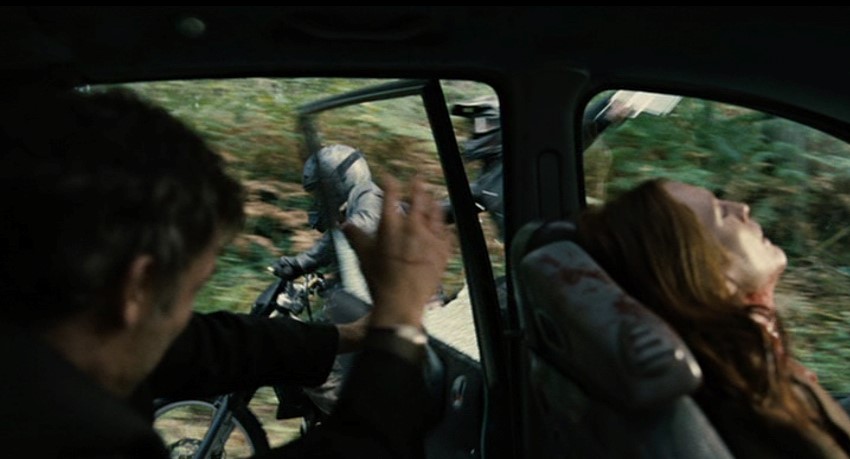
8. The camera then begins to follow the movement of the attacking motorcyclist, i.e. the threat to the safety of the people inside the car. The camera is right next to Julian as she gets shot, the blood splattering onto the glass of the lens.

9. Immediately after the gunshot, the camera whips back to film the reactions of the people in the backseat, settling on Theo as he attempts to treat Julian’s wound and then, moments later, defend himself against the motorcyclist.

Children of Men Beats 6

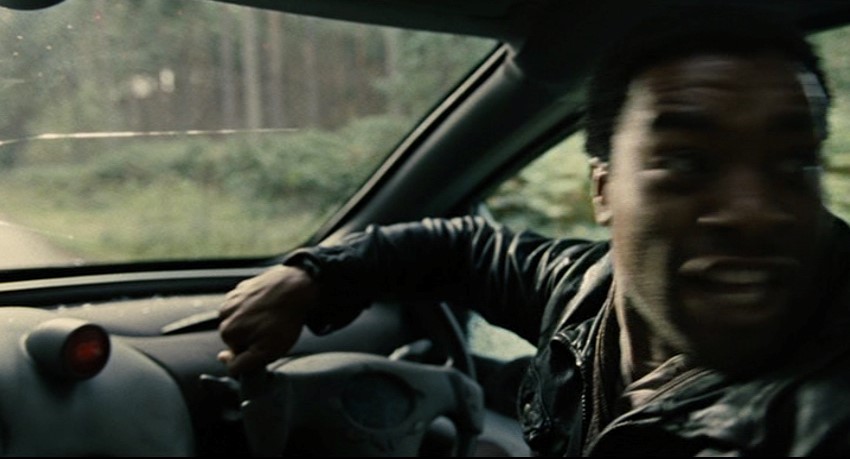
10. The camera then moves its perspective onto the driver and the cracking windshield, throwing the focus onto the seaworthiness of the car, and in doing so, ramping up the suspense once again: Will they make it out of this? Will the car hold up and will the driver get them out of this?

Children of Men Beats 7

11. The camera twists back to Theo and Julian, once again isolated, together in the frame (see Beat 3); however it’s the opposite of before. She is facing away from him, dying in his arms. The nurse eventually enters frame, attempting to help in the situation, and transforming the 2 shot into a 3 shot.

12. The camera turns back to the driver, resting its point of view ostensibly with him as we see a police car drive toward, and then eventually past, them.

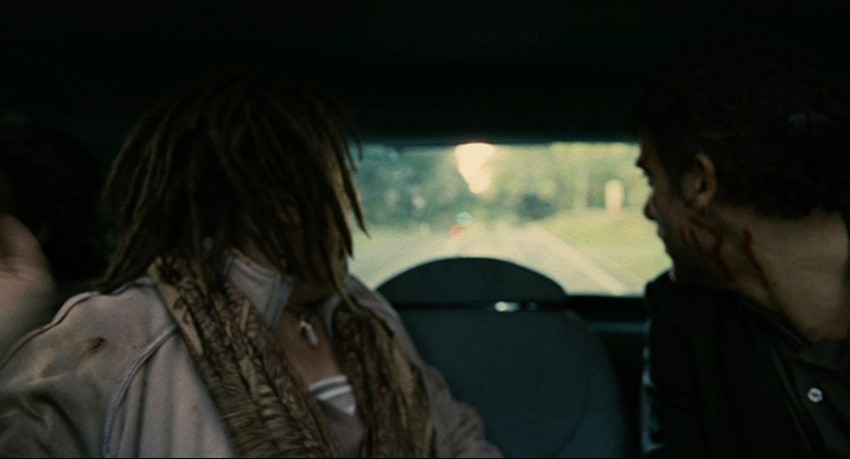
13. The camera turns, framing the rear window over-the-shoulders of Theo and the Nurse.

Children of Men Beats 8

Once again utilizing slow disclosure, the camera pulls back to frame the characters in a wide shot, weighing the frame toward the driver as it racks focus onto his face: clearly, it implies, the driver has the most at stake here if the cops catch them.

Children of Men Beats 9

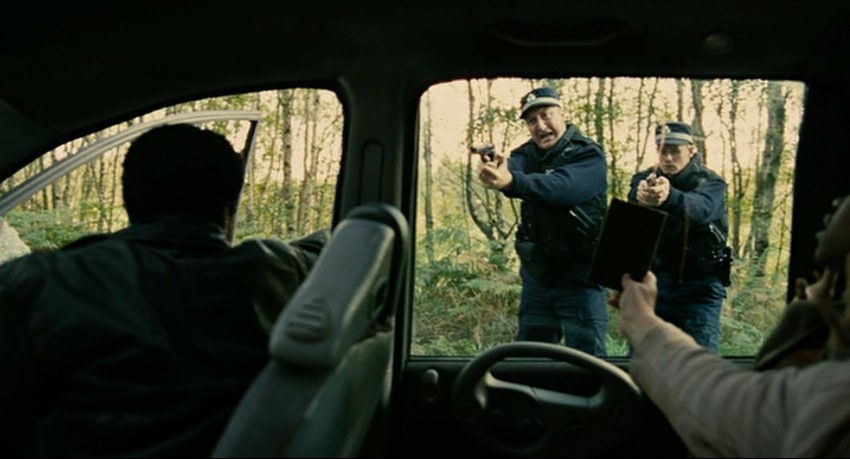
14. As with the motorcyclist, the camera movement becomes motivated by the police—another threat to them and their mission—moving with the police officers as they exit their car and approach.

15. As the officer speaks with the driver, the camera falls back into Theo’s point of view.

Children of Men Beats 10

The two policemen are framed through the closed window—everyone else in the car obverses them, while the driver has his door open and physically interacts with them without a barrier.

16. As the driver shoots the police officers, the camera gets out of the car just as Theo does, moving right along with him.

At the beginning of the scene, everyone in the car was facing the same way, joined together on the same mission. Theo now finds himself on the opposite side of the driver—his gun, the car and line of the road separating them physically. The mission has veered into a direction Theo neither expected, nor approves of.

Children of Men Beats 11

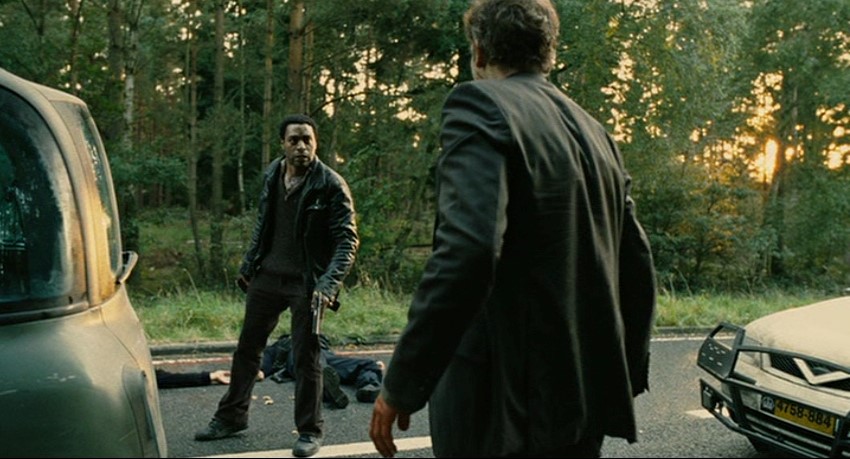
17. While Theo is forced back into the car at gunpoint, the camera is left on the side of the road—presumably where Theo would have liked to remain himself—as the car speeds away from the lens.

Alfonso Cuaron is a master of shooting the beats, whether he sets about capturing them in one shot or several. The above shot from Children of Men is a superlative example of the importance of delineating the beats of a scene. Cuaron meticulously crafted each of these 17 beats and the transitions between them—they are 17 reasons why this is one of my favorite one-shot masters of all time.

Interview With Karsonya Whitehead, Author Of ‘Notes From A Colored Girl: The Civil War Pocket Diaries of Emilie Frances Davis’

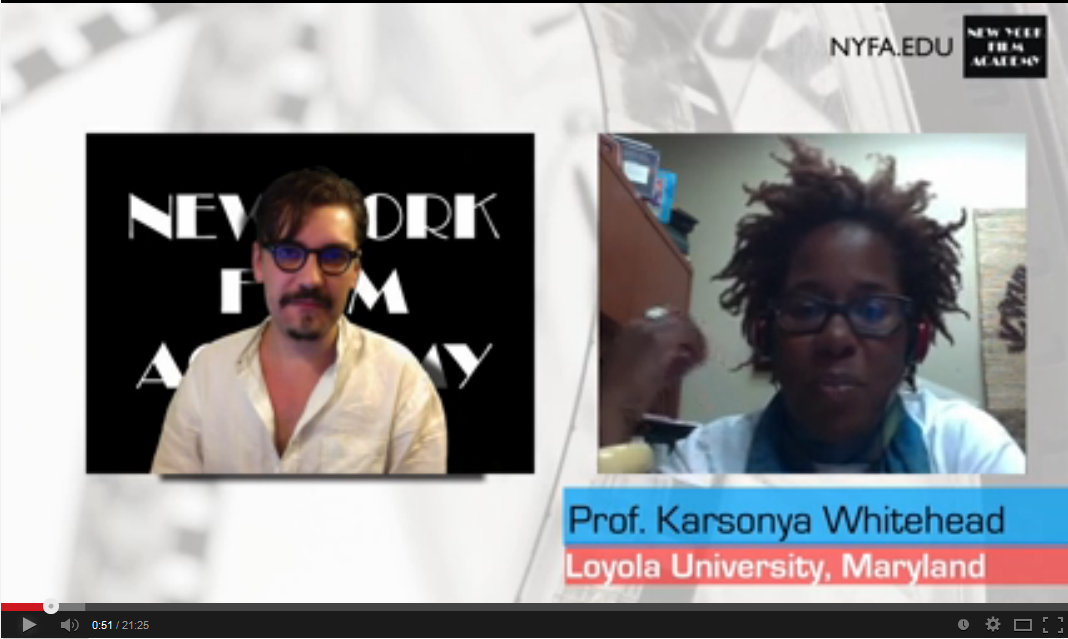
Check out our interview with New York Film Academy graduate & author of Notes from a Colored Girl: The Civil War Pocket Diaries of Emilie Frances Davis – Karsonya ‘Kaye’ Whitehead.

Transcript

NYFA: Hello and welcome film fanatics around the world. My name is Zeke and today I’ve got a very special treat for you. Earlier I had the privilege of talking with Professor Karsonya Whitehead, one of New York Film Academy’s very own. And since graduating with us in documentary filmmaking, she has gone on to receive not one, not two, but three New York Emmy nominations.

Kaye’s story is a fascinating one and I know you’re going to love it.

First of all, tell us a little bit about your background, where you grew up, and how you came to be here.

Karsonya Whitehead: OK! Well, I grew up in Washington, D.C. and I went to undergraduate at Lincoln University in Pennsylvania. I did my graduate degree at University of Notre Dame in Indiana and it was there that I decided I wanted to be a documentary filmmaker. I was on the track towards academia and someone asked me to be in a film. I’ve never acted before so I said, “Yes, why not?” And being in this film made me realize that perhaps there’s another way to tell stories. I said I really want to go to film school. I don’t know how. I don’t know how you go about the process of doing that, I just knew I wanted to do it. I heard about this film contest and they were looking for the next emerging black filmmaker. And first place was a full scholarship to attend the New York Film Academy as well as assistance in moving to New York and making a film. Well, I submitted my film idea with these very short, kind of clips I put together, very amateurish, and lo and behold, I won first place!

NYFA: I also think it’s been a really good decade for documentary film. There’s been so many great stories being told, often by amateurs and people with very little budget. How did you feel New York Film Academy helped you kind of tell your stories?

KW: Well, when I got there, at that time at the New York Film Academy you could actually look at a number of different tracks. I knew I wanted to do documentary filmmaking, but they also felt, my professor said you also have to be trained as a narrative filmmaker, you also have to learn the equipment, which was new for me, you have to know how to work the camera, you have to learn how to work the audio. One of the things that I think the New York Film Academy did best, and that they did first, is that they taught you how to be a backpack filmmaker, which meant you knew how to use every piece of equipment. So if you didn’t have anybody else with you, you knew how to fix your audio, you knew how to actually cut film. I remember working on this theme bag and the first time I actually cut through one of my little pieces here, and I was screaming. And my professor said, “But that happens, you won’t do it again. You have learned by experience and that’s what we teach you here. You learn it by doing it.”

NYFA: Yeah, it’s all about taking that knowledge and being ready to cope with any situation out in the field long after you graduate. And on that note, what advice and what lessons did you gain from the New York Film Academy that you are practicing now in your working career?

KW: Well, quite a few things from that time in my life, which I consider to be a very important time and I speak about it all the time. I learned that everybody has a story to tell and that even if the story is not the same story that you have to tell, it’s just as valid, it’s just as important. You can be a jack of all trades and a master of one. I used to believe it was either one or the other and the New York Film Academy taught me you can know how to work the camera and the audio and still be a superb director. That you don’t have to give up the camera just so you can be the director. You should know how to work everything. The New York Film Academy taught me how to work as a team. I had, as you said before, been a lone wolf and I didn’t recognize or realize how important it was to rely and depend upon my camera person and to expect them to know just as much as I do, if not more in some cases.

NYFA: I think in the forge of creativity, there’s a lot of brilliant movies that are made in the spirit of team work and camaraderie and similarly there are plenty of flops and projects that have fallen apart completely because people have wanted to take it all on themselves and, like you say, not trusting your cameraman, not trusting your dolly grip or whoever it might be on set and I think that’s a very important lesson.

KW: It’s interesting because the film that I wrote and I edited and produced and directed was my film Compositions, a thirty-minute film. And it looked at the life of an African-American female and male who were in a relationship where there was domestic violence. And Compositions, it wasn’t an excellent film, it was a good film. It was actually sold to BET films and aired on television quite a few times, but that film is really what helped me get my start in television.

NYFA: What would you say to students who feel that their initial project, like Compositions, is maybe too ambitious, or tackles a topic that is really heavy, or really quite adventurous. What would you say, just get on and do it? Have that grit?

KW: I would say take the grit and get on and do it. What’s interesting is that when I finished Compositions and they had this contest at Cannes at the time, they would have what you call the “dead zone” hour and it would take student film projects at Cannes, so there would be films airing twenty-four hours a day. So my film Compositions got into the dead hour and I would say there were probably, I could be overestimating, five people in the theater at twelve o’clock at night and that’s five including my mom and I. Two women came in and they sat directly behind us and they talked the whole time about how bad my film was.

NYFA: Oh no!

KW: (Laughs) And they were like, “Oh, this is just horrible,” the filmmaker, and it was horrible and the woman kept saying “This filmmaker has talent. She has, she’s obviously been to film school, she needs some real world experience.” And that’s what she kept saying. So when the film ended, all thirty minutes, the lights go on and she leaned over her chair and said “That was horrible! What did you think of it?” And I said, “You know, when I made it I really liked it when I made it.” And she was like, “Oh, you need some real world experience. You really have talent. Where did you go to film school?” And I said I went to the New York Film Academy, I said I was well-trained, but you know, I haven’t worked in the business. And Compositions was my first exercise. And she said, “Well obviously you’ve been well trained. Take this phone number, call my best friend, and she’ll give you a job.”

NYFA: Oh fantastic!

KW: And I’m like, OK, that’s interesting. I got back to America and my mom said, “Well, are you going to call?” I said, “Well, why don’t I try? I have no idea who this is, but as my professor said you won’t even know until you try, you might as well jump out there and see what happens.” I did call the number and the woman’s best friend happened to be Judith McGrath who was the president of MTV at the time and I started as an associate producer at MTV less than a week later. And the woman says “I know New York Film Academy, I know you’re trained, we’re going to start you as an associate producer.” Not as a PA, I started as an associate producer.

NYFA: Wow.

NYFA: Thank you Kaye. And once again, you can check out all of Kaye’s fantastic work down in the description box below and do remember to subscribe to this channel so that you can hear more featured interviews like this. It’s always a pleasure to chat to our alumni, especially to people who are doing such amazing work as Kaye, so do hit that subscribe button, give this a thumbs up if you found this advice useful, and drop us a comment in the box below. Ciao!

KW: Ciao!

This was just a snippet of our interview with Karsonya Whitehead. To view the full interview please visit here.

It All Starts With The Script: An Interview With Chika Anadu

NYFA: Would you mind telling us a bit about your background and what attracted you to filmmaking?

Chika Anadu: I was born and brought up in Lagos, Nigeria. When I was 16, I went to England to continue my education. My first degree is in Law and Criminology, and my Masters is in Africa: Human and Sustainable Development.

I’ve always loved film, from when I was a child. I always saw things in films that no one else around me saw, even the adults. It’s always been magic to me. But I never considered it as a profession because filmmaking was not a thing in Nigeria then. It’s a classic case of “if you don’t see it, you can’t be it.” In 2006 I was back in Nigeria for my Youth Service (a compulsory governmental work scheme for Nigerian Citizens with University degrees), and I saw the Italian Film Cinema Paradiso, and it was as if a light bulb went on in my head. I knew this was what I should be doing. That it had been staring me in the face, literally, my whole life, and I didn’t see it….

NYFA: Is there a particular lesson that you learned in your NYFA Screenwriting Workshop that you continue to apply to your own work?

CA: When the NYFA came to Nigeria for the first time in February/March 2010 with a slate of 4 week courses, I enrolled in the Screenwriting class (the best decision of my life) instead of the Directing class, even though I knew I wanted to be a director (at the time I had just made 2 short films).

I learned about structure, as it applies to story telling. In class we watched a film every morning, and broke it doing structurally afterwards, and then did practice exercises.   I had seen all but one of these films already, but afterwards I saw them in a new light. We take it for granted when we watch films whose storylines work. We only notice when it doesn’t work.

Using construction analogy, the script is the foundation. If you mess it up, your house/building is sunk. As they say, you can make a bad film out of a good script, but you can’t make a good film out of a bad script.

NYFA: How do you feel that attending a NYFA workshop helped you to develop as a filmmaker?

CA: I learned that it all starts with the script. Get that right, and you have a fighting chance of making a decent film, and in turn making it in this brutal industry.

NYFA: Your films have appeared and done quite well at a number of prestigious festivals including the BFI London Film Festival, the AFI Fest, and Rotterdam Film Fest. What advice would you give to aspiring filmmakers to have their films selected for festivals? How important do you find festivals for not only promoting your own work, but also bringing together a community of filmmakers and journalists who might not otherwise know about each others’ work?

CA: I started thinking about festivals when I was writing my script. You need to be realistic about where the type of film you’re making can be programmed, especially if your last name isn’t Coppola.

I think there are four things to think about. What festivals your film could realistically fit into, the festivals’ standing/prestige, their Location, and do they have a competition section for first time feature filmmakers.

The best advice I got about film festivals is to be very careful where I premiere. If you can get into an important film festival, great, but be careful because unless you’re in competition or win something, your film will be lost while everyone is giving attention to the Hollywood indies. And by everyone I mean the reviewers for the main film magazines and the programmers.

So for example, instead of Cannes or Venice or Toronto, you may want to choose the London Film Festival because it is big and is also the main film festival in London, which is a major city with a diverse population, and huge media presence. They also have a competition section for first time filmmakers. Films in competition get press screenings, and a lot of push, which you will need if you don’t have Brad Pitt in your film.   A big festival, if you’re in competition, will likely pay for you to come for the festival, and then you can schmooze. Meet your audience, programmers, producers, media, and best of all, other filmmakers like you. You’ll swap stories with the latter, and feel better because you’ll know that you’re not totally alone in your suffering. You may not love the schmoozing part, but it’s a job hazard and necessary.

If you’re lucky, it kind of falls into place from there. You get reviewed by major film websites/magazines, and other good festivals could start emailing you and asking to program your film. There are no guarantees of course, because there are at least a thousand people with first features freshly in the can. But you might want to find out the contact emails of the programmers for the festivals you think your film would fit. Contact them even before your film is ready, so you can build a kind of relationship with them. In my little experience, I’ve noticed that programmers program the films of filmmakers they know. Good or bad.

NYFA: Following on the above question, you won the Breakthrough Audience award at the AFI Fest last November for your feature film debut B for Boy. How has this award and the recognition that comes with it effected your career?

CA: I got even more emails from other film festivals who wanted to program my film. And more people started following me on Twitter:)

NYFA: B for Boy tackles head-on the gender discrimination women face in Nigeria by telling the story of a pregnant woman who desperately wishes to have a male child. In which ways do you find the themes and narrative in the movie particular to Nigerian culture? And on a larger scale, what does it speak to regarding the way women are perceived and treated by global society?

CA: The two main themes I explore in B for Boy are the uneasy co-existence of modern and traditional culture in Nigeria. A woman is encouraged to get a good education, a great job, but she must conform and get married and have children – at least one of which must be a boy.

The second theme is that these injustices are perpetuated and sustained by other women. The victims become the victimizers, so to speak.

I’m glad you say gender discrimination because that is what it boils down to quite simply, and this is a universal problem. Men and women are under pressure to fit society’s idea of what male is and what female is. The key difference is that all the things a woman should be, sugar, spice and all that’s nice, is bloody hard. A woman is expected to be smart, not too smart though or men won’t think you’re sexy. Be sexy (I hate that word) , but not too sexy or you’ll only be good for being the bit on the side. Be successful, but not too successful or men will feel threatened and you won’t get a husband. The latter was reiterated by a U.S female senator or congresswoman when they were debating the equal pay act (victim becomes the victimizer). Why should there even be a debate about equal pay in the United States of America in 2014? Isn’t that crazy?

It’s like society expects the life of a woman to revolve around how she’s perceived by men. We’re not allowed to indulge in the large spectrum of human emotions, especially if we’re not looking sexy doing it, lest we appear less desirable to men. It’s made a lot of us miserable or irritated. I’m in the latter group, and I’m lucky that in B for Boy I have the medium to show the insanity, and hopefully it starts a debate that will stop it.

NYFA: The Nigerian film industry has grown exponentially in the past decade with Nigerian filmmakers and actors receiving increased attention from the global film community. Do you feel that Nollywood has grown in a positive direction? How has being a Nigerian filmmaker shaped the stories you tell?

CA: I think of Nollywood as a genre, as opposed to the Nigerian film industry as a whole. I really can’t speak for or about Nollywood because I work outside of it. But it has grown exponentially, yes.

As a Nigerian, so far I’ve only told stories about Nigerians because I write my own stuff, and you write what you know, and I know Nigerians. As a budding filmmaker, you’re still discovering you as a storyteller, so I’ve found that in the beginning successful story telling is better achieved the closer to home (the familiar) you stay i.e with regard to the themes in your story, the locations, your characters.

NYFA: What was the inspiration for the fantastic name of your company No Blondes Productions? Does the name hint at a certain philosophy or concept you seek to promote or explore through your film work?

CA: Well, the meaning is two fold. I’m saying no to women being judged, or judging themselves based on their bodies instead of their brains. And no to the western idea of beauty (skinny, blonde, and light or white skinned).

As a filmmaker I seek to question the status quo. “That’s how it is, or how it’s always been”, is not a good enough answer for me.

NYFA: Any parting advice you have to give female filmmakers who are looking to realize their visions on the big screen?

I need advice myself! I’m only just starting my career, but what has made it easier at times is to know that there are other people going through the same challenges as me. So get in touch and stay in touch with other female filmmakers (our journey is different because of our gender, like it or not). And work with other talented women on your crew. If we don’t employ each other, who will?

Aubrey Plaza Gets Real with NYFA About Being An Actress, Her Affection For Chris Bosh, and More

Aubrey PlazaNYFA: How has your training at institutions like NYFA helped you to develop as an actress? What advice would you give to students looking to enroll in acting school?

Aubrey Plaza: Experience, experience, experience! NYFA gave me the opportunity to work with other like-minded creative excited people.

NYFA: As you are primarily known for your comedic work as an actress, at what point did you know comedy was the path for you? Were you a funny kid?

AP: I don’t really know. When I was about 12 I started doing community theater and auditioned for Cinderella. Instead of getting cast as the lead (which I was hoping for) I was cast as the Ugly Stepsister

NYFA: You have worked with some of the funniest actors in the business, including Amy Poehler, Seth Rogan, Nick Offerman, Will Arnett, and Adam Scott, to name a few. If there was a comedy version of Survivor, who do you think would be the first one to be voted off the island?

AP: Adam Scott. What an asshole!

NYFA: If your parents didn’t name you after Bread’s song Aubrey, what other 70’s song would you have liked to be named after?

AP: Summer Breeze. Summer Breeze Plaza. In fact, I might change my name to that…

NYFA: If you could work with any actor, alive or dead, who would be your dream co-star? And on that note, are there any particular animals or monsters you would like to act with?

AP: Judy Garland. Nicolas Cage. And all the dinosaurs from Jurassic Park (the first one).

NYFA: As Parks and Recreation enters its final season, what would be your dream ending scenario for your character April Ludgate?

AP: I would like April to shadow Joan Callamezzo and then take over her show after she overdoses. Then April will turn it into a variety show and become famous. This way I can do different characters and begin world domination.

NYFA: What do you think the most general misconception the audience has about you as a person? Do people tend to confuse your personality with that of April’s on Parks and Recreation?

AP: People tend to think I will be mean or sarcastic like my characters…but I am nice! I am definitely sarcastic but that is not my most dominant characteristic…in real life I am much more jazzy.

NYFA: You’ve made it very public your affection for Chris Bosh on Twitter. If he was a dinosaur or magical creature, what kind do you think he would be? Has he yet to recognize your fandom and has his wife commented on your fraternizing?

AP: He has not. She has not. He IS a magical creature and someday we will go on a journey together through a magical forest of dreams.

NYFA: Having worked primarily in comedies and dramas, what genre would you like to try your hand at, if you could pick any? Could you see yourself fronting an action movie like Die Hard or going the fantasy YA route?

AP: I would absolutely kill to be in an action movie. I want to kick some ass real real bad.

NYFA: Do you have any rituals or superstitions that you perform before filming a scene? Or are superstitions for wusses?

AP: I stare at myself in the mirror and slap myself over and over again until I feel ready.

NYFA: What actor or comedian do you think the rest of the world is totally sleeping on right now? 

AP: Marcy Jarreau.

NYFA: You’ve stated in the past that you modeled the character of April on your own younger sister. Have you used any other friends or family as inspirations for roles?

AP: I cannot tell.

NYFA: What do you dislike most about being a publicly recognized actress?

AP: Expectations.

NYFA: In a perfect or parallel world, where do you see yourself in ten years?

AP: In the south of France, with a bunch of adopted children and blonde hair.

Aubrey Plaza portrays the title character in Matt Spicer’s dark comedy “Ingrid Goes West,” releasing August 2017.

How to Prepare for a Dance Audition: Eight Keys For Success

Auditions are a fact of life for the dancer. They are your chance to show your skills and talent to a panel of judges. Whether you are auditioning for college, a dance company, or an entertainment position, they can feel overwhelming to prepare for. Here are some tips to help get you on the right track.

1. Practice Regularly

Take dance classes in different styles consistently. During your classes, take your training seriously so that your technique is in peak form. Perform each combination in class to its fullest potential and take corrections in stride, employing them immediately. This will help condition your body and mind to the rigors of the audition world.

Know what style of dance you excel in, and then try something completely different. You never know when a choreographer is going to throw some ballet into a hip-hop routine these days. Versatility is a sought after quality in a dancer.

It also helps to take new classes regularly; that way you are continually testing your mental ability to pick up choreography quickly.

2. Gather Your Information

Be informed about what you are auditioning for. Are you auditioning for a Swan Lake role, or a music video backup dancer?

Learn as much as you can about the role or company you are auditioning for beforehand. Find out if there is a fee to audition and be sure to bring it with you. Then, find out if you need to bring or submit any documents. If the audition requires a resume and headshot, start to prepare the required documents.

Make sure your resume highlights your strengths and recent accomplishments, and includes your name and phone number. Also be sure to mention where you have trained, who you have studied with, and performance experience.

Your headshot should be a professional photograph. Some auditions may also require a full body photo. They may require you to apply and send this information in advance; others may want you to bring printed copies that they can keep.

3. Cross Train

Become a stronger dancer by cross training.

Increase your cardio health through running, biking, or swimming. Lift weights to increase your strength for partner work. Do yoga or Pilates to stretch, strengthen your core, and focus your mind. Be patient to find what works for you.

This will help you get through a long audition. Cross training also keeps you in physically good shape, so that the judges are seeing your best self when you audition.

4. Be Healthy

Get plenty of sleep in the week and night prior to your audition.

Maintain a plentiful and balanced diet. Focus on eating whole foods rather than processed foods as much as possible, especially the night before and day of the audition. Have a good, healthy, and filling meal the night before your audition, but don’t overdo it.

Eat a light meal an hour or so prior to your audition. This is very important so that you can function to your highest ability when auditioning. Drink plenty of water regularly.

5. Dress Appropriately

Be smart about knowing what you are auditioning for. A ballet role is going to want to see you in leotard, tights, ballet slippers, or pointe shoes. A hip-hop role will allow you to express your personality through your outfit.

If appropriate, wear something that helps you stand out in the crowd. Be edgy, but, keep it clean and neat. Inquire if you have any questions about the dress code. Bring the correct dance shoes as well.

6. Be Prepared for Anything

This may mean choreographing a short solo piece, participating in a group class, or performing an improvisation.

Find out if the audition will require a solo, and prepare by choreographing in advance. You can choreograph it yourself or have someone else choreograph it on you if you are more comfortable with that. Make sure your choreography suits the style of the audition and also shows off your technique and artistic ability. Practice your solo regularly.

This also means to bring back up supplies such as hair bands, bobby pins, band-aids, extra water, other dance shoes, knee pads, or anything else you think you might need.

7. Arrive Early

Give yourself time to check-in and warm up. A good, thorough warm up is essential to any dancer being able to perform at their best. Take time to center yourself, stretch, and move, even if they are giving you a warm up in the audition.

This time will also help orient you to the studio space. If you start to feel nervous, take a few deep, slow breaths to calm yourself down.

8. Be Positive

Remain lighthearted and natural if you begin to feel nervous at all. Channel your nerves into enthusiasm for the choreography.

The more you can allow your talent to shine through your dancing ability, the closer you will be to landing the job! Be there for yourself and your desire for the job.

There is no need to compare yourself to others, so leave your judgment at the door. Be optimistic in the time leading up to the audition and bring that passion into the studio with you. Be yourself, relax, and have faith in your abilities.

When the time comes to audition, focus your mind on the present moment rather than what the results will be.

Auditioning is a skill that should be practiced often and will improve over time. Remember to learn what you can from both good and bad audition experiences. Remain hopeful in yourself and dedicated to your craft to continuing growing as a dancer and performer.

Following these tips to prepare for a dance audition will give you the confidence you need to succeed. And remember…you have already done most of the work through your training!

Image Source: Lowell Hendrix