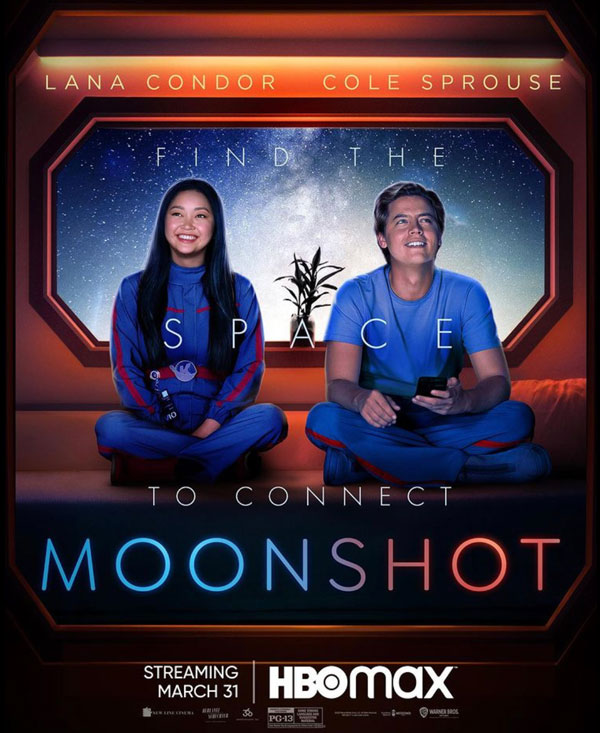
NYFA Acting Alum Lana Condor is no stranger to rom-coms with the To All The Boys I’ve Loved trilogy sitting comfortably under her belt. Since graduating from Acting for Film at NYFA’s camps, Condor has been seen in films like X-Men: Apocalypse, the TV series Deadly Class, the coming-of-age film Summer Night and Mark Wahlberg’s thriller Patriots Day, co-starring alongside fellow NYFA alum Themo Melikidze.
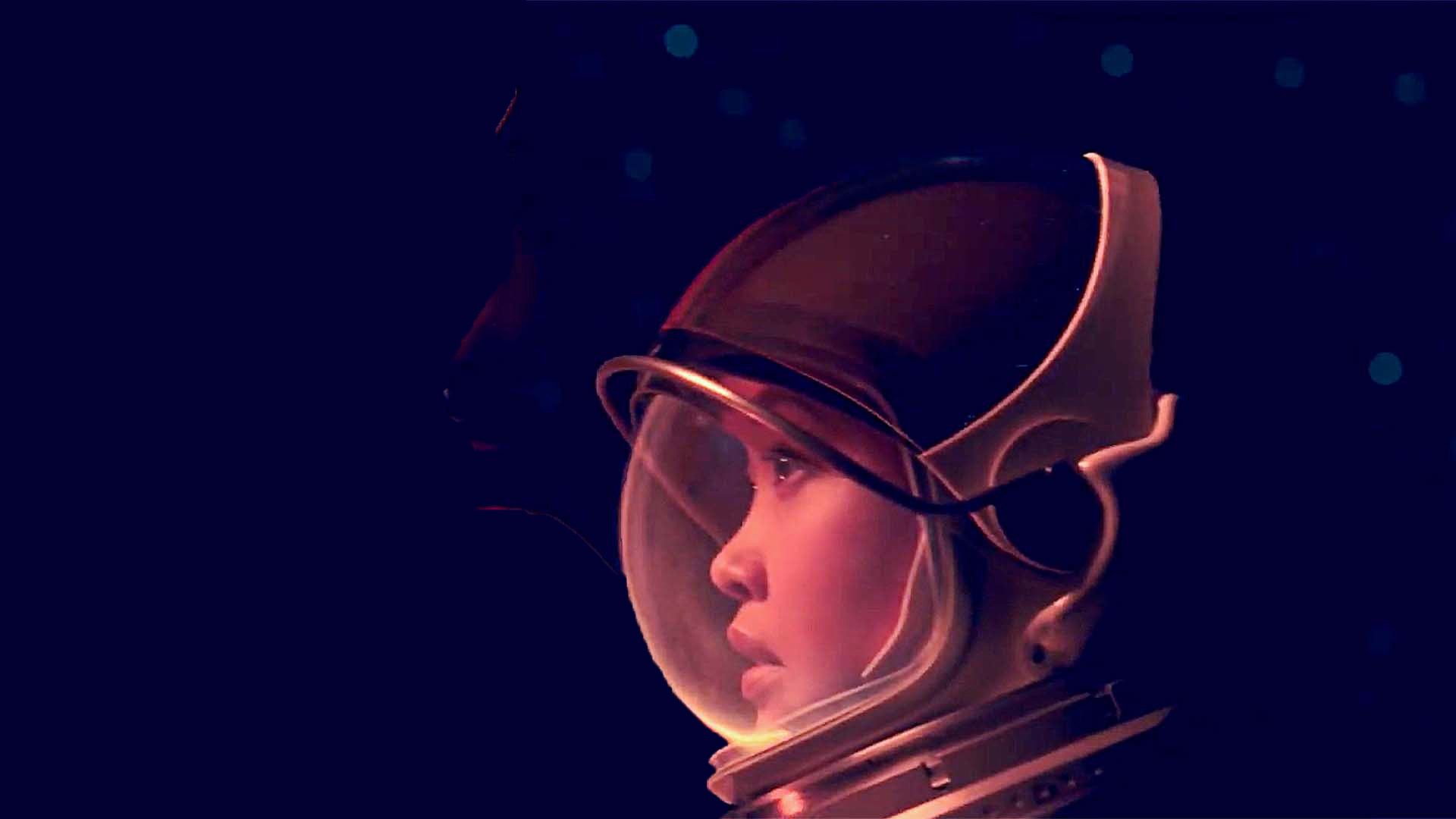
Lana Condor was more than prepared to head to Mars with Cole Sprouse in Moonshot for HBOmax. Sophie (Condor) hatches a plan to move to mars to mend a long-distance relationship with her boyfriend who lives on the red planet; Walt (Sprouse) has always dreamed of going to Mars and decides to tag along – without authorization. Sophie is then tasked not only with mending her relationship but also with ensuring that Walt makes it to Mars without getting caught.
Lana shared with Black Girl Nerds that what was most attractive about Sophie was, “she’s quite type A … sophie is also quite strong, stubborn in a good way … once she set her mind to it she was like i’m going to get over my phobia and I’m just going to do it … like my mom always says when I get overwhelmed with things – with life, she says ‘bird by bird … just do what you have to do in the moment and don’t think about anything else’ … [Mars] was not part of the plan but now that it is I am going to perform to the best of my abilities.’
Cole said that Walt, the relentless dreamer, “is helping Sophie be a little more present and Sophie is helping him be a little less present.”
The two are said to have gotten along greatly on the set of Moonshot.
When asked for advice for dreamers like Walt who are type A like Sophie and have a hard time dealing with the instability that comes with being in the entertainment industry Lana replied, “… if you want it so bad and you love it – whatever that goal is, if you work really hard and … honestly drown out the noise and just focus on the goal, I’m a believer that everything is possible.”
The New York Film Academy couldn’t be more proud to see Lana Condor shooting for the stars!
NYFA congratulates Lana Condor on all of her success!
Please note: NYFA does not represent that these are typical or guaranteed career outcomes. The success of our graduates in any chosen professional pathway depends on multiple factors, and the achievements of NYFA alumni are the result of their hard work, perseverance, talent and circumstances.
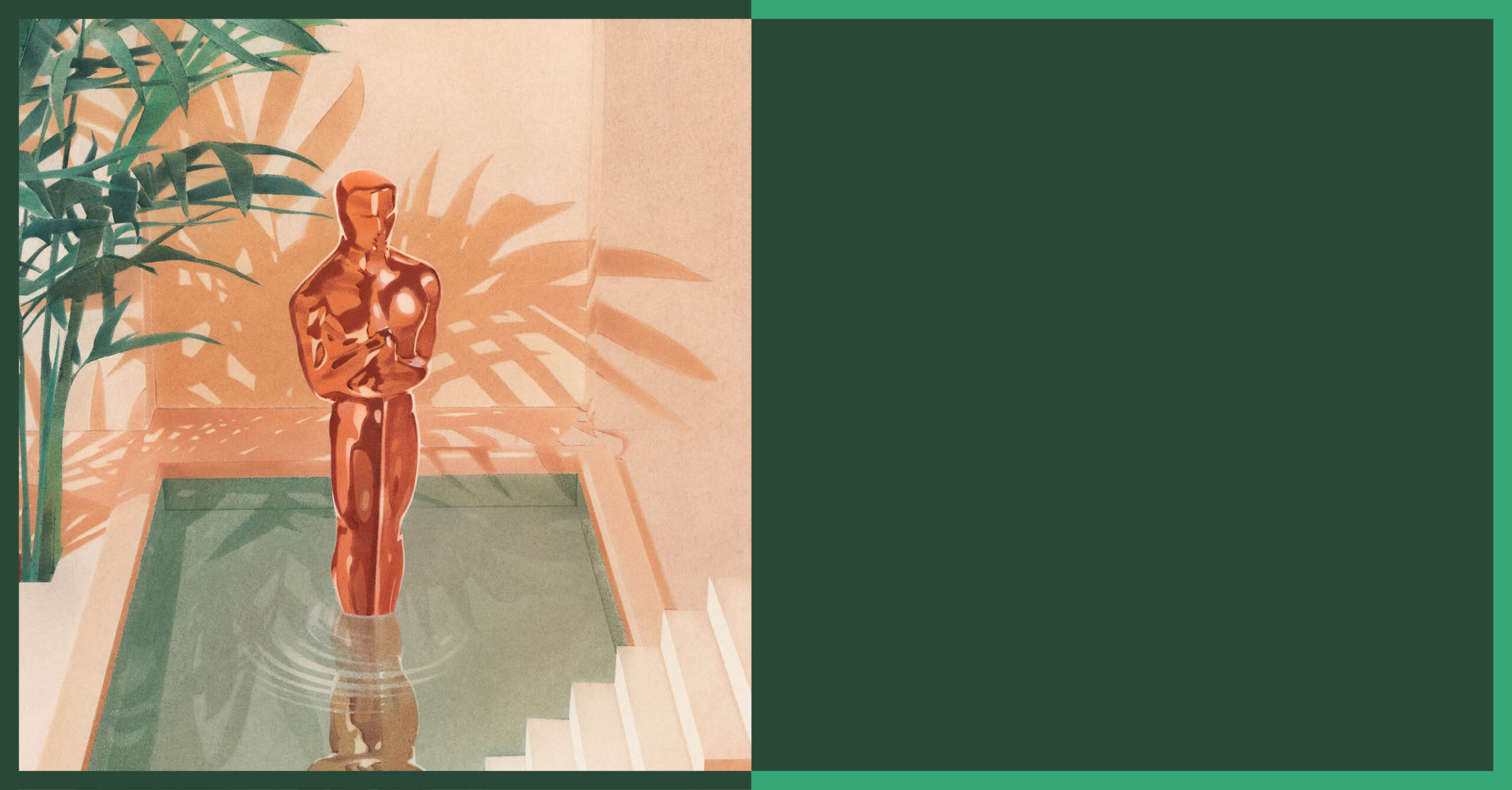
Last night’s 94th Academy Award was a night to remember in more ways than one. We’re recognizing the work and achievements of our alumni and the NYFA community as well as industry highlights and historic moments!
Dune won big last night with several awards including Best Cinematography and Best Visual Effects. NYFA 3D Animation and VFX Alum Francesco Panzieri was the in-house compositor for the adaptation of the Frank Herbert classic. In a Q&A with NYFA about the film, Panzieri told NYFA that he had been tapped for the project long before it began production; the in-house team at Wylie VFX sought his collaboration after Panzieri’s work on Terminator: Dark Fate.
NYFA Guest Speaker Steven Spielberg’sWest Side Story had a historic win with Ariana Debose taking home the Oscar for Best Supporting Actress. Debose is the first openly queer Afro-Latina to win the award.
CODA also made Oscar history last night as the first-ever streaming film to win Best Picture at the Academy Awards. The film won in all three of its nomination categories including Best Picture, Best Adapted Screenplay and Best Supporting Actor, making Troy Kotsur the first deaf man to win an Academy Award for acting. CODA was nominated for Best Picture alongside Belfast, Dune, Drive My Car, King Richard, Licorice Pizza, Nightmare Alley, The Power of the Dog and West Side Story.
Jane Campion took home her first Best Director Oscar win for The Power of the Dog. She is the third woman to win in this Oscars category.
Our NYFA Guest Speakers also won big with Zach Baylin’s King Richard scoring Will Smith his first Oscar win. The actor had been nominated two times before for Ali and The Pursuit of Happyness; and Hal Tulchin would have been proud to see the fruits of his labor as Summer of Soul won Best Documentary. NYFA Guest Speakers David Dinerstein and Robert Fyvolent spoke with moderator and curator Tova Laiter about the film and why it took 50 years to bring Summer of Soul to the big screen.
“Belfast” “CODA” – Winner “Don’t Look Up” “Drive My Car” “Dune” “King Richard” “Licorice Pizza” “Nightmare Alley” “The Power of the Dog” “West Side Story”
ACTRESS IN A SUPPORTING ROLE
Jessie Buckley, “The Lost Daughter” Ariana DeBose, “West Side Story” – Winner Judi Dench, “Belfast” Kirsten Dunst, “The Power of the Dog” Aunjanue Ellis, “King Richard”
ACTOR IN A SUPPORTING ROLE
Ciaran Hinds, “Belfast” Troy Kotsur, “CODA” – Winner Jesse Plemons, “The Power of the Dog” J.K. Simmons, “Being the Ricardos” Kodi Smit-McPhee, “The Power of the Dog”
INTERNATIONAL FEATURE FILM
“Drive My Car” – Winner “Flee” “The Hand of God” “Lunana: A Yak in the Classroom” “The Worst Person in the World”
DOCUMENTARY (SHORT)
“Audible” “Lead Me Home” “The Queen of Basketball” – Winner “Three Songs for Benazir” “When We Were Bullies”
DOCUMENTARY FEATURE
“Ascension” “Attica” “Flee” “Summer of Soul” – Winner Writing with Fire”
ORIGINAL SONG
“King Richard” “Encanto” “Belfast” “No Time to Die” – Winner “Four Good Days”
ANIMATED FEATURE FILM
“Encanto” – Winner “Flee” “Luca” “The Mitchells vs. The Machine” “Raya and the Last Dragon”
ADAPTED SCREENPLAY
“CODA” – Winner “Drive My Car” “Dune” “The Lost Daughter” “The Power of the Dog”
ORIGINAL SCREENPLAY
“Belfast” – Winner “Don’t Look Up” “King Richard” “Licorice Pizza” “The Worst Person in the World”
ACTOR IN A LEADING ROLE
Javier Bardem, “Being the Ricardos” Benedict Cumberbatch, “The Power of the Dog” Andrew Garfield, “Tick, Tick… Boom!” Will Smith, “King Richard” – Winner Denzel Washington, “The Tragedy of Macbeth”
ACTRESS IN A LEADING ROLE
Jessica Chastain, “The Eyes of Tammy Faye” – Winner Olivia Colman, “The Lost Daughter” Penelope Cruz, “Parallel Mothers” Nicole Kidman, “Being the Ricardos” Kristen Stewart, “Spencer”
DIRECTOR
Kenneth Branagh, “Belfast” Ryusuke Hamaguchi, “Drive My Car” Paul Thomas Anderson, “Licorice Pizza” Jane Campion, “The Power of the Dog” – Winner Steven Spielberg, “West Side Story”
PRODUCTION DESIGN
“Dune” – Winner “Nightmare Alley” “The Power of the Dog” “The Tragedy of Macbeth” “West Side Story”
CINEMATOGRAPHY
“Dune” – Winner “Nightmare Alley” “The Power of the Dog” “The Tragedy of Macbeth” “West Side Story”
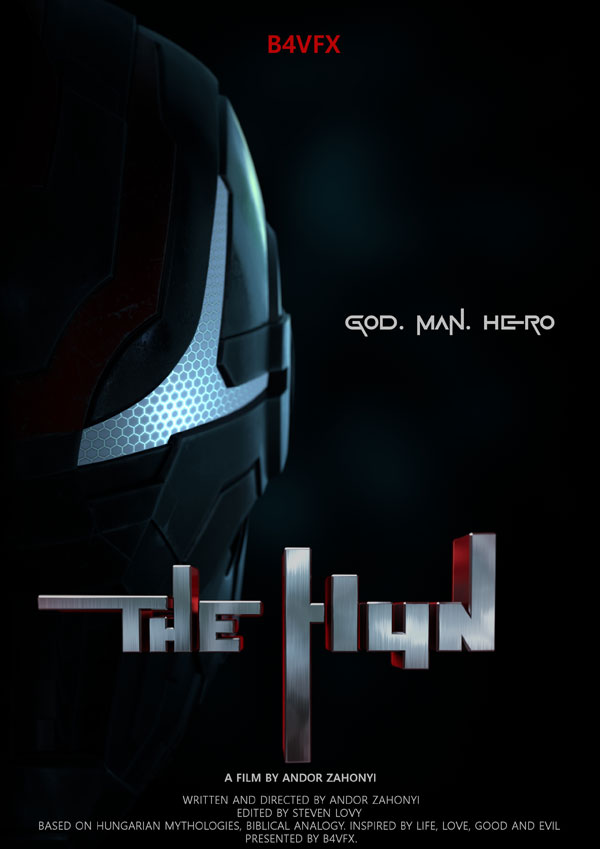
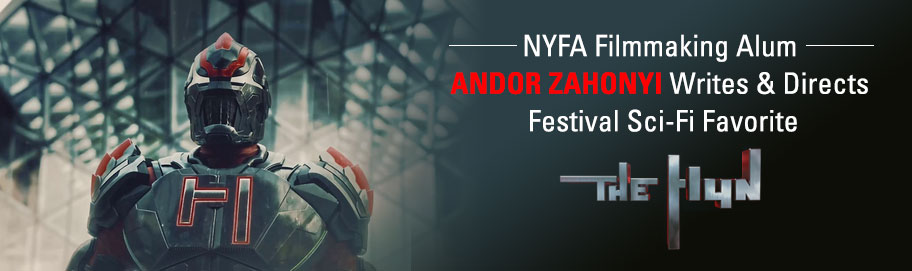
Since graduating from New York Film Academy, 12-Week Filmmaking Program Digital Compositor Andor Zahonyi has not stopped creating breath-taking visuals. Andor has almost 50 visual effects credits on IMDB and more than 300 TV commercials as either VFX supervisor, editor, lead VFX artist or VFX artist credited to him. When NYFA asked about these achievements Andor said, “[these] projects had a lot of great festival awards but it wasn’t my merit – I directed The HUN, the trailer [went] viral and won first place in 12 festivals including Cannes World Film Festival, Europe Film Festival, Berlin Underground Film Festival, New Harvest Film Festival in Moscow and Hollywood Independent Filmmaker Awards and Festival.” Andor was also the Director of Photography for 30% of the footage.
Below is the viral trailer for The HUN:
Andor most recently worked on the Halo series as a visual effect artist. Halo is an American military science fiction television series developed by Kyle Killen (Awake, Fear Street, Mind Games) and Steven Kane (The Last Ship, The Closer, American Dad) for Paramount+, based on the video game franchise of the same name, where aliens threaten human existence in the 26th century.
When asked about NYFA, Andor said that the 12-week filmmaking program helped him master the entire field of filmmaking and in this project he used all of his knowledge on pre production, production, post production: producing, directing, DoP, editing, VFX. However, wearing so many hats comes with a challenge. “ [I knew] I should choose only one field to master. I chose VFX but I still can’t give up the rest, I have to push 24 hours to 48.”
For incoming NYFA students, Andor had some advice: “Get the most out of your studies. Build great relationships in the film industry and don’t forget to nurture these connections.”
Andor is currently working on the script for The HUN and hopes to see it streaming soon.
NYFA congratulates Andor Zahonyi on his success, we look forward to seeing The Hun.
Please note: NYFA does not represent that these are typical or guaranteed career outcomes. The success of our graduates in any chosen professional pathway depends on multiple factors, and the achievements of NYFA alumni are the result of their hard work, perseverance, talent and circumstances.
Since graduating from New York Film Academy, 12-Week Filmmaking Program Digital Compositor Andor Zahonyi has not stopped creating breath-taking visuals. Andor has almost 50 visual effects credits on IMDB and more than 300 TV commercials as either VFX supervisor, editor, lead VFX artist or VFX artist credited to him. When NYFA asked about these achievements Andor said, “[these] projects had a lot of great festival awards but it wasn’t my merit – I directed The HUN, the trailer [went] viral and won first place in 12 festivals including Cannes World Film Festival, Europe Film Festival, Berlin Underground Film Festival, New Harvest Film Festival in Moscow and Hollywood Independent Filmmaker Awards and Festival.” Andor was also the Director of Photography for 30% of the footage.
Below is the viral trailer for The HUN:
Andor most recently worked on the Halo series as a visual effect artist. Halo is an American military science fiction television series developed by Kyle Killen (Awake, Fear Street, Mind Games) and Steven Kane (The Last Ship, The Closer, American Dad) for Paramount+, based on the video game franchise of the same name, where aliens threaten human existence in the 26th century.
When asked about NYFA, Andor said that the 12-week filmmaking program helped him master the entire field of filmmaking and in this project he used all of his knowledge on pre production, production, post production: producing, directing, DoP, editing, VFX. However, wearing so many hats comes with a challenge. “ [I knew] I should choose only one field to master. I chose VFX but I still can’t give up the rest, I have to push 24 hours to 48.”
For incoming NYFA students, Andor had some advice: “Get the most out of your studies. Build great relationships in the film industry and don’t forget to nurture these connections.”
Andor is currently working on the script for The HUN and hopes to see it streaming soon.
NYFA congratulates Andor Zahonyi on his success, we look forward to seeing The Hun.
Please note: NYFA does not represent that these are typical or guaranteed career outcomes. The success of our graduates in any chosen professional pathway depends on multiple factors, and the achievements of NYFA alumni are the result of their hard work, perseverance, talent and circumstances.
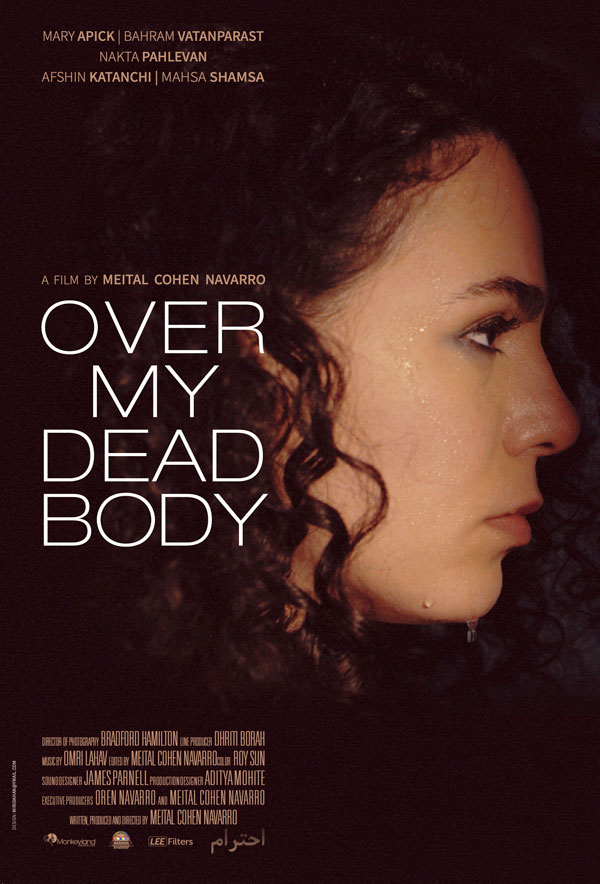
NYFA MFA Filmmaking alum Meital Cohen Navarro is an award-winning, Israeli-born narrative and documentary filmmaker based in Los Angeles. Meital’s most recent film, Over My Dead Body, tells the story of a young Jewish Persian-American woman, who reveals to her parents that her fiancé is Muslim right after anouncing her engagement. Her parents are devastated by the news and give her an ultimatum: her fiancé or her family. The film explores the internal conflict surrounding a family of Jewish immigrants from Iran now living in Los Angeles.
“As a grandchild of immigrants, making this film was an amazing journey,” says Meital. “I hope the film helps families with intergenerational rifts to better understand each other: For parents to see the toll it has on their children and for the younger generation to acknowledge their parents’ equally heartbreaking cultural challenges.”
Over My Dead Body premiered in the United States at the Atlanta Jewish Festival and has since been collecting awards and nominations at festivals like the Film Pittsburgh Festival International Short Film Competition, The Valley Film Festival and many others. Meital’s film also won the San Luis Obispo Film Festival’s George Sidney Independent Film Competition For Best Narrative Short 2021.
Recently, the film received a nomination for “Best Scripted Series” at the College Television Awards (College Emmys) streaming this Saturday, March 26th at 6PM PT.
Meital spoke with NYFA about shooting a film in a foreign language, the importance of cinema at a time like this and how food brings us together. Check out the interview below!
Tell us about yourself. What were you doing before you came to NYFA? Wow, this is a big question. I don’t know where to start. I began filmmaking when I was 14 and by the age of 18 I had already written and directed my first film called Happy New Year, which is about a prisoner’s 48-hour visit with his family. It explored the tension between himself and his younger brother. This film won the top award at the Wim Van Leer Young FilmMakers Competition at the Jerusalem Film Festival for a short film. I was starting to work as a documentary filmmaker and editor at Israel Broadcasting Authority. Part of my life journey, I moved to Africa and lived in Democratic Republic of Congo for a handful of years, then moved to South Africa and among the things that I did there – I was a journalist, writing for one of the main newspapers in Israel Maariv and covering social and financial stories. My journey in Africa changed my life. I lived in places that few people are fortunate enough to visit, and I had the privilege of getting to know a different culture, a more simple and naive one. I learned to look at the world in a different light, to find beauty within great hardship, to recognize nuances within traditional societies and learn to what extent their history still influences their modern cultures. To discover beliefs, emotions, and stories that had moved me and captivated my thoughts. Being in Africa, just like my time in the documentary world, once again strengthened my deep connection with filmmaking. The hardships, the poverty, the personal defeats, the small magical moments that the simplest people experience, the stories I find myself wanting to tell again and again, the desire to write, to document, and to send my feelings and experiences to anybody who would accept them.
Tell us about your film. What is it about? Where does it take place? What was the inspiration? Over My Dead Body tells the story of a young Jewish Persian-American woman who tells her parents that her fiancé is Muslim, then they make her choose between him and them. When I moved here to LA, through one of my friends, I discovered that within my new neighborhood there was a huge Persian-Jewish community. They invited me for dinners, and I felt so at home because of our similar backgrounds. Persian culture reminded me of my family. They all immigrated from Iran to America and as a grandchild of immigrants, I had experienced similar conflicts and questions as the younger generation I was meeting. My grandparents immigrated from Yemen and Morocco to Israel in the early 50’s. As a teenager, I felt the clash between two different worlds: my grandparents and parents who held to the traditional, conservative ideals and the modern liberal one that I was experiencing in Israel outside of home. I did not understand the reasons or implications for this gap. I simply rebelled against all the traditions and values that influenced my parents’ lives. Filmmaking has allowed me to explore the different points of view and the gap that exists between the generations. I decided to create a film that would reflect my background as well as take place in my new home, Los Angeles. I started interviewing individuals across the generations within the Persian-Jewish community. Meeting these children of immigrants and their parents as well as my personal experiences inspired me to write Over My Dead Body, an authentic Persian-Jewish family drama which explores an internal conflict surrounding a family of Jewish immigrants from Iran, played by Muslim, Christian, and Jewish actors, now living Los Angeles.
What was your favorite thing about directing this film? My favorite thing was directing a film, learning about a new culture, and conducting an anthropological study of that culture. You learn so much about them, but you learn so much about yourself. You often see things on the surface, but to do a deep dive is fascinating. To consider how they think, the food, the meaning of everything, the music, the hierarchy, their values. Everything makes you consider your own choices and life. It makes me think about what we miss as humans when we just get excited about something, we’re moved by trends, but we don’t really appreciate where things are coming from.
What was the most challenging thing about making the film? What did you learn in the process? This film was full of challenges, notably my choice to maintain authenticity by shooting it in the Persian language. I’m not Iranian and I don’t speak Farsi, therefore directing a film in a new language was challenging. Language creates the music in the film and I had to understand the music of my film. For a few months, every morning I would listen to music, radio, and TV shows in Farsi so that I could understand the language and the sound of the language, so that I could successfully direct a film in Farsi that presented the people’s story authentically. Another challenge for me as a director was to make sure that I was building the right emotional arc for the characters. This film could easily have had five people screaming for half an hour because of the conflict that they are faced with. The film tells a story of five different characters, each with a different point of view regarding the conflict and a different relationship to one another. I had to take a step back to see the big picture of the film first as a unit then go back and disassemble each character’s journey so that I could guide the actors accordingly.
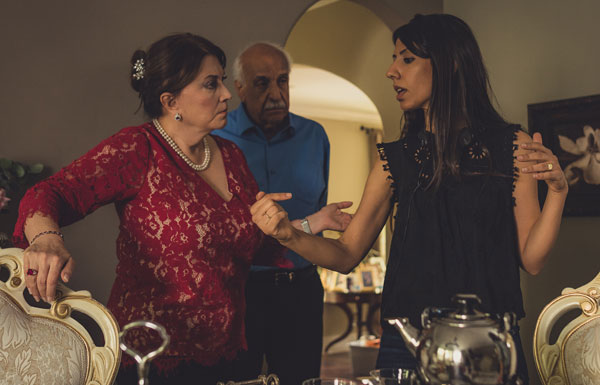
Meital (right) on set with renowned Persian actress Mary Apick (left)
I’ve noticed that food is a common motif in your films. They always make me hungry! What is your take on food, your characters, your stories? This is such a great question! I see food as a gateway to experiencing cultures. In fact, food, in addition to its practical function, is also a key element to our social and cultural identity. Every society has its own authentic food that reveals its own story. It can be a story about origin and tradition; or about the connection of that food to an individual or collective memories and feelings. Every time you travel to a different country the first thing that you will do is to eat their food, right? It is the best way to learn about a new place we are discovering.
Also, food connects people. We always meet people for breakfast, lunch, dinner, coffee, ect. We don’t care about the food as much as we care about the company. We can experience falling in love around food, we fight around the food, and we can make up after a conflict around the table. As an Israeli and Middle Eastern woman, I grew up in a family that treats their guests like royalty in their house. Whether you are poor or rich, you will give your best in abundance to show the host’s appreciation for your visit. Big dinners are a way to connect within the family unit. Once there is food on the table, everyone will gather around to enjoy. It doesn’t matter what happens during the day – conflict or difficulties – the shared meals are the glue that keeps the family together.
Tell us about the festivals you’ve participated in. Unfortunately, I completed post-production for the film in the middle of the pandemic and all of the festivals underwent big changes as a result. We were fortunate enough to have our world premiere in the UK Jewish Film Festival, one of the largest Jewish film festivals in Europe that is also BAFTA qualifying. In February of 2021, we had our North American premiere in the Atlanta Jewish Film Festival, where only 16 short films were selected that year. It was an honor to be part of it. Our West Coast premiere happened the following month at the San Luis Obispo International Film Festival. Since then we’ve been fortunate to participate in many festivals, including New Filmmakers LA, Cordillera, and Julien Dubuque, and to pick up some awards along the way too! I am beyond honored to share that we are currently nominated for a College Television Academy Award (College Emmy). I cannot be more excited.
What was your favorite festival experience? Every festival has its own character and we had wonderful experiences all over the US and Europe. Dances With Films was a special event for us, since the cast and crew were all in attendance, alongside audience members from the Persian community that the story is based on. It was truly unforgettable, and we are grateful we could all share this great experience, especially during the pandemic. That being said, we really are thankful to take part in every single festival we have gotten the chance to participate in. No matter which festival it is, the best part is always engaging with the audience after the screening, seeing where the story meets them and what it brings up for them.
What awards have you won for this film?
Winner Beaufort International Film Festival (Best Director, Best Ensemble cast) 2022
Winner San Luis Obispo International Film Festival 2021 George Sidney Independent Film Competition Winner – Best Narrative Short
Winner Dances With Films 2021 -Grand Jury Honorable Mention
Winner The Valley Film Festival 2021 – Jury Award
Winner Film Pittsburgh Festival International Short Film Competition 2021 – Audience Award
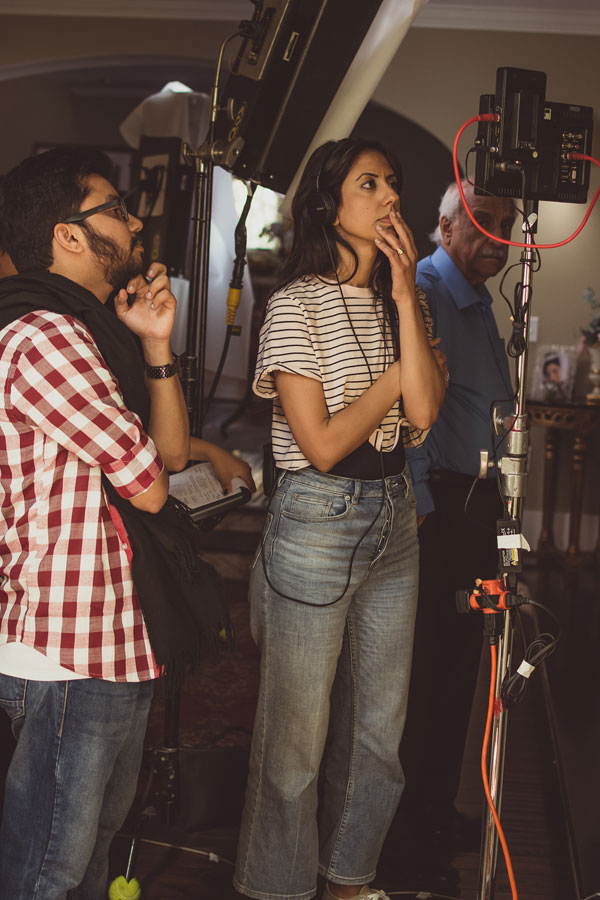
Meital on set of Over My Dead Body
How do you think your education at NYFA and the work you did here prepared you for a career in filmmaking? Coming from Israel where I grew up as a filmmaker most of my focus was on European cinema. As a young filmmaker, I always thought that American cinema focused first on entertainment and then on the director’s artistic view and message. Whereas in European cinema, you should be true to yourself and what you are trying to say and it will be conveyed to the audience. Obviously over the years my perspective changed as well as things within the industry. Learning at NYFA expanded my point of view on the industry overall. I learned that Hollywood is so much more than just the big studios; you can find many paths and colors, and you just need to discover it.
I took the MFA Filmmaking Feature Track, and it was definitely a great decision. What I love about NYFA’s faculty is that they don’t give you short-cuts. You feel like you are always on a professional set. From day one they have pushed me to the edge and forced me to give everything that I’ve got. What I really appreciate is the honest feedback and the challenging questions from the faculty. I met amazing instructors that always challenged me in a way that helped me to grow and rise to better performance.
And even as alumni, the door has always been open for any questions or requests. Crickett Rumley (Director of NYFA’s Film Festival Department) created for us all these amazing Labs and Q&As from which I still learn so much to this day.
Do you have any advice for recent graduates making their way into the professional world? First, I would advise them to have a clear voice as a filmmaker. You need to know what you are trying to achieve and what your message is. It doesn’t matter if you are making an entertaining comedy or have a social-political film, just make sure that everybody understands what you are trying to say. The second thing is good networking. Meet as many people as you can and get your name out there as much as possible. You never know who you will meet and where you will meet them. And most importantly don’t give up when you hear “no”, because eventually something will click.
These are trying times in the world today. Art matters more than ever. Do you want to share any words/your personal views about the importance of film in the lives of humans living right now? Watching movies is something that makes you feel happy, scared or a variety of emotions for an hour and a half. When you watch a movie from the comfort of your own couch, you move into another world, away from reality, and enter into a dream (at least that’s what happens to me until I see a boom in the frame). Aside from fun and entertainment, watching movies has many other benefits that affect our lives in the last year.
We have been isolated in our homes for over a year and people have lost so many things, including friends and family, work, and they feel a great sense of loneliness. Movies play a very important role for us at this time, as a source of entertainment and escapism. Movies contain music, stories and images, and it is a way to forget the real world for about two hours but at the same time can give us a reality check.
This year not only do films allow us to escape, but they are also our travel agent, our teacher, and inspiration. We learn through films about new cultures and films make our imaginations run wild. Many movies give us a glimpse into the reality of life through the eyes of someone else. They often show how ordinary people embrace life and the things around them. This is why you are able to see life from a completely different point of view. And watching our favorite films brings us joy and inspires us, even in hard times. Until the world will be open again, I believe we can explore and experience new things through films.
What are you working on right now? I recently got back from Democratic Republic of Congo, where I have been shooting a documentary about a high profile politician and his desire to make his country a better place for his people. It’s truly an inspiring process, and I can’t wait to be able to share more about it. Additionally, my feature script One Way has been making rounds through the festival circuit, including Austin Film Festival (2020), and earning a finalist spot at Raindance Film Festival Script Competition (2021) as well as reaching the final rounds at the Sundance Development Track. It tells the story of a Jewish mother, estranged from her family and her ultra-orthodox community, who returns from exile to stop her daughter from entering into an arranged marriage. I am also currently pitching Morasa Polo, a TV series expanding on the story in Over My Dead Body.
The New York Film Academy congratulates Meital on all her success and wishes her the best as she continues her filmmaking journey.
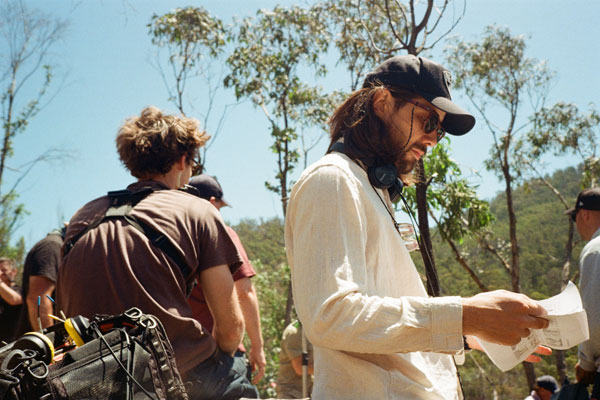
NYFA MFA Filmmaking alum Kane Senes is an award-winning filmmaker from Sydney, Australia. Since graduating, Senes has been writing, directing and producing critically-acclaimed films in varying genres. This year, his horror venture, Sissy, is premiering at South by Southwest (SXSW) tomorrow, March 11th at the Alamo Lamar Theater in Austin, Texas.
Since graduating, Kane has been writing, directing and producing critically-acclaimed films in varying genres. Kane followed his first feature, Echoes of War, starring James Badge Dale, Ethan Embry and William Forsythe with another award-winning independent feature, For Now. The film was nominated for best picture at multiple film festivals and was acquired by Amazon Prime. Sissy is Kanes third feature which he wrote, produced and directed with his partner Hannah Barlow at their shared production company, Dog Park Pictures.
Kane spoke with the New York Film Academy about what it takes to shoot a micro-budget feature, the inspiration behind Sissy and what he learned at NYFA.
New York Film Academy (NYFA): Can you tell us a bit about yourself, where you’re from, and what brought you to New York Film Academy?
Kane Senes (KS): I grew up in Sydney, Australia, a first generation Australian to European parents. I was always into movies. My parents would debate who’s taking me to the video store as I would be in there for hours, reading the backs of every VHS box, renting the same movies over and over again: Tim Burton’s Batman, Teenage Mutant Ninja Turtles, Ghostbusters, Home Alone. It wasn’t until my first year at college that I took a film studies course and realized I wanted to be a filmmaker. I was always into the arts in school – drawing, painting, acting, writing, photography – and I made this realization that filmmaking was this ultimate artform that combined them all. I made my first short films at university, began watching movies from a different perspective, re-organised my DVD collection by director and enrolled in film school as soon as I could. I wanted to go straight to LA, surround myself with Hollywood history and start making movies as soon as possible. NYFA provided that and I never looked back.
NYFA: What projects have you worked on since graduating? Have you won any awards or been showcased in any festivals or competitions?
KS: Shortly after graduating, I got a job as an assistant to one of the producers of Baz Luhrmann’s The Great Gatsby, which was shooting in Sydney. I got to see, from a front row seat, how a big studio movie is put together and I learned a lot. I couldn’t help but wonder what kind of movie I could make with their catering budget alone. So, at night and on weekends, I started writing my first feature, adapting my NYFA thesis film A Relative Stranger, which I would go on to shoot in Austin, Texas, soon after finishing on Gatsby. The film starred James Badge Dale, Maika Monroe and Ethan Embry and won a special jury prize at the Dallas International Film Festival before coming out in AMC Theaters and on the Showtime network in 2015 under the new title Echoes of War. It was during post on Echoes that I met my fiancée Hannah Barlow, an Australian actor who had just moved to LA, and we quickly started dating and working together, creatively, culminating in the micro-budget comedy feature For Now, financed entirely on Kickstarter and shot guerilla style on a 7-day road trip through California. We both acted in it and our crew consisted of one cameraman, one sound guy and a friend who came along as a PA. We traveled the film to festivals for a good year before releasing it via Amazon Prime in 2019. I realized how much I loved co-directing with Hannah and our creative partnership was cemented.
NYFA: Tell us more about your latest project & how you got involved in the project?
KS:Sissy came as a result of Hannah and I moving back to Australia after the release of For Now and wanting to write something in the horror genre. The most horrific thing we were observing in society at the time was the prolific rise of social media and how becoming an ‘influencer’ was the number one profession that kids were interested in. Who put these influencers in such positions of power and influence? What messaging and subliminal brainwashing is going into the minds of our youth? Anxiety, depression, suicide are all on the rise, and it’s intrinsically linked to social media. Everyone’s hooked on the drug, the dopamine hit, and yet we’re not calling it a drug epidemic, because it’s become the norm. That’s scary. So we made a movie about that.
NYFA: What did you learn at NYFA that you applied directly to this project and others?
KS: I learned most of what I know about filmmaking at NYFA. My directing teacher, Adam Nimoy, was a huge influence on me. I remember, on one of my short films, re-writing a certain scene over and over and over again. I shot the film and showed Adam a rough cut, and the first scene he said to cut was that one. I realized very early on that there’s the film you write, the film you shoot and the film you edit. He taught us how to watch a movie on mute, and with the best films, you can still follow the story, because it’s a visual medium, first and foremost. You can have great dialogue, but it never surpasses clarity of visual storytelling: the way the shots are designed to cut together, the look in an actor’s eyes, the pieces you leave on the cutting room floor so that what remains is tighter, more focused, enhanced. My writing teacher, Mike Connors, taught me how to break a story down using cue cards on a wall, a process I start with everytime I write a script. Eric Conner, my producing teacher, taught me the importance of a director understanding a budget, and how to adapt your vision to fit the resources you have. He is also a wonderful human. I feel very lucky to have had the teachers that I had. Most of all, they taught me that being a student of film never ends, and I try to be a better filmmaker each time out the gate.
The New York Film Academy congratulates Kane Senes on the success of his previous feature films and the premiere of Sissy at SXSW!
Please note: NYFA does not represent that these are typical or guaranteed career outcomes. The success of our graduates in any chosen professional pathway depends on multiple factors, and the achievements of NYFA alumni are the result of their hard work, perseverance, talent and circumstances.
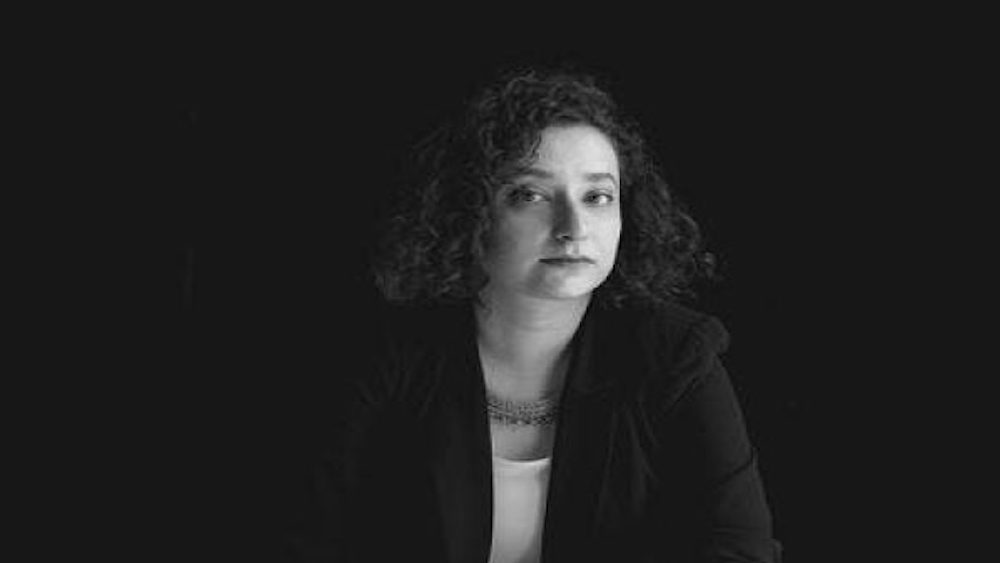
NYFA MFA Filmmaking student Israa Al-Kamali decided not to bring a seat to the table but instead build a table of her own. Israa, who is of Iraqi origin, co-founded the Independent Iraqi Film Festival. IIFF is a community driven, not-for-profit platform dedicated to supporting films from and about Iraq.
Israa Al-Kamali spoke with NYFA about what inspired her to bring this festival to life and the importance of Iraqi stories.
New York Film Academy (NYFA): What did you study and what made you decide to come to New York Film Academy?
Israa Al-Kamali (IA): I graduated with a BSc. in Foreign Service in Culture and Politics, at Georgetown University. I am currently studying MFA in Filmmaking at NYFA, LA. Ever since I was a kid, I was writing stories and over the years I began to notice that my stories are very visual; I would imagine the way the camera would move or what the soundtrack would sound like. I decided on NYFA because I wanted a hands-on intensive experience with a holistic approach to the art of directing. The NYFA LA campus is located in one of the hot spots of the filmmaking industry in the US. Therefore, I chose NYFA-LA.
NYFA: Do you have any advice for incoming students? What about international students coming to study at NYFA?
IA: My advice would be to make sure to always be visible and that happens through collaboration with other students, take advantage of networking opportunities, be professional, carry a good attitude, and try new things. I know it’s easier said than done but as long as you carry your passion with you, people will notice it. The second piece of advice I want to give is that your education and your degrees not only depend on the classes you take but also on the way you shape them; use the resources at the school to network with people in the industry, look for like-minded individuals who have similar goals and approaches in their creativity. Do not limit yourself to your classrooms, venture out and seek fellow creatives who focus on similar interests.
NYFA: Can you tell us more about your career and more about starting Iraq’s first independent film festival?
IA: After graduating from Georgetown, I worked in PR, social media, and content development, but I was writing scripts and stories on the side. It became unavoidable. I had to start working on my dreams. Independent Iraqi Film Festival (IIFF) is a community-driven platform dedicated to supporting films from and about Iraq, facilitated by me and three other Iraqi volunteers working in the creative industry. The seven-day festival is online and free, featuring shorts programs, feature films, and Q&As. It can be viewed worldwide, with English subtitles. Sharing the most exciting work by emerging and established Iraqi filmmakers, our aim is to showcase the diversity and resilience of our people, as well as the breadth of our culture to a global audience.
NYFA: Why is the film festival market an important place for independent film festivals? Can you explain the significance of this particular film festival in Iraq?
IA: The Independent Iraqi Film Festival was born out of my love for films and Iraq as well as the urgent need to create a platform and space for Iraqi stories and storytellers. From conversations with Iraqi communities both in Iraq and in the diaspora, I and my fellow co-founders knew that there was an appetite and curiosity regarding Iraqi stories by Iraqis. Our experiences are complex whether back in Iraq or in the various Iraqi communities in the diaspora. Iraq is rich in culture, history, and diversity, and it is time for our stories to be highlighted and brought to global audiences.
We created this first-of-its-kind festival to uplift filmmakers, inspire audiences, and engage the film industry in the country. Iraqi films are not given the spotlight they deserve and it is not because there aren’t any films made by Iraqis; the 90+ submissions we received this year and the 5000 online viewers we had last year are an indicator that there is a lot of talent and passion out there.
Iraqis have watched their experiences and stories being told by others through films that are usually filled with racism and stereotypes; War and destruction is the only point of reference and it often ignores the nuances of the Iraqi experience whether in Iraq and outside the homeland. Our festival created a space for Iraqi creatives from all communities to come together to tell our stories. This festival is for Iraqis in Iraq and in the diaspora, for every resilient Iraqi who is fighting the everyday battle to preserve our history, culture, and experiences. It is for the creatives and storytellers. It is definitely for non-Iraqis too to come and watch our stories on screen, celebrate people’s resilience, learn more about our rich and complex experiences in the homeland and beyond. It is for the emerging young Iraqi filmmakers to get a chance to showcase their talents to global audiences and for the established filmmakers to give more people the chance to enjoy and engage with their films.
NYFA: How do you hope to see IIFF grow in the next few years?
IA: Our first edition of the festival, August 2020, was very successful. We had 80+ submissions last year and 5000 total online viewers. For our closing night, we hosted an in-person premiere of Baghdad in my Shadow (2019) by Dir. Samir in London. Our festival was covered by various international news outlets, radios, and magazines such as GQ Magazine, Al Jazeera, Grazia, Middle East Monitor, Monte Carlo Radio in Arabic, etc.
We are hoping to continue to grow as a festival and showcase more Iraqi stories, host lectures, workshops, and screen more films in person.
NYFA: Do you have any upcoming projects coming up that you can share?
In addition to working on the festival, I am currently working on my first feature film at NYFA. Right now I am in the development stages and I hope I see it come to life.
The New York Film Academy congratulates Israa on all the work she’s done with the Independent Iraqi Film Festival – we can’t wait to see this festival continue to grow!
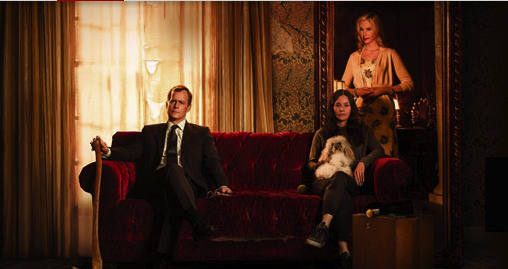
NYFA Cinematography instructor Suki Medencevic studied cinematography in Prague, Czech Republic. There, he studied under the guidance of renowned cinematographers and artists from around Europe. Medencevic trained in a rigorous five-year program and shortly after he graduated, he made the move to the United States because he “felt that the United States would be a much, much better place for me, which proved to be true.” Medencevic’s credits include American Horror Story, Them, The Great Water and many more. His latest work Shining Vale, starring Courtney Cox, Mira Sorvino and Greg Kinnear is currently streaming on Starz.
Medencevic’s lighting strategy, collaboration with visual-effects supervisor Jason Piccioni, and the equipment used while on set for Shining Vale were captured in the May 2022 issue of American Cinematographer Magazine. The cinematographer achieved unique looks by introducing additional cameras in special cases. When discussing the tiki-bar scene, Medencevic said, “Lighting for the tiki-bar scenes had four different looks, depending on the scene and characters. The idea was to always keep the lighting ‘invisible,’ and make it look like the set is lit only by practical sources.”
Medencevic spoke with NYFA about filming horror-comedy, Shining Vale, the importance of preparation before and after getting the job, and collaboration on set.
NEW YORK FILM ACADEMY (NYFA): What did you learn on the set of Shining Vale?
SUKI MEDENCEVIC (SM): Oh, I learned a lot. The great thing about cinematography is that you can never say that you know it all. Every project is different. Every day is different. Shining Vale taught me to not be afraid to risk, to not be afraid to experiment and not to be afraid to have fun. Honestly, I had a lot of fun because of the subject of Shining Vale. The story, the script and the characters gave me a lot of opportunities to really push the limits and be really daring in terms of visuals. So be brave and have fun. That was what I learned on Shining Vale.
NYFA: What was the hiring process like for this job in particular? And how did you prepare for Shining Vale?
SM: So the way this works is normally you get a meeting based on your previous work or based on recommendation by your agent or somebody that you’ve worked with. I remember reading the pilot for Shining Vale initially and I absolutely loved it. I decided I would do everything I needed to do to really show that I was excited about the project – not only that I had ideas and a vision. Enthusiasm and excitement are very important to the people that are interviewing. They have to feel that you aren’t seeing this as another paycheck or another job. I remember spending three days doing research, getting visual elements and putting together a presentation book of about twenty-five pages of text and images – which is a lot of work when you think about it. And you’re doing it based on speculation, you’re presenting something which might not even be close to what they want. But I did it anyway.
It was probably the longest interview I ever had for any show. I think we spent maybe an hour and half talking and they really enjoyed the meeting and what I presented. But as it often happens for pilots, it ended up that the producer or actual director had somebody else that they worked with before that had become available. So I ended up not doing the pilot, which is OK. They were kind enough to let me know that they really enjoyed meeting me and that they liked my ideas, etc. But after the pilot was shot and done, a few months later, I received a call and they asked me if I would be interested in doing the series for season one. I guess the original cinematographer of the show was no longer available and they wanted to go back and give me a chance. And of course I said, ‘yes, I’m very much available and interested,’ and that’s how I got on board.
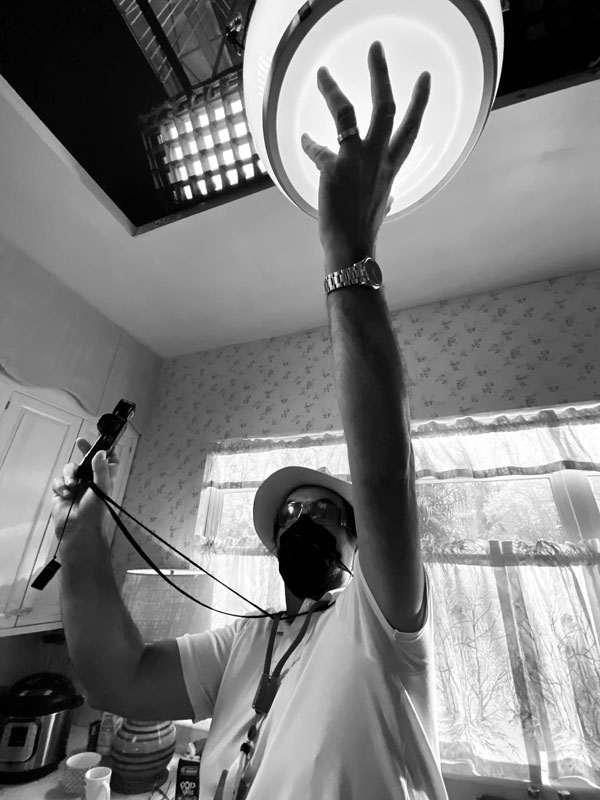
Suki Medencevic working on the set of Shining Vale.
NYFA: What would you say is most different about the field of cinematography today from when you first started?
SM: I would say the last ten years have seen the most dynamic changes because digital technology became widely embraced on both acquisition and distribution sides. Prior to digital technology, a cinematographer was kind of like a magician. It’s magical shooting on film and I still love shooting on film. It actually brings a level of excitement and a level of anxiety that is necessary when you are creating images. With film, you’re exposing some photochemical elements inside the emulsion that you can only see when you have your final result. So there is this big moment of anticipation. Nobody on set knows what’s really happening when you take a light meter, do the reading, put the color, put the diffusion and do the things that cinematographer do with film. So, then, nobody would question it or have any opinion. But with digital cameras there is the instant gratification of viewing your images on the monitor, you’re seeing it immediately. Not only you, but everybody’s seeing and it kind of demystifies what you do. And it also gives people the right to an opinion.
The discipline of filmmaking has completely changed. Before, you didn’t have too many chances to get it right. The shot had to really be the right shot and you wouldn’t do 20 takes because you just couldn’t. There is the economic aspect: film is not cheap; and if you know that, you get 3 good takes and move on because you have to. Shooting on digital changes things quite a bit. The directors know that you can just change the card and keep shooting. So instead of shooting less, you are all of a sudden shooting more because you can and because you shoot more, the days are longer. You very often shoot things that you don’t necessarily need, but you do because you can.
However, the biggest technological advancement has been, I would say, the advancement in camera and chip technology. We now have cameras that are so sensitive that it makes it much more nimble when it comes down to lighting. However, you still need to light. Just because you’ve got a camera with higher sensitivity to the light, does not mean that you’re just going to turn on the camera and keep shooting because you can capture the image. As a cinematographer, you need to be in control of the image, the image needs to be properly lit. No matter what happens with technology in the future, we will still use light. The cinematographer will still set the lights, illuminate the scene, and make sure the light is the way it should be otherwise we’re doing a documentary.
NYFA: How do you approach your work as a teacher?
SM: Teaching was always something that I had a passion for. I find it very stimulating as a teacher to share ideas and also get feedback from my students about things that I talk about. Cinematography is craft and it’s art at the same time. So I try to encourage my students to learn the craft in order to apply it towards the arts so that they can explore it and find their own language, find their own vision. In order to be a really good cinematographer, you have to be very well-trained because a cinematographer’s job is to interpret the text that is in the script. So you have to find the visual language and preferably not have a style and always do what works for the story. I encourage my students to sharpen their skills, understand and observe things around them and try to memorize and capture the moments; to be photographers, even if it means just carrying your cell phone in your pocket. If you see something interesting – capture the image. I encourage my students to be constantly active and also learn from the other cinematographers.
You’re not only a cinematographer when you are on a movie set and setting lights and making images, you’re a cinematographer 24 hours a day.
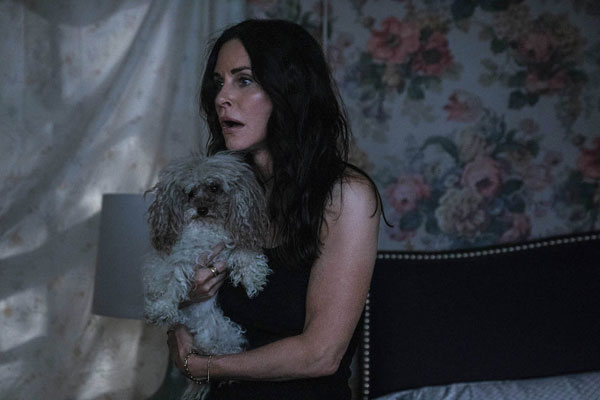
A still of Courtney Cox in Shining Vale
One thing I want to add, is how important it is and why it is important to know how to light a face, how to properly light the actor or actress. In Shining Vale, the three main characters are Courteney Cox, Mira Sorvino and Greg Kinnear and they are amazing actors. They’re beautiful people but you still have to light your actors in the most flattering way. If anyone reading takes anything away from this, let it be that moody lighting doesn’t mean turning off the light to let things go dark. Even in the darkest darkness, you have to light. You have to know how to light for darkness. Make a scene moody by using light, and especially when you have high paid talent on the set. So I would say if you want to be a cinematographer and really, really do well learn how to light your main actor or actress because that is something that hasn’t changed from the early days of Hollywood.
NYFA: What was the collaborative experience like on Shining Vale? Did you work with the set designer or anyone else to bounce ideas off of?
SM: I can tell you, this is a truly important question and a very important thing for students to know.We weren’t using a real house for logistical reasons so the only option was to build a house on a stage. We did it using 3 sound stages at Warner Brothers Studios. The production designer Jeff Sean and our creative department did a great job of reconstructing a massive Victorian style house on a stage and making it look as real as possible. The realism that they were going for in the art department with set dressing and set decoration was key for my lighting concept. I decided to start much earlier than normally. I started my prep on my own, on my own time. But having conversations about the set construction with the production designer early on, before they even started putting one single wall up, was so important because I would give my input in terms of how the walls should be treated and the colors of the walls. The ceiling was also an important aspect of the whole set building because I did insist that every set have a solid ceiling so that we could look up and see that the place was real. And even though it made it limiting for me as a cinematographer to light, it made it look more believable for the show. So because of the conversations I had: what type of lights we should have, what type of practical sources, what type of shades we would have on all these lights in the house, there were no surprises. I really benefited from the whole process. When I showed up on the sets I knew exactly the tonality, the reflectivity of the floor, of the walls, of the tiles, everything had been tested.
As a cinematographer, you have to be proactive because the cinematographer is usually one of the last people to get hired. If there is no early conversation with the production designer then when you get to the set, it’s too late to make changes and then you have to work around what has already been made.
The New York Film Academy congratulates NYFA Cinematography instructor, Suki Medencevic on his work on Shining Vale. We look forward to seeing more of his work!
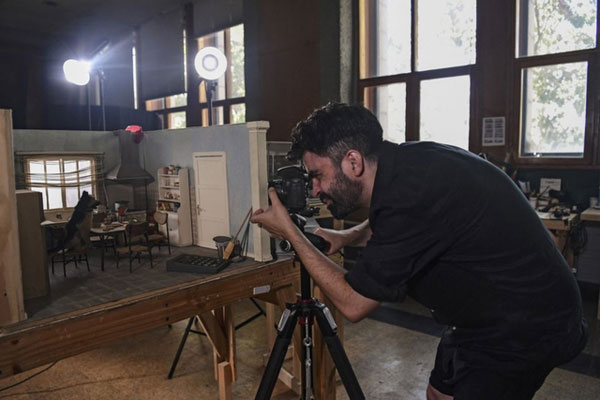
Last year, Mexican film producer and NYFA BFA alum Mariana Méndez Alejandre joined the Oscar and Annie-nominated short film Bestia as co-producer alongside Tevo Diaz from Trebol3, a Chilean production company.
Mariana is a seasoned producer and has supported Academy Award campaigns for films like Promising Young Woman, Harriet, Blackkklansman and Belfast with Focus Features as well as the campaigns for Oscar-winning shorts Skin (2019) and The Neighbor’s Window (2020). Of her partnership with Tevo Diaz and director Hugo Covarrubias’ latest work Mariana said, “I’m thrilled and honored to join the talented team of the animated short film Bestia. Hugo Covarrubias’ artistry is unparalleled and I couldn’t be more excited to support a film that invites the audience to consider not just the banality of evil, but the way it moves through our world, often looking just like the rest of us.”
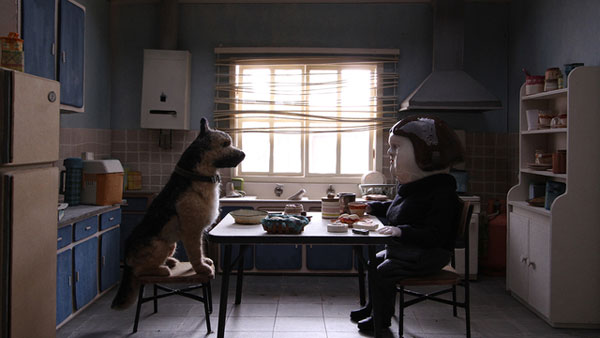
The Oscar-nominated short film, Bestia, is described by Covarrubias as a “psychological portrait that reveals a macabre fracture in a country.” Bestia centers on the secret, private life of Ingrid Olderöck, a DINA (Directorate of National Intelligence) agent of the Chilean dictatorship known for committing grave crimes against humanity, carrying out hits and using her dogs to torture people, mainly woman. The dictatorship, established by a US-backed coup d’etat, was enforced by the Chilean military and led by General Augusto Pinochet. The dictatorship lasted 17 years, from 1973 -1990 and was the backdrop of director Hugo Covarrubias’ childhood and adolescence. The film is the first installment in what might be a series of shorts that dive into the less known, darker figures of Chilean history.
With Bestia, Covarrubias and his team shed light on the hardly-embarked topic of the role of women in la dictadura. Covarrubias spoke with Solomonos about the film and his intentions, “[Bestia] is not a biography about Ingrid Olderöck but a visit into her secret life, the relationship with her dog, her fears and frustrations. That is, in the end, the x-ray of a fractured country, a country that is filled with wounds that are not even close to healing. More than anything, we use this case as a tool to speak of malice, evil.” However, he clarifies, “obviously without empathizing with the person but trying to understand what kind of frustrations can live inside such a bad person and whether or not this malice is inherited.” Olderöck was the daughter of German Nazi-sympathizers who emigrated to Chile at the end of World War II.
The film’s theme and examination is so captivating and nuanced that it received an Annecy nomination from an incomplete, work-in-progress submission. At the time of the submission, Bestia had not been through post-production, there were visible green screens and no digital or analog completion, just reference music. “I feel like it adds an extra merit to have the film be selected in this way. It means that the film works without needing to be 100% completed.”
NYFA Director of Film Festivals, Crickett Rumley says “I’m so excited to see our NYFA alum connected with such a terrific film. Bestia has had an impressive festival run and been very well-received. Fingers crossed, the team will bring home the Oscar win in March.”
Director Hugo Covarrubias and producer Tevo Diaz will be joining NYFA’s Regional Director for Latin America and the Caribbean, Gil Matos in a virtual Q&A this Thursday, March 10th to talk in detail about the film and the process of creating an award-winning stop motion animated short film. This event is open to the public and will be conducted entirely in Spanish. You can register for the Q&A here.
Please note: NYFA does not represent that these are typical or guaranteed career outcomes. The success of our graduates in any chosen professional pathway depends on multiple factors, and the achievements of NYFA alumni are the result of their hard work, perseverance, talent and circumstances.
Manage Cookie Consent
This website uses cookies to improve user experience. By using our website, you consent to all cookies in accordance with our Cookie Policy.
Functional
Always active
The technical storage or access is strictly necessary for the legitimate purpose of enabling the use of a specific service explicitly requested by the subscriber or user, or for the sole purpose of carrying out the transmission of a communication over an electronic communications network.
Preferences
The technical storage or access is necessary for the legitimate purpose of storing preferences that are not requested by the subscriber or user.
Statistics
The technical storage or access that is used exclusively for statistical purposes.The technical storage or access that is used exclusively for anonymous statistical purposes. Without a subpoena, voluntary compliance on the part of your Internet Service Provider, or additional records from a third party, information stored or retrieved for this purpose alone cannot usually be used to identify you.
Marketing
The technical storage or access is required to create user profiles to send advertising, or to track the user on a website or across several websites for similar marketing purposes.
To provide the best experiences, we use technologies like cookies to store and/or access device information. Consenting to these technologies will allow us to process data such as browsing behavior or unique IDs on this site. Not consenting or withdrawing consent, may adversely affect certain features and functions.
Functional
Always active
The technical storage or access is strictly necessary for the legitimate purpose of enabling the use of a specific service explicitly requested by the subscriber or user, or for the sole purpose of carrying out the transmission of a communication over an electronic communications network.
Preferences
The technical storage or access is necessary for the legitimate purpose of storing preferences that are not requested by the subscriber or user.
Statistics
The technical storage or access that is used exclusively for statistical purposes.The technical storage or access that is used exclusively for anonymous statistical purposes. Without a subpoena, voluntary compliance on the part of your Internet Service Provider, or additional records from a third party, information stored or retrieved for this purpose alone cannot usually be used to identify you.
Marketing
The technical storage or access is required to create user profiles to send advertising, or to track the user on a website or across several websites for similar marketing purposes.
.jpg)




 NYFA MFA Filmmaking student