How to Make a Game Without Coding: 5 Game Engines That Don’t Require Programming Knowledge

It’s no secret that making a computer game usually requires a solid understanding of computer programming—they are “computer games,” after all. Unfortunately not all of us have a knack for programming, no matter how hard we’ve tried, which has led us to believe that we’ll never be able to make a game on our own.

Although these can’t truly replace the flexibility and offerings of computer programming, here are a few tools that could help you make simple games without the need to learn a language.

You probably won’t make the next triple-A RPG or FPS with these programs, but they’re perfect for those looking to prepare for a game jam, make a small indie game, or just play around.

GameMaker: Studio

GameMaker is probably the most popular game creation tool, and for good reason.

The drag-and-drop options and other easy features allow anyone who has never programmed in their life to make a game. Despite the simplicity, it’s still possible to make good games as evident by the fact that Hotline Miami and Spelunky, two popular indie games, saw their first version made on GameMaker.

The best part is that GameMaker does come with a built-in scripting language that allows people with some programming experience to do more with the tool. This makes GameMaker perfect for those looking to get familiar with a game creation program in hopes that they can continue learning more and not run into the limitations of other programs.

Currently YoYoGames offers three versions of GameMaker. The first is a FREE version, which is only good for trying out the system. If you want to get serious about making a game with GameMaker, the $50 Professional version is what you should get as it offers a lot more tools. Seemingly overpriced, the $800 Master Collection version offers everything YoYoGames has to offer, including the ability to export to current-gen games.

Adventure Game Studio

Aimed at developers with more experience than beginners, Adventure Game Studio lets you make point-and-click or keyboard-controlled adventure games like the Monkey Island series.

A few recent indie titles that saw success used this tool, including Wadjet Eye Games’ Gemini Rue and Blackwell series.

Even if you’re just starting out, Adventure Game Studio is still pretty easy to use as your first game making software. The editor used is a Windows-based IDE that lets you do just about anything fast and easy, including writing game scripts, importing graphics, and so on.

Adventure Game Studio is completely free to download and even offers plenty of resources such as templates, fonts, backgrounds, characters, etc.

Unity

Perhaps none of the tools on this page have seen as much growth in use and popularity as Unity.

Unity not only supports an incredible library of platforms, but it also comes with its own built-in IDE. It is also used to make both 3D and 2D games and boasts a massive store of assets and resources.

Many high-profile game developers like Obsidian Entertainment (Pillars of Eternity) and inXile Entertainment (Wasteland 2) have started using Unity. Several successful indie devs like Facepunch Studios (Rust) and Press Play (Max: The Curse of Brotherhood) have also jumped on board.

The good news is that Unity is completely free. However, if you make more than $100K a year then you must purchase the Unity Pro license for $1,500, which does offer a few extra features. No big deal if you’re making that kind of money though, right?

RPG Maker

Remember that awesome RPG adventure idea you’ve had for years now? The one with cool locations, memorable characters, and a story players will never forget? You can finally make it happen with RPG Maker; the best tool that, for years, has helped developers make simple RPG games.

It has everything you’d want from a game creation tool: easy-to-use interface, tons of tile sets to use, and systems that take care of all the numerical elements that come with an RPG game. Plenty of features have also been implemented over the years that make this tool very powerful, which means you won’t feel limited despite a lack of coding knowledge.

There are currently several versions of this tool available, with RPG Maker VX ACE being the latest and costing $59.99. Fortunately each version offers a free trial so you can check it out before considering a purchase.

GameSalad

GameSalad is similar to GameMaker in that it allows you to make and publish games on several platforms, as well as having its own intuitive drag-and-drop interface that’s easy for anyone to use.

Most impressive is the behavior library which allows developers to implement complex behaviors that someone without coding knowledge would have a hard time executing if they had to use a computer language.

Thousands of games have already been made via GameSalad, and most of them have seen success in the mobile market. GameSalad Creator is currently available for free while a $300 PRO version offers some additional benefits.

Ready to learn more about game design? Check out NYFA’s Game Design School to begin your journey with the world’s most hands-on, intensive programs.

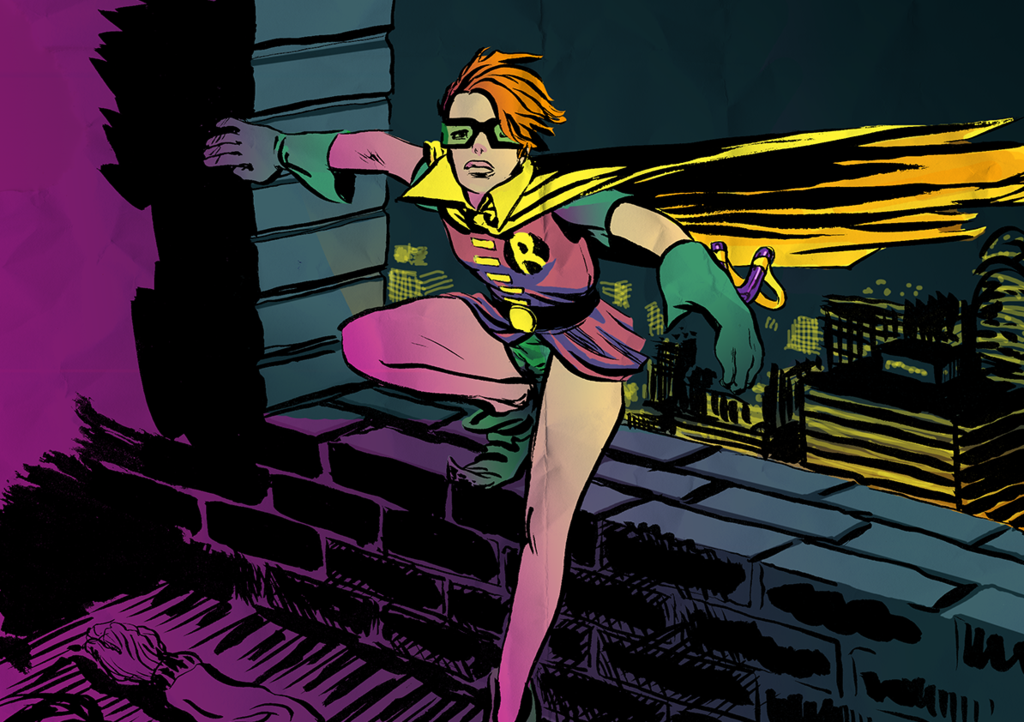
Image Source

Female Robin for Batman v Superman: Dawn of Justice?

Rumors are coming in thick and fast for Batman v Superman: Dawn of Justice, quite possibly one of the most anticipated comic book movies to ever be released. Very few have been outright confirmed by the Snyder team, but many of them have been dismissed simply by their own implausability.

The new and breaking rumor, however, seems like a pretty cast iron bet:

Dawn of Justice’s Female Robin

How do we know this? Because someone is risking bankruptcy to deliver you this juicy little development.

Presumably having worked on the initial filming during the LA production, an extra broke his non-disclosure agreement to reveal to WILX-10 News (in Michigan) that not only will there will be a female Robin, but that the female in question is none other than Jena Malone:

Jena Malone Robin

Malone is hot off the set from the last Hunger Games franchise entries, and curiously, someone’s added Dawn of Justice to her Wikipedia filmography (under an ‘unknown’ role) and IMDB have followed suit, although they’ve cautiously added a ‘rumored’ tag on the entry.

The extra who revealed this tantalizing leak may end up regretting speaking up, however. Assuming that it isn’t a clever marketing ploy from Warner themselves and that the extra isn’t a stooge, they’re eligible for a fine for breaking contract… of up to $5,000,000. 

The studio hasn’t commented on the news leak so far, though it was only broken an hour ago. While the fate of the extra lies in their hands (or at the hands of Warner’s lawyers), what other evidence do we have to back up the claim that the Jena Malone will play the new Robin?

1. Snyder himself has stated that he’s drawing off The Dark Knight Returns as source material, which features a young female admirer of Batman’s (Carrie Kelley) donning the Robin suit and becoming Wayne’s sidekick. There’s not really much reason to deviate from a female Robin, and it would probably help avoid the campiness that usually goes along with a male Robin.

2. Malone has been spotted in and around Michigan, where the next stage of production and filming is underway

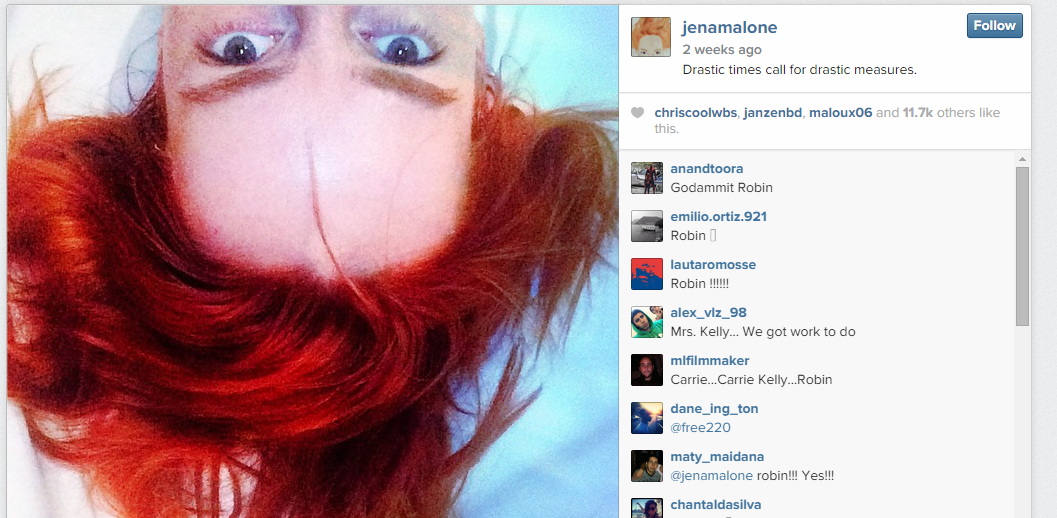
3. She’s also dyed her hair red recently, a la Carrie Kelley’s motif

Jena Malone Dawn of Justice

4. If the ‘extra leaks female Robin casting’ angle isn’t simply a PR stunt – and that cannot be ruled out – would anyone really risk never getting work again and a substantial fine if it wasn’t true? Either it’s a stunt or a genuine leak, and in either scenario it’s unlikely to be dud information.

We do, however, have to consider the other side:

The Case Against Jena Malone Playing Robin

The obvious talking point is that Jena is 29, whereas in the graphic novel Carrie Kelley is only 13. Clearly there’s no way Malone can convincingly play a female Robin even close to that age, and while it’s not a crippling roadblock for the character’s inclusion in the Batman v Superman movie, the extreme youth is fairly intrinsic to her characterization (assuming Snyder wants to stick as close as possible to canon).

Robin Dawn of Justice Batman v Superman

The other issue is less of a technical problem, but no less worrysome for those who are holding out for Dawn of Justice being any good. Consider the current list of confirmed major characters which are set to appear:

  • Batman
  • Superman
  • Wonder Woman
  • Aquaman
  • Lex Luthor
  • Cyborg
  • Louis Lane
  • Alfred Pennyworth

That’s a lot of leading characters; add in another fairly major sidekick in the form of Robin, and it’s starting to look unfeasible that each character is going to get the correct amount of screen time and keep the movie as a well-rounded whole simultaneously.

Can Zack Snyder handle such a monumental task? Is Jena Malone up to the task of playing a female Robin?

Let your voice be heard in the comments below.

Four Reasons The Gaming Industry May Be Nearing Another Crash

It’s hard to believe that only thirty years ago we almost saw the complete demise of the video game industry in North America.

The now-infamous crash saw the plummeting of consumer confidence due to several reasons, resulting in publishers with piles of games they couldn’t sell. You may have heard about Atari’s mass burial of nearly a million cartridges that nobody wanted to buy, forcing them to bury them in a New Mexico landfill.

Unfortunately the gaming industry is currently seeing a few of the same symptoms that led to the original 1980s crash. Will games come full circle and suffer a tremendous market crash before rising in popularity again? Here are a few reasons this could be the case.

Too Many Bad Games, Not Enough Good Games

Back in the 1980s, it reached the point where people were no longer willing to pay their hard-earned cash for games that, quite frankly, were terrible.

The famous example is E.T., a highly-anticipated game that was supposed to be amazing considering it was based on a beloved movie. Of course, it turned out to be one of the biggest commercial failures in gaming history. Too many high-profile failures resulted in a loss of trust from consumers, leading them to spend their cash on other forms of entertainment.

Today, there’s a huge variety of games that all have the same price tag, making it hard to decide which games are worth buying. Worse still, many games that players expect to be amazing end up a disappointment.

Destiny is an example of a game that ended up being less than what people were expecting for a game with a massive budget and half a decade of development time. It’s possible we will see consumers lose faith in games again, leading them to buying less titles a year and putting in less money into the industry.

The Downside of Self-publishing

An interesting turning point in the gaming industry back in the 1980s was when developers realized they could hire a few programmers for a few weeks to make a game, slap it onto an Atari cartridge, and sell it without problems. If this sounds similar to the exploding indie scene of today, that’s because it is.

Although some amazing games have been made by indie developers, there’s a ton that are just plain bad.

Simply going through the App Store to find the good games among the clones and shovelware is a difficult task. Sadly, the same is occurring on Steam, the most popular digital distribution platform.

Hundreds of games are being approved on Steam Greenlight via an arguably poor voting system before ending up on the Steam store. This means that a terrible game can make it onto the market without the need for a publisher, making it harder for people to find a good game on the Steam store.

This is why Nintendo, to avoid this happening again in the 90s, added many restrictions for publishers that wanted to release games on their system. In fact, they even placed a five-game-a-year limit so that developers focus on creating high-quality titles rather than churning out dozens of terrible games in a short time.

Publishers Have Their Hand in Reviews

But surely you can simply tell a good game from a bad one based on reviews, right?

Actually, publishers are influencing the reviews of games more than ever, and to deny this takes a good level of naivety. If you recently dropped $60 for a heavily-marketed game that got amazing reviews on several sites only to discover that it’s actually pretty mediocre, you can thank publishers for that.

A simple comparison of professional reviews vs. user reviews on Metacritic is enough to shed light on this practice. How does Watch Dogs for PS4 hold an 80 Critic score vs. a 6.3 User score? Mass Effect 3, which is published by none other than EA, has an 89 Critic score vs. a much lower 5.2 User score.

Since money talks, it’s no secret many websites are accepting cash from publishers to have their games receive better reviews than they deserve.

Game Industry Still Makes Money, Just Like Before the 80’s Crash

Ironically, the gaming industry was exploding just before the crash. Like today, games were a huge moneymaker in the 80’s as holidays saw parents fighting for new games to be played on the console under almost every living room. Games were flying off store shelves and the gaming industry looked like it was only going to keep growing and growing.

Of course, the same can be said today. More people are buying more games than ever, both indie and AAA titles, physical and digital games.

The problem is, why should publishers change what they’re doing if people are buying whatever they put out?

Just like before, consumers are helping publishers find success despite a market of over-hyped games with price tags much higher than they’re worth, and that’s not including DLC.

Image Source

Gone Girl Reviews Herald Brighter Times For Hollywood Production

After hitting a home run with The Social Network back in 2010 and following on with the remarkably well-adapted Girl With the Dragon Tattoo, director David Fincher is still on form with his latest release.

Gone Girl (adapted from the Gillian Flynn novel of the same name) is a delightfully dark romp which keeps you guessing all the way through as it spins around one central question: did Nick kill his wife?

Nick, in this case, is played by Ben Affleck which is significant given that it’s likely to be his last feature film appearance before he dons the cape and cowl for 2015’s Batman vs. Superman, a casting choice which has garnered significant ire and doubt. If nothing else, Affleck’s performance as the disheveled and slightly unhinged Nick Dunne should at least assuage those on the fence that he’s still got some serious acting chops when given the kind of excellent direction which Fincher provides.

In addition, Trent Reznor provided the soundtrack so that’s the cherry on the cinematography cake.

So, all in all Gone Girl is an excellent book adaptation and one which suspense fans will relish. It’s also sitting pretty at 87% on Rotten Tomatoes at the time of writing.

But is that success mirrored in the box office figures?

Yes. Resoundingly so.

Missouri and LA Production

Fincher opted for a joint Missouri and LA production for Gone Girl, which could be deemed as a risky move. Although Hollywood is still a hotbed of activity and home to many film companies and LA production schools, the costs are higher and we are in an era in which the industry is increasingly moving out of Hollywood (and even the US) for that reason. In addition, with self-distribution only gaining more traction, some worry that the day of box office blockbusters are on the wane.

The budget did end up running to $61 million, which is a fair amount for a flick which isn’t overly VFX-laden.

But if investors were worried before the release, they surely must be rubbing their hands together now: critics predicted a $100 million dollar hit. What they didn’t predict is that it’d totally smash this and land at over $160 million in box office takings so far.

A few key statistics that have Hollywood and LA production teams jumping for joy:

  • Gone Girl took $13.1m on its opening day
  • $37.5m in total revenue from the opening weekend
  • It competed extremely closely with the supernatural horror Annabelle ($37.1m), which, despite being a terrible movie, is of a genre which typically performs very well this time of year
  • Gone Girl‘s opening revenue beat Fincher’s previous debut record for Panic Room, which took in $30m
  • It’s the third best opening weekend for Ben Affleck, topped only by Pearl Harbor (at $59.1m) and Daredevil ($40.3m)
  • Overall, it’s the tenth biggest October opening on record

All said and done, it’s a big achievement for all parties involved on the movie and it may just be a sign that things are on the up for Hollywood and LA production in general.

Why Gone Girl‘s Takings Are Good News for Hollywood

Last summer, domestic takings were a good 15% higher (read: a lot) than they have been in 2014. This is despite the great commercial performance by huge summer blockbusters like Edge of Tomorrow, which, while different in substance to Gone Girl, was a similarly good movie and reached the same level of acclaim from the critics.

This past weekend appears to have reversed this year-long slump, however. With Gone Girl, Annabelle, Dracula Untold and Alexander the Terrible all pulling in big numbers, last weekend’s takings stand at $149,000,000. This is a whopping 28% better than the same weekend last year, a number so huge that it can’t be written off as just a blip in the figures.

Whether this positive upswing in box office takings is a sign of long-term resurrection for LA and Hollywood production remains to be seen, but it certainly isn’t anything other than a good start.

Cinequest Screenwriting Competition

Cinequest Screenplay Submission


Calling all screenwriters! Have a screenplay that you think could be the next big thing? Then submit it to Cinequest’s Screenwriting Competition and not only compete to win the $5,000 cash prize if you win best feature-length script, but also have your screenplay read by a panel of established industry professionals. In addition, there are also categories in Short and Teleplays, with the winners of each receiving a $1,000 cash prize.

Interested parties can choose to submit their script today, October 17 and enter the code STUDENT15 to receive a $15 discount. You can submit your script here.

In addition, there is an Extra Late deadline that closes November 7. Entrants must submit via WithoutABox and are unable to use the promo code.

Cinequest creates global connectivity between screenwriters, filmmakers, and innovators. Cinequest welcomes writers of all genres for Features, Short-films, and Teleplays to submit for a chance at $7,000 in cash prizes and opportunity to be read by industry pros. The annual Writers Celebration in March 2015 features innovative writing forums and inspiring Maverick Spirit event honoring legends like Neil Gaiman, Chuck Palahniuk, and J.J. Abrams! For more info, visit Cinequest Screenwriting Competition.

How Important is Scientific Accuracy in Sci-Fi Screenwriting?

Last year, a sci-fi film entitled Europa Report made its way onto online rental services to little fanfare outside of a few hardcore sci-fi and indie film blogs. The plot follows a team of astronauts on an alien planet, searching for life, And what makes it a remarkable film is that it’s one of the most scientifically accurate sci-fi movies, ever.

What Apollo 18 Should Have Been

Director Sebastián Cordero and crew took great pains to make sure everything in the movie was scientifically plausible; orbital physics are adhered to, the galactic geography is sound, the surface of Europa is realistically rendered and every line of space-talk between the characters is as it should be. The decision to stick so dogmatically to real-world physics is a bold one, and arguably makes this space romp into an incredibly fascinating entry into the genre.

Now, it’s not the best film in the world by any stretch, and only the most ardent of space fans won’t balk at spending $10 just to rent itthe pacing is uneven, there’s some hammy acting in places, and it doesn’t bring anything new to the ‘found footage’ aspect of the film. All said and done however, it’s the immersive exploration horror film which Apollo 18 tried to be, made all the better for its scientific realism.

But what of movies where the science gets silly? Excluding purposeful bending of reality for comic effect, does a movie hamstring itself by not paying enough attention to the hard laws of the universe?

Breaking the Rules, For Better or Worse

Consider the old amnesia movie trope. Rarely is it portrayed with any accuracy, and in fact, rarely is it used as an effective plot device.

But the scientific inaccuracies which usually come with the ‘man wakes up remembering nothing’ cliché aren’t the underlying reason why we groan every time a scriptwriter falls back on it. We actually forgive extreme oversights on silly things such as ‘reality’ as long as the trope is used to execute some original ideas or to craft a compelling experience for the audience. Think of the screenwriting in Memento, or even Total Recall.

There are, of course, some very good reasons to forgo realism, especially when exploring science fiction. In the real universe, it would take nearly 20,000 years of sailing through an uninteresting void in order to get to the nearest exoplanet, and if we’re looking for possible life, it’d be pointless to make the trip given its molten temperature. To get to the Gliese 581 set of planets, which are the closest place with a chance of harboring anything interesting, we’re looking at a 500,000+ year voyage. As such, it’s hardly practical to hinge a movie featuring human exploration on such stellar figures (and the reason why Europa Report was set on our own cosmic back door).

When quizzed on the speed of the Excalibur craft in Babylon 5, creator Michael Straczynski famous said with a wry smile “it travels at the speed of plot.” Namely, precisely as fast or as slow as the writers need it to in order to move the story forward at the desired pace and there’s nothing wrong with that. It’s also true that some of the best inventions in science fiction were the product of writers trying desperately to get from A to B, either in a physical sense or within the narrative.

Firmly Grounded

But if the lack of scientific accuracy is born out of sheer laziness, then it can create a jarring hole in the very fabric of the movie. While we don’t question why the Icarus II starship in Sunshine has gravity because it’s an unimportant detail not worth spending screen time explaining, we do have our willing suspension of disbelief popped when the relatively small (on a planetary scale) asteroid in Armageddon appears to have more gravity than the moon.

This is because we can easily assume there’s some sort of device or centrifugal force creating the gravity on the Icarus II; we can’t imagine that everything we know about astrophysics goes out the window the second someone steps onto an asteroid. Whether this laziness on the director or writer’s part is through ignorance or an inability (or unwillingness) to present things in a more believable light doesn’t matter; audiences don’t need to have a PhD in rocket science or filmmaking degree to see right through it as the sloppy craftsmanship that it is.

All in all, both good and bad sci-fi will exist regardless of how much of a grasp the filmmaker has over accuracy, or how much they care to use it. Case in point: in one of the DVD extra commentaries for Alien, Ridley Scott mumbles hesitantly about the movie being set “something like… twenty, thirty years from now.” While that film testifies to his mastery of horror and a superb movie all round, if he thought back in the eighties that we’d already be terraforming deep space by now, his understanding of the limits of space exploration technology is severely lacking (at least it was back then).

Back to the present, and we should really take our hats off to the producers of movies like Europa Report and the (slightly less but still impressively accurate) Gravity for at least trying to make extreme accuracy a selling point. It raises some interesting questions, but it remains to be seen whether this will become a trend in mainstream sci-fi writing.

Our accelerated 3-Year BFA in Screenwriting program teaches students the fundamentals of screenwriting for film, television, and the stage with the support of industry-leading faculty. Visit our BFA in Screenwriting page today to launch your screenwriting career today.

Vimeo as a Distribution Service – Is Google’s Monopoly Under Seige?

Despite having been among the top five most-visited websites for some time now, the Google-owned YouTube has gone through numerous changes over the years while trying to figure out how best to present itself—a process many believe is still in full swing. In the interim, however, independent filmmakers and producers of every persuasion have been exploring what can be achieved on YouTube, often to great effect. No longer deemed as a stamping ground purely reserved for the amateur or semi-pro, YouTube has become a hugely viable distribution platform in its own right. The potential for audience outreach on YouTube, as well as the built-in monetization, is well publicized and has seen many independent projects reach stratospheric heights.

Creating video content specifically for online media sites has become so pervasive that it has necessitated its own insurance provider… but it’s not all smooth sailing in YouTube land.

Hiccups in Paradise

Regardless of the site’s popularity surge, for content creators it can often seem that YouTube is progressing on a two-steps forward, one-step back basis. Just as long-standing complaints are ironed out, Google will roll out changes which almost across the board baffle and irritate channel owners (such as the controversial new One Channel design which was made mandatory for all users, and the forced integration with Google+). In addition, the ad revenue split regularly comes under fire as being unfavorable with less than 50% going to the content creator—a big disparity when compared to other online markets such as the Apple app store which only takes 30%.

As such, it can be difficult to justify the effort for a professional filmmaker who spends years getting through producing school, creates and uploads quality work, pushes hard to gain an enviable audience of thousands, and receives a virtual pittance in recompense.

But detractors be damned, perhaps, since Google almost has a monopoly in this area. After all, it’s a hard service to compete against given the astronomical costs of hosting this volume of streaming media—although Google keeps official operating costs under its hat, it has been estimated to burn anything around $500m a year and up just to keep servers running.

As such, there’s only a handful of competitors operating today that pose any kind of real threat.

Chief among them is Vimeo. How does it stack up against the ubiquitous YouTube, particularly for independent producers?

Failing Where the Other Succeeds (and Vice Versa)

We’ll have to start off on a negative here since it’s the most obvious difference between Vimeo and YouTube. The basic account only allows for 500Mb per week of video uploads and only standard encoding of videos (which all display banner ads). Naturally, this is a big drawback for filmmakers—not in terms of file volume, but file size given that most projects these days are shot in HD and even a five-minute short can max out the 500Mb limit in a single file.

The Vimeo Plus account (at $9.95 a month or $59.95 for the year) is a bit more forgiving with a higher limit of 5Gb per week of storage space and unlimited HD uploads. However, this is all academic anyway.

If the uploader is looking to produce commercial videos, they’re obligated to sign up for a Pro account. As this caveat will apply to most producers, this will set them back $199 and there are still limits on the amount you can upload, but as of last October this has been upgraded to 20Gb a week or 1Tb a year. Fine for most usage, but it’s still a limit that YouTube doesn’t enforce.

Another downside is the lack of editing options within Vimeo itself, although the rudimentary video editing features offered by YouTube are usually ignored by anyone with even basic post-production skills anyway.

But let’s get onto the good stuff. One major benefit to Vimeo is the ability to create unlimited channels. While YouTube technically has this capacity, multi-channel management via Google accounts is cumbersome at best. This kind of feature is ideal for those who want to host one channel featuring polished film work and another to host a production vlog or other supplementary material.

Vimeo also has the edge over YouTube when it comes to social sharing. Given that the latter is owned by Google, it’s not surprising that YouTube is mainly geared around G+ sharing and only provides cursory tools for Facebook and Twitter sharing. Vimeo, on the other hand, has no such biases and users are able to fully link their video content with a whole plethora of social media accounts. In the long run, this has a noticeable benefit to the amount of viewers attracted through natural, cross-platform sharing.

Another point worthy of note is that Vimeo has recently implemented pay-per-view functionality, a feature-oriented YouTube have been struggling to get off the ground so far. While it won’t be a revenue model every filmmaker or producer will want to explore, the in-built tip jar feature is a solid alternative for raising money from an established fan base.

But perhaps the biggest kick in the teeth for YouTube is Vimeo’s 90/10 profit split on their On Demand service (which is available to Pro account holders only). That is a figure which will give any filmmaker serious pause for thought, and one which competitors are going to have a hard time trying to catch up to.

The Perfect Solution for Feature-Length?

On the face of it, at the time of writing Vimeo seems more geared up towards being a feature-length film distribution service (particularly given its quicker upload times and monetization structure). Of course, this is only useful to producers if there are people on the platform to actually consume their content—while Vimeo’s 60+ million visitors per month is nothing to be sniffed at, the fledgling service have a long way to go to catch up to YouTube’s 800 million.

But the online video sphere is changing at a phenomenal rate, and it remains to be seen which way each services will evolve and grow over time.

In essence, independent filmmakers and producers will always find ways to innovate, both in a creative and a business sense.

Where they will ultimately choose to do so is still anyone’s guess.

Creating an Awesome Resume to Land Musical Theatre Auditions

Musical theatre resumes are often seen as some kind of enchanted item of lore, but really, they’re no different from any other resume – if you want a job, you’ll need to send off a good resume and if you’re planning on auditioning for musical theatre, you’ll need one that really stands out from the crowd.

99% of the time, that resume and headshot will be the only opportunity you get to land a musical theatre audition. With that in mind, here’s how to get yourself ready for the big time.

1. Obey the 10 Second Rule

Bear in mind that you need to convey what you’re about in no less than 10 seconds – this is the average time a director will glance at your CV.

As such, make sure everything’s easily visible at a glance. You shouldn’t pack things too close together or use a ridiculous amount of words in describing anything. Strong headings to separate areas of your resume are also useful.

2. Education is Everything

This section is paramount to those who don’t have a huge amount of on-stage experience: the name of a reputable musical theatre school and any formal training and/or qualifications can speak volumes, so do list anything applicable here.

This includes instructors who have helped you over the years, since a good recommendation — especially in lieu of experience — is worth its weight in gold.

3. Don’t Forget Understudying

If you performed a role that you understudied, do list that as a credit on your resume with (u/s, perf.) next to the name of the role. It is important to say that you were the understudy, as someone could have seen the production and known you were not the person cast in the role.

Understudy roles are ideally best replaced with full credits if at all possible, though naturally these will come over time.

4. Skills to Pay the Bills

Ah, the special skills section … tantamount to being asked to talk about yourself, many people struggle with this and some even neglect it entirely.

Don’t. This is the one area in which you get to really set yourself aside from the crowd, although you might have to think outside the box and consider that you might have many unrelated skills that are actually relevant to a production.

If you speak other languages, you can say you are intermediate or advanced, anything less is not worth listing. If you have the ability to do physical tricks, list the most difficult that you are completely comfortable with, and always be prepared to do these in the room if asked.

Musical instruments are especially useful, and again should only be categorized as intermediate or advanced.

5. Not Everything is Relevant…

Naturally, you don’t want to put anything on your musical theatre resume on that may hurt you in a casting environment. Numbers are generally bad for resumes; this includes weight, address, and age. You can give an age range that you normally play, but you never have to give your actual age. If you are an adult and asked your age, you can reply with “over 18” and the age range you usually play. As long as you leave a bit of wiggle room, sometimes it’s better to let the people on the other side of the table decide what they think you are.

You also don’t need to list absolutely detail about yourself and every role you’ve ever been. Sometimes, blank space is preferable to black ink…

… and hopefully, with a killer CV, you’ll land some excellent musical theatre auditions and be able to fill the blank spaces with only enviable credits.

Our two-year, intensive musical theatre program is designed for students looking to gain practical experience in acting, dancing, and singing for the stage. Offered over four semesters on our New York campus, this program can help launch your career in musical theatre. Visit our Two-Year Musical Theatre Program page to learn more.

Brooklyn Girl Film Festival

Brooklyn Girl FF

Here is something for the female filmmakers at the New York Film Academy. The 4th Annual Brooklyn Girl Film Festival, which runs from March 26-28, 2015, is now open for submissions. Brooklyn Girl Film Festival’s mission is to showcase the work of women filmmakers from around the world, and bring these artists together for networking in a fun, informative and supportive environment. In a seemingly male dominated industry, the BGFF Films are sought in which a woman plays a key role as a director, writer, or lead animator. Features, documentaries, shorts, music videos, experimental and animated works are all considered. All genres are welcome as well.

For efficiency, all submissions are accepted through Withoutabox at http://tinyurl.com/3n639ne or Film Freeway at https://filmfreeway.com/festival/brooklyngirl.

Official Selections will be in competition for an Audience Choice Award in two different categories, feature film and short film.

Deadlines For All Submissions:

  • Regular Deadline: November 22, 2014
  • Late Deadline: December 12, 2014 
  • Extended Deadline: December 19, 2014

A three-day annual event that takes place in March, BGFF features screenings that include filmmaker Q&A, workshops, an opening night reception, special events and an awards ceremony. BGFF attendees include local filmmakers as well as those from around the country and the world. Programs and events are designed not only for filmmakers, but anyone interested in the moving image.

What Filmmakers Have Said About the Brooklyn Girl Film Festival:

“Brooklyn Girl Film Festival is a fantastic festival. They communicate with and care about the filmmakers and provide a warm place to showcase work by women filmmakers. We had a wonderful time at the Festival!” – Amanda Melby – director of “Kerry and Angie

“I was really blown away by the films that screened at Brooklyn Girl Film Festival. These are film Makers that have big careers ahead of them, many very established already and really very cool people doing very important work. April, The festival director and the festival team made the whole experience enjoyable as a filmmaker and an audience member. The talent here was pretty amazing! The Brooklyn Girl festival has the pulse of upcoming film makers from all over the world!!!” – Megan Corry, Director “The Smell of Sand