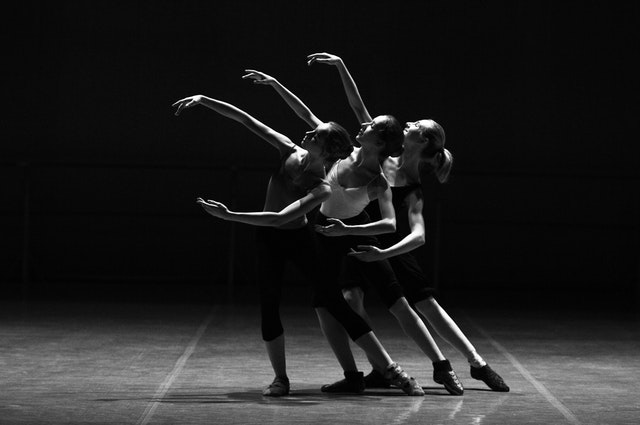
The dance world today is comprised of many dance styles. But whether you study hip-hop, contemporary, tap, or jazz, there is always something you can learn from a ballet class to incorporate into your other techniques.
Ballet technique is like taking your vitamins. Even if ballet is not your main focus, the practice of this fundamental style will surely supplement your dancing. It will help you maintain and improve your overall technique, coordination, body awareness, musicality, and more.
Terminology
Ballet is like the mother of all dance techniques. Most Western styles of dance today can be traced back to ballet and its codification has been extremely influential in all styles of dance.
Many dance techniques borrow from ballet’s French terminology. For example, the basic foot positions such as 1st position, 2nd position, etc., and words such as plié and tendu are used in most dance classes. Learning these basics in a ballet class and practicing them regularly will give you a greater understanding of the language used to describe technical movements in all kinds of dance. Additionally, other techniques outside of ballet will also codify their style, so it is important to understand the difference as well as the reference point.
Almost every style of dance will include pliés and tendues in their warm up. Other techniques, such as jazz or modern dance, will also borrow terms such as pirouettes or battements to describe turns or high kicks. However, the way in which they are done may differ between styles of dance.
Technique
Taking ballet class in addition to your other techniques will always give you a good base line of overall dance technique.
Ballet is linear; emphasizing form, extension, and lightness in the body. This can clearly translate well into certain styles of jazz dance and modern dance (such as Horton or Graham Technique).
However, other styles of dance, such as release technique, hip-hop, and others, will require you to throw out all of that ballet technique. But knowing these opposing techniques as a dancer will only enhance your movement quality, enabling you to become a more versatile dancer.
Ballet is also a structural technique that has a defined form and general class outline. When you work at the barre, you generally perform each exercise on the right and left side. The same is true for the rest of class—petit allegro, adagio, and grand allegro.
In other techniques, less time may be spent on balancing the coordination of both sides of the body, as more time may be spent on larger center combinations. However, this structure of balanced body integration is essential to being a well-rounded dancer. When you are working towards leveling out your flexibility, strength, and coordination of right and left sides in ballet class, you will be able to adapt to choreography in any discipline with ease.
Ballet dance is also a great way to train your musicality as a dancer. Musicality is your awareness of the music and rhythm while you dance. It goes beyond just staying on the beat of an eight count phrase; musicality emphasizes how you can accent the music accordingly through your specific movement. Musicality training will help improve your sense of tempo (i.e. whether something is fast or slow). It may also determine whether something is performed sharply or more fluidly depending on the rhythm or melody of the music. This will enhance your ability to understand different movement qualities in the body that may be asked of you outside of ballet.
Use Ballet To Improve Your Modern Dance Technique
So how can you use ballet to improve your skills in other dance techniques?
Take a ballet class at least 1-2 times per week if ballet is not your focus.
Become familiar with the terminology in ballet and recognize when it is used in other disciplines to describe a similar movement. Understand the differences between the techniques. For example, a ballet pirouette (turned out) versus a jazz pirouette (in parallel).
Use the class to notice imbalances between your right and left sides, and work to improve them.
Let your ballet class time be a time to work on your personal dance technique, without any of the embellishments from jazz or modern dance.
Train your body and mind to become familiar with ballet musicality. Classical music is the basis for much of today’s contemporary music just as ballet is the basis for much of Western dance forms. This basic musicality will help you adapt to more complex rhythms in other styles.
Ballet paves the way for success as a dancer since it is the backbone of many dance techniques. It keeps the body strong, supple, and agile. Ballet will help any other movements in other disciplines look clean, clear, and polished. Turns, jumps, leaps, extensions, and other moves will improve and look better in performance. Use ballet as a tool to become a stronger and more well-rounded dancer.
The United Film Festival Los Angeles will be returning to the City of Angels for its 7th year at the Los Feliz 3 from September 5th through the 11th. The festival will be screening great independent films, both features and shorts, and a midnight screening of their cult classic documentary, The Rock- afire Explosion.
Selections include:
Live-In Fear on Friday, September 5th at 9:30pm (In order to escape the anxieties and fears of their normal lives, four emotionally distant friends travel to the Utah mountains to try and reconnect but it only ends up driving them further apart. They soon find the world coming down on them as they must face their fears and a deranged cult hell-bent on waking something ancient and evil up from a thousand years of sleep.)
Chasing Notes on Saturday, September 6th at 7:00pm, (The first documentary of its kind – focusing on the real-life challenges and demands faced by film composers who apply their craft in an intensely competitive field. Broader than that, however, it captures the spirit of chasing one’s dreams, which is an aspect of life that everyone can relate to. This film will allow you to meet the personalities of those who write the music we love in our movies, showing you a human side of an overlooked industry. As you get to know the key players of film composing, and hear their widely entertaining (and at times painful) tales of experience, you will also witness the emotional journey of an emerging composer attempting to break through into the industry at all costs. Capturing the very essence of the independent spirit, Chasing Notes shares candid stories intertwined with behind-the- scenes access about what it’s really like to be a composer in Hollywood today, and how some will brake for nothing to succeed at it.)
Legend of the Red Reaper on Sunday, September 7th at 6:30pm (For a thousand years, the Reapers guarded mankind from the demons that wait in the dark. Now, at the beginning of a new age, the Reapers are betrayed and slaughtered. Only one Reaper remains – Red, and she’s out to exact revenge.)
Echoes on Tuesday, September 9th at 7:00pm (Struggling with horrifying, sleep-paralysis induced visions, a young writer retreats with her boyfriend to an isolated desert house. As the visions intensify, she finds herself on the verge of losing her mind…or uncovering a life-threatening secret.)
Furthest From The Wild on Wednesday, September 10th at 7:00pm (Chronicling the many struggles that non-profit animal sanctuaries must face, Furthest From the Wild is a window into the world of captive animals. It offers a unique look at the lives of those who care for beautiful, and at times, dangerous creatures.)
Jason Connell is the founder and director of the United Film Festival, which started in Tulsa in 2002 and then spread to Los Angeles & New York in 2007 and next to San Francisco, Chicago & London in 2009. The festivals have a rich tradition of screening exceptional independent films and have gained a respectable reputation in only a few years time. Connell’s distribution division, the appropriately named United Films, has grown rapidly and now represents an impressive and constantly expanding library of independent films.
There is hardly a month that goes by that someone doesn’t declare print journalism as ‘dead’, often using the medium to do so. While the industry has definitely changed dramatically over the past decade – for better or worse – there is still a place for those who wish to dedicate themselves to the written word.
The divisions between print, online and broadcast journalism have never been more blurry (many outlets use an amalgamation of all three) and a journalist these days may find him or herself shifting between the these different areas of expertise over the course of their career. But which discipline is more lucrative from a salary point of view – print or broadcast journalism?
Let’s take a look at the average salaries for the various roles in each sector.
Reporters and Correspondents – $44,360
The annual salary for reporters doesn’t vary dramatically between the different type of media, though radio and television correspondents can expect around $48k while those working in print are more likely to earn $40k (the bold figure above is an average across all sectors). However, if you can get into a job with a cable or subscription platform, the fee rises to a cool $53k.
Naturally, this all correlates neatly with how much competition is in each area – three times as many people work in newspaper reporting than in broadcast journalism. And, of course, national-level reporters and newscasters are able to command a fee way above national average.
Editors – $62,820
It’s important to note here that ‘editor’ is quite a nebulous word that encompasses a wide range of jobs, and this slightly throws off the average salary figure – the above includes things like periodicals, books, and political work.
So, instead, let’s focus on the specifics. Broadcast editors can expect $56k a year, but it’s those who work in newspaper editing that come up trumps here at $62k. That all said, there is even a lot of variance within those figures – the state in which you work can make as much as $20k difference to your salary. In addition, those in the top 10% of earners are on over $100k, while at the other end of the spectrum it can drop as low as $29k.
In short, averages don’t work here. The salary for editors really is job-specific.
Writers – $69,250
A cool $70k for writing work may sound like a dream come true, but again, the figure above is skewed by those working in motion pictures (as well as a few blockbuster novelists). The reality for those in print or broadcast journalism is slightly less impressive, but there isn’t much difference between the two – writers for radio and television average a $59k salary, while newspaper writers are on a slightly lower $52k.
AV Technician – $43,300
Needless to say, an audio visual technician role is specific to broadcast journalism. Many AV technicians work freelance, with the mean average wage being around $20 per hour.
This entry generally refers to low to mid level technical work, and excludes engineering roles such as sound engineering technicians who earn slightly more at $49,860.
Broadcast Technician – $38,920
Despite being a rather complex skillset, those who are responsible for all the equipment that gets the broadcast from a news team to a listener or viewer are generally paid a lot lower than other roles. The average salary does rise for those who land a job with cable and subscription programming, but only up to $47,650.
There doesn’t appear to be much variance between states, either; New York averages the highest at $54k, while Illinois is the lowest at $39k.
News Analyst – $84,710
Excluding becoming in the top 10% of reporters and correspondents – the famous kind that run their own national shows or whose writing sells newspapers by the thousands – being a news analyst is where the money is.
The difference between the print and broadcast fields are minimal; those in radio and television average $84,780 while print news analysts can expect to pull in $85,040. It should be noted, however, that job opportunities for those looking to work with a newspaper are few and far between (in fact, it’s reported that there are only 140 employees doing this in the entire country).
All figures from the Labor Bureau of Labor Statistics’ most recently released information (May 2013). References to ‘average’ refer to the mean average, unless otherwise noted.
Every now and then, stories can be found of rare video games cartridges — usually from now defunct companies, or parts of a tiny production line — appear from the blue on auction lines, garage sales, on eBay or in any number of improbable locations, from where they are snapped up by gaming fans for prodigious sums.
Some of these games have earned themselves an almost mythical status over the years, fetching prices of up to $40,000 a piece when they appear on the market even if their quality falls far short of modern-day video game design. For many gaming fans, the simple prestige attached to owning one of these immensely valuable cartridges is so great that reselling them – or sometimes even using them – is simply out of the question.
The publicity attached recently to some of these stories of rare games finally being tracked down and bought for these staggering sums has begun increasingly to shed light on some of the more intriguing stories of missing or exceedingly rare games cartridges. The 2010 sale of a rare game known as Stadium Events, produced by Bandai, for an astonishing $43,300 prompted widespread coverage of other exceptionally rare and valuable games.
It was around this time that increased attention was paid to an obscure cartridge called Air Raid.
Mystery Cartridge
The Air Raid game isn’t necessarily the most expensive rare game out there, but it’s arguably the most mysterious. An ancient Atari title, precious little is known about its origins. For instance, the name of the company is thought to be Men-A-vision, but there are those who distinctly remember it being known as Men-O-Vision… and so on. Even the name Air Raid is disputed, since the name only appears on a couple of boxes but not the cartridge itself.
The game seems to have first appeared around the year 1982, in a clear, bright blue cartridge of an unusual ‘T – Handle’ shape. This is more akin to cartridges sold in Brazil than America, its supposed country of origin (where cartridges were the traditional square shape at the time). Stranger still is that while only a handful of copies remain, we can’t find any record of more than 13 copies having ever existed. In addition, only three have been found with an original box, and only one is known to exist with the original instruction manual.
In fact, it is one of the boxed sets that is the star of this whole Holy Grail story, since its existence ended up making the man who owned it a rather sizeable sum of money.
The Big Sell
The name of that man is Tanner Sandlin. A resident of Austin, Texas, what sets Tanner apart from most collectors and owners of rare and valuable cartridges is the fact that he doesn’t actually consider himself a professional collector, or even a collector at all, of Atari 2600 games.
It was only from the press surrounding the Stadium Events sale mentioned earlier that Sandlin realized he had in his basement one of the rarest video games cartridges in history. After listing the Air Raid game cartridge on eBay and mentioning his possession of it on a popular Atari 2600 forum (AtariAge.com), the mysterious blue cartridge began to get a lot of attention.
However, on the eve of selling the cartridge for a good price, Sandlin pulled the game from the auction just before moving to complete a final balance transfer, realizing that he had the one thing that could propel his game into a whole new realm of fame – the original box. As is commonplace in the world of rare games selling, games with their original boxes sell for substantially more than the actual games themselves (and in some cases the box alone is worth more than the cartridge).
“Once I found the box, I knew that I was playing in a whole different league.” Sandlin said in an interview with Betanews. “But I knew I was going to need an expert to verify that the box was genuine.”
For this he recruited rare games specialist and AtariAge administrator Albert Yarusso, also based in Austin. After examining the cartridge, Yarusso declared to the forums and now intrigued media that the Air Raid game box and cartridge either the real thing – in which case it was undoubtably worth 5 figures – or an incredibly well produced hoax. The package was subsequently re-listed on eBay as a truly one of kind ‘Holy Grail’ cartridge…
…then promptly laden with derision as the listing was put up, unfortunately, on April Fools day.
Yarusso’s involvement then became a hindrance, since the enthusiast was known to play frequent pranks on the antique video game collecting world, and many were suspicious of this latest event. However, against all the odds the auction ended and the winner is confirmed to have paid $31,600. At the time it was the highest sale in cartridge history – technically the aforementioned Stadium Events topped it at $41,300, but the sale fell through after auction.
Some video games have fetched higher amounts since then, but the mysterious story and microscopic availability of the cartridge makes Air Raid the most alluring Holy Grail cartridges in antique games hunting…
… Not bad considering he only paid $5 for Air Raid back in the early eighties, and he used to laugh with his friends at how bad the actual gameplay was.
NYFA: What is your personal background and what made you interested in animation?
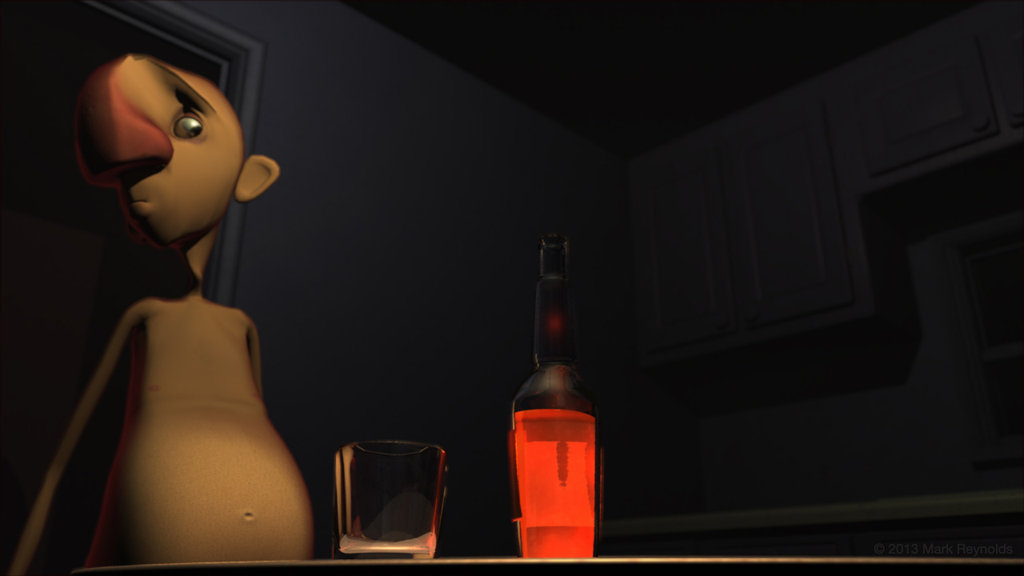
Mark Reynolds: My Previous Life was one spent dying a little every day in a stiflingly corporate environment and then racing home to apply what little energy had not been sucked from me to teaching myself computer animation.
While I had long been a fan of traditional animation, computer animation had grabbed my attention some time before when I saw Studio AKA’s stunning short, “Jojo in the Stars.”
I spent a few years trying to teach myself CG, and progressed very slowly due to the sheer scope of the undertaking.
One night, after spending seven hours plugged in creating a fairly simple animation, I realized that those had been the happiest seven hours of that week. It was time to resolve the disharmony between day job and night pursuits and plant myself in an immersive environment where I could truly learn CG effectively.
NYFA: You serve as a director of NYC’s SIGGRAPH chapter. Who should join the organization and why?
MR: NYC ACM SIGGRAPH is a great asset to New York’s CG community. SIGGRAPH unites the disparate fields of computer graphics: from the hardcore scientists who work under the hood and emerge with innovative technologies, to the artists who use them.
Local chapter events include various talks, presentations, and screenings. The annual Industry Spotlight allows some of the best and brightest NYC animation houses to give presentations on who they are and what they’re about. MetroCAF is an annual animation festival for regional students. And the monthly Bring Your Own Animation brings artists and aficionados together in a pub with a big TV so they can share their work while sharing a pint.
NYC ACM SIGGRAPH (I’m not shouting – those are acronyms!) offers many chances to meet new people who share your personal and professional interests, and to see new things you might not see elsewhere.
Many of the chapter’s events are open to non-members, as well. But membership gets you free or reduced admission to those events, as well as access to certain talks or site visits that might not be open to non-members of the chapter.
NYFA: What do you think is the most important skill for a professional animation artist to have?
MR: The ability to function without sleep for years, a unique eye, and a good knowledge of your tools.
Much of any computer animation project boils down to problem solving. Does your project need simulation of some sort (cloth, fluids, rigid bodies), or will straight-ahead animation do the trick? Do you even need to model something in 3D, or can you just composite it in 2D without anyone being able to tell the difference? How do I make that hairy banana look even more hairy…but still yellow…and smile?
There will be several ways to do any given task – be able to find one that works using the tools and techniques you know.
NYFA: What made you choose NYFA as your school of choice for your animation studies?
MR: I “did” college many years ago – decent school, decent GPA, decent degree (okay, English Lit, so that last part is up for debate).
Once I decided to return to school to learn computer animation, I originally did investigate going to a four-year school. But so much of the college experience is not one that needs to be relived by a gent in his, ahem, later thirties.
Going to NYFA, I emerged three years sooner and $100K less in debt. So even if I have to spend extra post-school time on my own continuing to beat my showreel into submission, that’s time that, were I in a four-year program, I would not yet be using for my showreel at all!
NYFA: You returned to NYFA as an instructor. How much was your experience as a student a part of that decision?
MR: It was a tremendous part. In department head Robert Appleton I found as much a mentor as a teacher. His love of teaching was infectious.
And I also enjoy helping guide new students to those moments where, all of the sudden, everything clicks; all the tedium and technicalities that are part of the process. And they see the magic, which they themselves created, happening on the screen.
NYFA: Do you find any difference between teaching adults and teaching teenagers?
MR: The teen animation program is essentially a summer camp and is a very charmed environment for working with teens. It doesn’t require an Edward James Olmos-with-a-baseball-bat approach.
So, with teens or adults in these situations, we’re dealing with people eager to learn this art. The main difference between the two would probably be that my own sense of humor is much more in line with a 14-year-old’s than an adult’s.
NYFA: Between being a board member of SIGGRAPH, doing freelance CG animation work, and being a CG animation instructor at NYFA, when do you find time to eat and sleep? Any time management tricks for busy students who are going to turn into busy professionals?
MR: Sleep? What a charming idea.
NYFA: Do you have any parting advice for aspiring animation and visual effects professionals?
MR: Animation, of any kind, is mind-numbingly tedious and mind-meltingly complicated; requiring insane amounts of time, dedication, attention, and love. It truly takes a somewhat damaged person to fall in love with the art of making things move one frame at a time.
That being said, that first moment that wad of pixels, or lump of clay, or scribble of ink comes alive for the first time and dances on the screen is absolute magic and can’t be beat.
NYFA: Would you mind giving us some background information and what drew you to the producing program at NYFA?
Dorottya Mathe: After working in the television industry for thirteen years in Hungary I wanted to challenge myself and was curious to find out what my knowledge was worth on the international market. As a foreigner with no connection in the American entertainment business at that time it was very appealing that NYFA’s producing course offered internships built into the curriculum. It was also paired with hands-on education offering an insight to all aspects of film production—besides producing—including screenwriting, directing, camera operating, editing, and even acting, which were completely new territories for me.
At the age of thirty-two, making quite a decent living in Hungary, I left behind everything and landed on US soil in 2007 with two suitcases and some savings. I was relentless and determined though I did not know that within a few years NY would be my new home.
Eight months later I graduated from NYFA with ten short films that I produced [including short fiction, music video, commercial, reality and documentary], one non-fiction film in production, switching between two internships, and trying to survive on a shoestring budget.
NYFA: You originally received your degree in economics; what inspired you to work in the entertainment/arts market?
DM: I started to work in the entertainment industry part-time almost right after high school at the age of 19—before having any degrees. I was in the audience of a huge entertainment show in Budapest and seeing the synchronized work of all the crew members and being attracted to the atmosphere of the TV studio I decided on the spot that this is where I want to work. A few months later I started college and [at the same time I] began to work part-time at that TV production company, which produced the above mentioned show. After graduation I stayed there as a full-time employee and left for New York literally from the office.
I have a degree in hotel management, event producing, tour guiding, and economics. I am using all the acquired knowledge combined in producing, since this profession requires a rather versatile skill set.
NYFA: What opportunities or career goals did you see as being obtainable in New York that inspired you to stay here after your studies?
DM: Due to the size of the market (Hungary’s entire population is only 1.5 million more than NYC’s) the opportunities in “The Big Apple” are truly endless. Regardless I had to realize that it does not necessarily make life easier. On the contrary, coming from a former communist country where even in my childhood I had to sit in the school straight, with my hands behind my back, always being told what to do it is overwhelming to have such a wide variety of choices. And there is no right way, no beaten track, you have to find what works for you. Every single day has its challenges though and it is like an aphrodisiac, which makes you move forward since you are attracted to the unknown. New York keeps you alert, it never allows you to fall into a routine, you always have to improve your skills, network endlessly and try to be a step ahead of others.
NYFA: What was the biggest challenge that you had to face?
DM: The biggest challenge for me was to leave my professional life behind and start from scratch as if I was freshly graduated with no financial stability only with years of work experience, which was not necessarily compatible with the job requirements here.
Of course, it is very liberating to know that I can always go home to Hungary and switch back to a “comfortable life” there—but that is my retirement plan.
NYFA: What lesson or lessons did you learn in the NYFA producing program that you continue to apply to your own work?
DM: The best advice I got was: “You will get many refusals before the first opportunity will arise, so regardless how many times you’ll hear ‘no’ for an answer you should keep believing in yourself and move forward. If you stick around long enough without giving up you will eventually succeed.” Well, sometimes “eventually” never seemed like it was coming, therefore I would mention three important qualities: patience, persistence, and perseverance. Looking for a job I was considered over-qualified and over-experienced in my field so I simplified my resume and cut back the years I had spent working in Hungary indicating only 2-3. When I got my first internship my biggest challenge was to pick up the phone and understand the LA accent, and the company’s clients constantly hung up since they did not understand my Hungarian-seasoned English accent and thought they had dialed the wrong number. Even though it was a great experience to understand how an entertainment company works on a day to day basis, after a couple of months I decided to switch to freelancing, which worked out much better for me. It allowed me to produce a wide variety of eclectic projects including music video, theatre, opera, art installation, documentary, etc. I enjoy taking on assignments that force me to step out my comfort zone, require me to get familiar with various aspects of producing, and learn new skills. I can work with different circle of people and expand my network, which is one of the crucial assets of a producer.
NYFA: Throughout the years, you’ve worked on a large number of art projects through An Films that have included the documentary Sing for Hope’s Pop-Up Pianos and you also work regularly with David Michalek on his slow motion video series. What are the different challenges you face working with arts institutions as opposed to production studios and companies focused on making feature films?
DM: Artwork fuels your heart but not your pocket. That is why I carefully chose what are the art projects that I am getting involved since it requires the same amount of work from a producer as any other film project—if not more due to the lack of finances.
I always preferred to watch independent movies from all over the world rather than blockbusters. I purposefully avoided getting involved in big budget studio productions. If that had been my goal I should have had gone right away to Los Angeles from Budapest instead of New York. I am a very hands-on producer who likes to know everyone on set and be involved in all aspect of the producing at all stages of the production both creatively and logistically. I found it very exciting and rewarding to see how an idea that only existed on paper ends up being on the screen and follow the transformation it goes through.
I regularly work with Brock Labrenz, the artistic director of New York based production company An Films. We are a great team, we share the same taste in choosing projects and our approach in executing tasks are very similar which makes the creative process really enjoyable. Our short documentary, Sing for Hope: Pop-Up Pianos is one of my favorite films that I have been involved as a producer. It is about New York City’s largest and most beloved public art project that takes place annually in the summer for two weeks. Namely almost 100 individually designed pianos are scattered all over the city—indoors and outdoors as well—reaching more than 2 million New Yorkers and making art available to all. It was fantastic to witness and capture the power of music as it brought together total strangers on the street creating an immediate community around the instrument. Regardless of their musical education, age, gender, ethnicity, nationality, or profession anyone could play the piano or embrace the moment by clapping, dancing, singing to the rhythm. For me that pulsation is what New York is about.
I truly enjoy the creative collaboration with director Paul Warner, who is also my colleague [and former acting instructor] at the New York Film Academy where I teach producing as part of the Documentary Faculty. I produced his project Women: The War Within, a multi-media dance-theatre-opera, which dramatized the parallel stories of four influential women in history. Throughout the production I was collaborating with a team of renowned artists—including Obie Award-winning librettist Matthew Maguire, internationally acclaimed choreographer Stephen Petronio, New York City Ballet’s premiere ballerina Wendy Whelan, Obie Award-winning actress Ching Valdes-Aran.
I often produce David Michalek’s high profile slow motion video portrait films such as Portraits in Dramatic Times that premiered at the Lincoln Center Festival in 2011 featuring Alan Rickman, William H. Macy, Liev Schrieber, Holly Hunter, Ludivine Sagnier etc. and Figure Studies that was commissioned by the Edinburgh Fringe Festival and recently the retrospective Dries Van Noten video series which is exhibited at the Louvre till August 31, 2014—unveiling the extensive work of the famous Belgian fashion designer. These projects gave me the opportunity to work with high-profile actors’ agents and managers and synchronize our production schedule with their clients’ limited availability. Maneuvering our rehearsals and shoots trying to squeeze them into the talents’ agenda was definitely a challenge.
NYFA: To follow up, you’ve worked on a number of documentaries focused on the work of individuals that have covered such a diverse gallery of people that includes Andy Kessler and The Fleshtones. Is there something in particular that drives you to the stories of the creatively successful and have you found something universal in these stories that you’ve been able to apply to your own life?
DM: I try to chose projects that are somehow related to New York or if I am fascinated by their character or if I pursue a collaboration with one of the creators or the director.
Grandmaster of 108 is a short documentary featuring veteran skateboarder Andy Kessler [44] that I produced with one of my classmates Nadia Jeronimo at NYFA. It was rather unusual to be a pro-skateboarder at his age therefore we wanted to find out what made him keep going especially that he barely had any bones that had not been broken before. Little did we know at that time, that years later the film would be very popular amongst his fans after Andy Kessler had died unexpectedly—oddly enough—due to an allergic reaction to a wasp sting. As it came out there were hardly any footage of him, so besides the skateboarding community his family was also very grateful to see our film.
I worked with director Geoffray Barbier on Pardon us For Living but the Graveyard is Full about The Fleshtones. He has been a huge fan of the garage rock band and followed their career since he was a teenager. As a co-producer it was exciting for me to get to know all the artists who were major players of NYC’s music and art scene in the 70s-80s. Especially The Fleshtones, who almost unprecedentedly have been playing together for nearly 35 years, still enjoying each others’ company, making their fans dance though still struggling to pay the bills.
NYFA: Any parting words of advice for aspiring producers and women looking to realize their career goals in producing?
DM: Do not change what makes you different in order to fit in, you should attempt to find your niche which makes you stand out. Living abroad for such a long time helped me to realize what makes me Hungarian and I try to use it for my advantage. We are all very lucky to do what we are passionate about and actually making a living of it and call it “work.” To be a producer is a lifelong learning curve, therefore in our attempt to excel in it we should not forget to enjoy the process!
NYFA: What are your professional plans for the future?
DM: Ideally, I would like to “create a bridge” between Budapest and New York and bring independent American films to Hungary and Hungarian productions to America. Voices of Change a Hungarian music video that was shot entirely in New York featuring the Harlem Gospel Choir—besides the Hungarian musicians—is a great example of this. I am also developing an American romantic-drama that will be shot in my native Budapest. This English speaking film will give me the opportunity to provide exposure for Hungarian talents abroad and to introduce contemporary Budapest to the foreign audience—not disguised as Berlin, Rome, Paris etc. but to reveal its real current beauty.
NYFA: Can you tell us a bit about yourself, your background, and what first got you interested in animation?
Elize Ohira: I have always been more “right-brained.” As a kid I would spend hours drawing little storyboard comics. When I was 17 years old I had my first fine art exhibition, where I gained some recognition and was able to sell two pieces.
I was born and raised in Brazil to a Japanese father and a Chinese mother. Cultural differences were a big part of my growing up, making me curious to learn more about them. I decided to come to the US for college and graduated from Boston University with a Bachelor of Science in Advertising.
I moved to New York City to work as a graphic designer and after three years I felt a need to expand my knowledge in the creative field. I have always loved animated movies and was always fascinated with visual effects, so studying 3D animation was the next step.
NYFA: You serve as a member of SIGGRAPH’s NYC chapter. Would you recommend that students join the organization while still in school? If so, why?
It brings the NYC-area professionals, educators, students, and organizations together through a variety of events. It’s a great way of networking and getting involved in our growing animation community.
One of the events that I benefited from as a student, and am still benefiting as a professional, is called BYOA (Bring Your Own Animation). BYOA happens every month, encouraging CG artists to show their work, whether it’s in progress or finished. It’s a great way of getting used to talking about your work, learning to accept criticism, and seeing what other artists are working on.
NYFA: How has living in five different cities around the world impacted your outlook on life, and how has it influenced your artistic side?
EO: Living in different cities around the world requires change, and change fuels creativity. Experiencing and learning to adapt to multiple cultures widens the perspective you have on yourself, on others, and the many creative possibilities.
NYFA: Having studied and worked in several different countries, are there cultural differences that dictate an artist’s job? Or are the skills and knowledge more or less universally applicable?
EO: Ambition and perseverance are what dictate an artist’s job. Having worldwide experience opens your mind and sharpens your artistic eye.
NYFA: What role did your time at the NYFA animation program play in establishing your career?
EO: Some of the greatest professionals in the field teach NYFA’s animation program. They guide you in the right direction, and help you grow as a professional. Don’t be scared to ask them questions, they are like eyes to the blind.
NYFA: What made you choose the New York Film Academy for your studies?
EO: NYFA offered a hands-on, intensive 1-year program that covered all the areas I was interested in learning in animation, and more!
One of the most exciting experiences was working with a motion capture studio. It gave us the opportunity to learn about the different mocap systems out there, and how to integrate that in our pipeline.
NYFA: Is there anything that is particularly memorable from your time at NYFA?
EO: I will never forget the all-nighters I spent rendering out my final project in the 3D animation room at Union Square. There was a lot of laughter, but also a lot of despair. You work crazy hours, but you still have fun because you are doing something you are passionate about.
NYFA: Is there anything you wish you would have known before beginning your studies?
EO: That your computer becomes your new best friend. You spend days and nights with it, and all your money on it.
NYFA: What is your ultimate career goal?
EO: Making the next Disney animated movie. I have always loved Disney movies, so working for the Walt Disney Animation Studios would be a dream come true.
NYFA: Any parting words of advice for aspiring animation pros?
EO: Be patient, don’t give up, and a smile goes a long way.
In the spotlight is a unique festival that is truly a one of a kind that focuses on empowering women filmmakers, producers, writers, and talent. This diverse festival screens films, documentaries, commercials, shorts, music videos and screenplays that are created “by women for everyone” as entertainment. This festival is not a conglomerate or big business venture but one woman’s vision to make a difference and increase the ability for women creating entertainment to get a head and be seen.
The upcoming deadlines are Aug 16th and Aug 23rd for this year’s festival.
LA Femme now has a first look distribution partner which LA Femme successfully paired over six of our filmmakers with distribution for their films screening at the 2013 festival. This distribution relationship is exciting since all our films are screened by our distribution partner annually. So, distribution is open to all those selected to screen not just the winners of the festival.
What sets this festival apart are its amazing sprit with unprecedented panels with experts in all avenues of the entertainment fields in getting films made, sold, and distributed. LA Femme uses a select handful of entertainment experts that actually inspire while giving filmmakers the reality of today’s entrainment pitfalls. This is where the female indie filmmaker scene shines and is the only festival of its kind in sprit, content, and distribution opportunities for the woman filmmaker.
The festival has networking parties every night with a gala closing night ceremony for the attendees, honorees and winners where filmmakers, entertainment professionals, distribution executives and celebrities mix and mingle all festival long.
Some of the following award winners at the festival have gone on to received distribution: Green Street Hooligans directed by Lexi Alexander (2000 screens nationwide, international distribution),The Colt, Directed by Yelena Lanskaya ( Hallmark), Draco y el Teatro, directed by Angela Alvarado (MTV music Video) just to name a few.
At LA Femme, we proudly celebrate all the contributions to entertainment by leading female directors, producers, writers and performers in the entertainment industry. In recent years we have honored such outstanding individuals as Angela Bassett, Virginia Madsen, Vivica A. Fox, Lorraine Toussaint, Tippi Hedren, Susan Seidelman, Penelope Spheeris, Jacqueline Bisset and Sally Kirkland, among others.
This is New York Film Academy students’ chance to become supportive and creative LA Femme Alumni and join the forces of the women making a difference in entertainment!
Plus, Bonus discount for NYFA students submitting a short or feature.
(THESE DISCOUNTS ARE GOOD UNTIL AUGUST 16, 2014 FOR SUBMISSION OF FILMS)
In the history of musical theatre, more than a few odd characters have been chosen as the topic for a stage play. Many of them — including the Boy George, Ted Roosevelt, and Bonnie & Clyde musicals — flopped into obscurity, whereas a few subjects went on to roaring critical and commercial success (think Jerry Springer among others).
Add controversial Canadian politician Rob Ford to this list. Whether this is a good idea or not remains to be seen, but we’ll find out soon as he’s set to get the musical treatment.
Aside from being the Mayor of Toronto, most will recognize Ford’s name for the crack cocaine scandal that hit the headlines earlier in the year. Ford initially denied having used the drug until indisputable video proof emerged among press circles. Although the controversy surrounding that incident reached global news levels, it was only one in a long line of substance abuse debacles which have followed a similar pattern of denial followed by a public apology in the face of evidence.
Such extreme behavior — as well as the failure of attempts to remove him from office — have attracted the eye of not just one, but two different writers who have chosen Ford as the subject of their musicals.
Rob Ford The Musical: The Birth of a Ford Nation
Open auditions were held last week for an upcoming musical charting the highs and lows of Mayor Ford’s scandal-laden career, due for a short run at the Factory Theatre in Toronto between Sept. 16 and Sept. 28.
Written by Brett McCaig, the open casting call attracting hundreds of potential actors keen to fill the politician’s rather large shoes for the musical adaptation. Having teamed up with lyricist Joseph Regan and composer Anthony Bastianon, the writing itself has taken an entire year but is now reportedly complete. Not surprisingly, numerous drafts of the play were written as Ford’s public and private life became increasingly erratic.
McCaig himself hasn’t ruled out having to revise the musical’s conclusion pending any further controversies that may arise over the next few months.
The story itself will contain multiple characters and as many as ten original songs, but other than knowing the music will cover a number of different genres (including a few ballads), we’ll have to wait until September to get a better idea of how the Rob Ford musical will sound…
… or will we?
15 Year Old Writes Rob Ford Concept Album
If you want an idea of how the Rob Ford musical might sound, you can thank a high school student in Toronto who had a similar idea (albeit independently from McCaig) as Ford’s meltdown unfolded last year.
Unlike McCaig’s upcoming musical, Mateo Lewis is yet to write a play much yet organize a fully-fledged production, but he has already managed to get all of the songs written and recorded. Even better, he has uploaded all of the 18 tracks to Youtube for all and sundry to freely enjoy:
Including songs such as Victory Speech, Conflict of Interest and the sublimely titled Rob F**kin’ Ford, the 40 minutes of music chronicles a lot of the defining moments of Rob Ford’s life and career to date.
At this stage, Lewis has been keen to point out that it’s strictly in the ‘concept album’ phase and he isn’t sure if the songs will ever make it into a wider production (especially given that McCaig’s version of the Rob Ford musical has since been announced).
Regardless, Lewis is continuing his musical theatre studies at the Etobicoke School of the Arts and is due to begin grade 10 after the Summer – with a full musical concept album already under his belt at such an early stage in his career, we can expect great things to follow.
Manage Cookie Consent
This website uses cookies to improve user experience. By using our website, you consent to all cookies in accordance with our Cookie Policy.
Functional
Always active
The technical storage or access is strictly necessary for the legitimate purpose of enabling the use of a specific service explicitly requested by the subscriber or user, or for the sole purpose of carrying out the transmission of a communication over an electronic communications network.
Preferences
The technical storage or access is necessary for the legitimate purpose of storing preferences that are not requested by the subscriber or user.
Statistics
The technical storage or access that is used exclusively for statistical purposes.The technical storage or access that is used exclusively for anonymous statistical purposes. Without a subpoena, voluntary compliance on the part of your Internet Service Provider, or additional records from a third party, information stored or retrieved for this purpose alone cannot usually be used to identify you.
Marketing
The technical storage or access is required to create user profiles to send advertising, or to track the user on a website or across several websites for similar marketing purposes.
To provide the best experiences, we use technologies like cookies to store and/or access device information. Consenting to these technologies will allow us to process data such as browsing behavior or unique IDs on this site. Not consenting or withdrawing consent, may adversely affect certain features and functions.
Functional
Always active
The technical storage or access is strictly necessary for the legitimate purpose of enabling the use of a specific service explicitly requested by the subscriber or user, or for the sole purpose of carrying out the transmission of a communication over an electronic communications network.
Preferences
The technical storage or access is necessary for the legitimate purpose of storing preferences that are not requested by the subscriber or user.
Statistics
The technical storage or access that is used exclusively for statistical purposes.The technical storage or access that is used exclusively for anonymous statistical purposes. Without a subpoena, voluntary compliance on the part of your Internet Service Provider, or additional records from a third party, information stored or retrieved for this purpose alone cannot usually be used to identify you.
Marketing
The technical storage or access is required to create user profiles to send advertising, or to track the user on a website or across several websites for similar marketing purposes.