Directors Essentials: 6 Unmissable Danny Boyle Classics

Question: Is there anything Danny Boyle can’t do?

Answer: Nope. Not a thing.

Sure, there may be a couple of misfires in his back catalog (we don’t talk about The Beach), but for the most part the British director’s success rate is as unparalleled as it is varied.

Trying to typify his career is like nailing jell-o to a wall, so today we continue our Director’s Essentials series by picking out the individual highlights of two decades of cinematic gold. With his recently released Steve Jobs biopic looking set to be another winner, it’s a good opportunity to cast our eye back on…
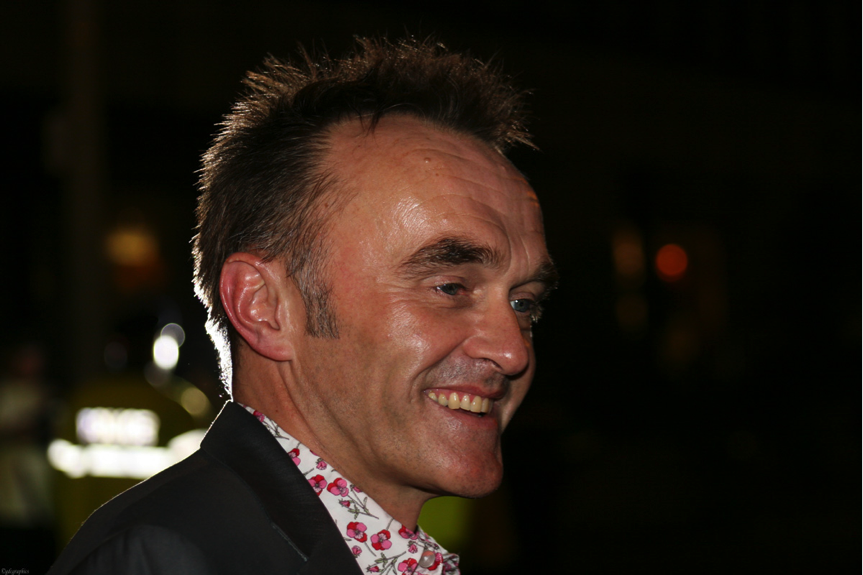
Danny Boyle

Trainspotting (1996)

In 1995, Danny Boyle hit the ground running with Shallow Grave, a powerhouse of a debut directorial effort which also saw Ewan McGregor in his first ever feature role.

The very next year, the duo worked once again to give Irvine Welsh’s novel Trainspotting the big screen treatment despite it being difficult to translate. What emerged was a gritty, brutal and pop culture-fuelled exploration into addiction and one of the finest British movie ever made.

Must Watch If: You loved Pulp Fiction and want to see it set in Edinburgh.

28 Days Later (2005)

One of the best zombie movies to have emerged in the last decade’s pervasive fascination with the genre (yes, yes, we know they’re not technically zombies. Let’s not go there.)

28 Days Later practically kickstarted the trend single-handedly, and hasn’t really been surpassed in terms of the originality it offered in a land of worn-out tropes. Boyle later returned to produce (although not direct) the sequel 28 Weeks Later, which wasn’t too far behind the brilliance of the original.

Must Watch If: You’re tired of movies that put zombies first and tight scriptwriting second.

Millions (2005)

In an incredible display of what would come to be known as Boyle’s trademark versatility, the director went from a harrowing tale of a crumbling civilization to this utterly charming kid’s movie.

Swamped in magic realism, this heinously underwatched children’s fable shows that Boyle has a lot of heart and knows where to apply it, regardless of the genre.

Must Watch If: You’re after a feel-good film about consumerism that doesn’t ever get preachy.

Sunshine (2007)

A genre-defining zombie movie. An expertly crafted kid’s film. What could Danny Boyle turn his hand to next?

Ah, yes. Science fiction.

Stunning visuals, a slew of remarkable set pieces, and a lot of clever directing on the part of Boyle in his second collaboration with Cillian Murphy. Every moment of the Icarus II’s journey to the sun in order to reignite the failing star is engrossing and filled with suspense along the way…

… Just ignore the slightly abrupt diversion into the slasher genre that this otherwise excellent sci-fi flick descends into for the third act.

Must Watch If: You want to see a cerebral Armageddon.

Slumdog Millionaire (2008)

Continuing on with the feast of unexpected surprises that is Danny Boyle’s filmography, we come to his highest grossing movie to date (and also the biggest earner in Fox Searchlight Pictures’ history.) Grossing over $377 million worldwide against a budget of just $15 million, it’s funny to think that executives were initially skeptical about Slumdog Millionaire and pushed for it going straight to DVD.

And on paper, it probably shouldn’t have ever worked. In the hands of Boyle, however, it was a masterpiece that worked marvelously across cultures.

Must Watch If: You never thought a working class kid from Manchester, UK could successfully craft a Bollywood-inspired movie that people in America would want to see.

127 Hours (2009)

They said Aron Ralston’s story would never work as a film, principally because it would involve just a single person acting in isolation and not being able to move anywhere for 90% of the movie.

But Danny Boyle, as he is wont to do, found a way to make the impossible not only possible, but damn near perfect. Not an easy watch, but an unmissable one nonetheless.

Must Watch If: You enjoy watching someone saw off their own arm with a pen knife. Who doesn’t, right?

Enjoy this? Try another entry in the Director’s Essentials series:

The Coen Brothers
Wes Craven
Kathryn Bigelow

[su_note]Learn more about the Film School at the New York Film Academy by clicking here.[/su_note]


Why We’re Excited About The Game Awards 2015

The Game Awards 2015

Almost one year ago we talked about how Geoff Keighley’s first Game Awards show was a long-awaited taste of how an annual awards ceremony should go. While there were still a few kinks we’d like to see gone at this year’s show, it was still an impressive leap forward from what the highly-criticized Spike Video Game Awards had become.

Instead of odd celebrity appearances and awkward jokes aimed at Spike’s primary demographic, we saw an appropriate honoring of not just games and developers but the industry as a whole.

On December 3, Keighley and his crew will hopefully prove that 2014’s show wasn’t a fluke by once again producing a solid and entertaining event. Below are some of things we’re most excited to see at the anticipated Game Awards 2015.

World Premiers, Teasers, & Announcements

After last year’s show, Keighley admitted that he would have liked to give more attention to awards as opposed to world premieres. While it makes sense since it is an awards ceremony, we don’t mind seeing more exciting reveals and info. Last year we got teasers and release dates for a number of titles, including Tacoma, The Banner Saga 2, Codename STEAM, and more.

For The Game Awards 2015, Keighley announced via tweet that there would be 10 world premieres along with 10 on-stage awards. While “world premiere” can mean a new trailer for a project we already know is in the works, it’s still exciting nonetheless to see more of our most anticipated games.

The Spotlight On Indie Games

As with every year, some of the top-selling and arguably best titles happen to fall in the big-budget category. Simply put, worlds like in The Witch 3 and Fallout 4 aren’t feasible with a small team. That’s why we’re excited to see our favorite triple-A titles receive well-deserved awards this year.

At the same time, it was very satisfying to see 2014’s show give independent games some attention. Indie titles like Tacoma, No Man’s Sky, and The Banner Saga 2 received plenty of minutes to show us what their small, passionate teams are cooking up for us next. This is a direct contrast to previous game awards shows that focused entirely on the big titles and rarely mentioning the small projects we enjoyed throughout the year.

There’s also good variety among the nominees for Best Independent Game. They include Axiom Verge, Her Story, Ori and the Blind Forest, Rocket League, and Undertale. RPG, Metroidvania, platformers, an interactive movie game, and even a soccer/vehicle game are being represented.

The Musical Performances

One of last year’s most memorable moments began with Nintendo’s Reggie Fils-Aimé introducing Imagine Dragons, who played an amazing rendition of classic Zelda tunes. About a minute in, the legendary Koji Kondo joined in by playing “Song of Healing” from Majora’s Mask on piano. Together, they no doubt put a tear in the eyes of everyone who has ever fallen in love with a Zelda game.

This year we’ll be getting something different in the form of Scottish electronic band CHVRCHES and progressive-house deadmau5. It’s exciting to wonder how these popular musicians will involve some of video game’s most iconic tunes into their own style.

The Honoring Of Industry Icons

One thing that has been sorely missing in Spike TV’s awards ceremonies was the honoring of our industry’s greatest developers. While we should thank all the artists, designers, programmers and more that help build great games, there are people who have made a bigger impact and deserve recognition for it. The only time Spike did this was with their one and only Video Game Hall of Fame award given to the well-deserved Shigeru Miyamoto in 2011. For whatever reason, the award was tossed out for the new VGX format.

We can only hope that what we saw at the Game Awards 2014 wasn’t scrapped as well. The honoring of Sierra On-Line’s Ken and Roberta Williams, the creators of the influential King’s Quest games, was a very touching moment that we’d love to see repeated for other deserving individuals in the gaming industry.

The recipients of this year’s Industry Icon Award will be Brett Sperry and Louis Castle. They are the co-founders of the late Westwood Studios, an American video game developer responsible for the highly successful Command & Conquer series. Having put real-time strategy games on the map back in the 90s, everyone who is a fan of the genre owes a deal of thanks to Brett, Louis, and everyone who ever worked at Westwood.

The Awards Themselves

No matter what kind of games you like, at least one of your well-received favorites is probably a nominee. That’s because this year’s show boasts 10 categories where all the nominees were selected by a jury of 30 media professionals from nearly a dozen countries. This includes people from Game Informer, Famitsu, GamesRadar, USA Today, LEVELUP, and more.

There are also six Fan’s Choice categories: Esports Game of the Year, Best Fan Creation, Trending Gamer, Esports Team of the Year, Esports Player of the Year, and Most Anticipated Game. The nominees were chosen by an advisory panel of eSports sites and media.

As with most years, the competition is very hot— especially for the Game of the Year category. With nominees like Bloodborne, Fallout 4, Metal Gear Solid V: The Phantom Pain, Super Mario Maker, and The Witcher 3: Wild Hunt, there’s no telling which of these fantastic titles will take home the award.

Geoff Keighley

From serving as host for GameTrailers TV and G4tv.com to writing for websites like Kotaku and GameFly, Keighley has had a presence in the video game industry for a while now. In fact, he was also the executive producer of the Spike Video Game Awards. Perhaps realizing that gamers deserve better, he decided to do his own thing with The Game Awards. This is what he had to say about last year’s show:

“I was really happy with how things turned out. Certainly the audience numbers were well beyond my wildest dreams, and creatively I’m proud of what we put on the screen. “I didn’t make money on the show, but I always knew it would be an investment,” he said. “If I’m going to invest in anything it’s going to be to support the industry which has given me my whole career.”

The Game Awards’ producer and host demonstrated a genuine appreciation for video games by going through the trouble of putting on a big show despite knowing he wouldn’t receive a cent. Instead of using it as a way to boost viewership numbers like Spike no doubt had him do, Keighley and his team simply wanted to give the gaming industry an awards ceremony that they can look forward to each year and be proud of.

He also went on to say that “moments like the tribute to Ken and Roberta Williams and the Koji Kondo/Imagine Dragons performance were once in a lifetime experiences.” Even if you dislike him as a host, every gamer should be happy to have someone who at least seems to care about video games as more than a cash-grab.

[su_note]Learn the skills you need to succeed as a game designer at the Game Design School at the New York Film Academy by clicking here.[/su_note]

Photography Tips on Working With Water

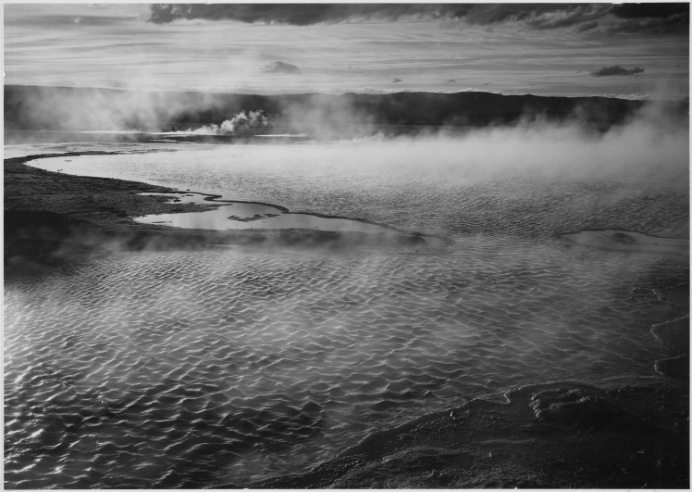
Working with water poses a lot of unique challenges when it comes to photography, but it also brings with it plenty of rewards.

Ansel Adams picture of water

Some of the most compelling images ever committed to film have used water as a central feature (see Ansel Adams, for instance), so today we’re going to cover how best to shoot that good ol’ H20. And be sure to check out our guides on shooting photos in extreme temperatures and photographing landscapes.

That Silky Look

Found yourself an awesome stream or even a waterfall that’s just brimming with motion, waiting to be captured? You might want to try an age-old technique that will get the best out of all that action.

silky smooth photography

That silky-smooth look to the water above is achieved by setting a very slow shutter speed; try it out with a shutter speed of between 2 and 8 seconds to replicate this effect on fast-moving water. Anything longer than this will probably result in a total blur (given that the water is moving rapidly), but either way you’ll need a tripod in order to stabilize the camera at this level of exposure (and drop the aperture down to around f/16 for a good depth of field which compensates for the slow shutter speed.)

You may need to tweak the numbers on a shot-by-shot basis (especially with balancing the ISO and aperture size depending on how bright it is), but once you get it right, it’s well worth the effort to achieve this really magical effect.

Don’t Forget Your Polarized Filters

An absolute essential when shooting water given that wet rocks (and the water itself) has the nasty habit of reflecting glare straight at your lens. It’ll also help get ‘behind’ the reflections and reveal the hidden textures and colors going on underneath the surface, whereas without a polarizing filter you’ll just get a rather flat surface to the water.

polarized filters

It’s also a very quick way of increasing color saturation and contrast, which is great for shooting bodies of water surrounded by a lot of lush greenery and colorful flora.

Get to Know Your ND Filter

Another highly useful type of filter that will serve you well is the neutral density filter.

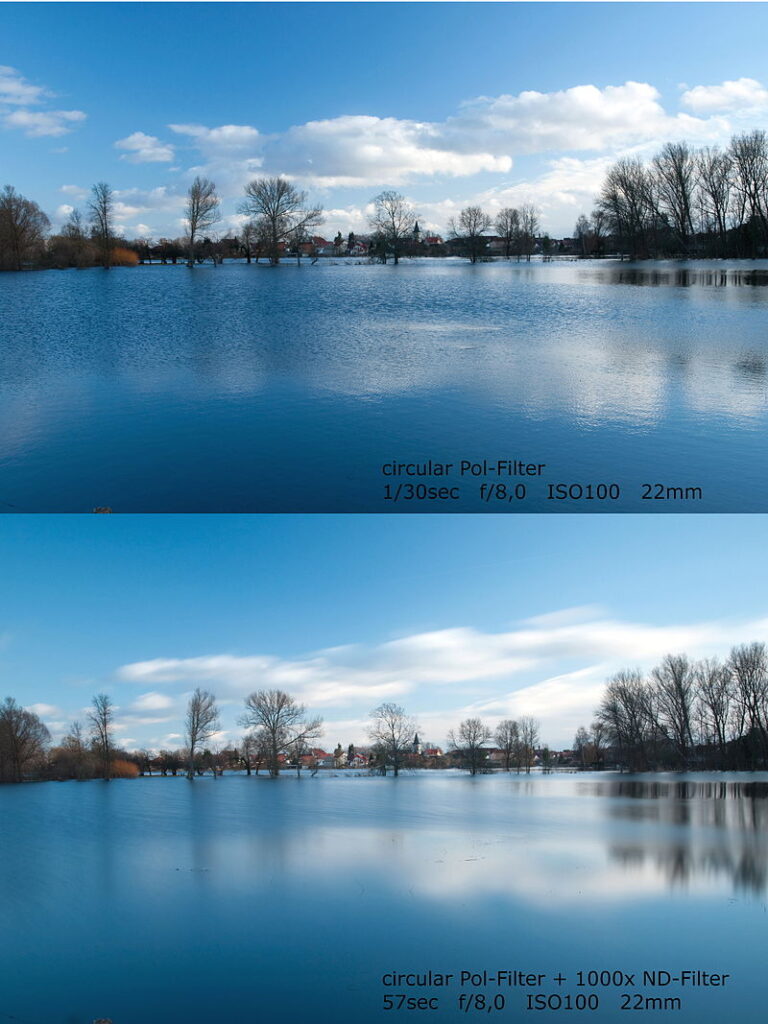
In brief, an ND filter is a gray filter that reduces the intensity of color evenly across all wavelengths without changing the color hues themselves. The reason this is useful in water photography is that when working with slow shutter speeds in bright environments, you can expect to spend a lot of time trying to correct for overexposure.

ND filter in water photography

An ND filter takes a lot of the headache out of this, allowing you to shoot at longer exposures and with wider apertures without blowing out the sensor.

Get Wet… And Stay Safe

To get the very best shots, you’ll often need to get right in the middle of them.

In short, expect to get very, very wet.

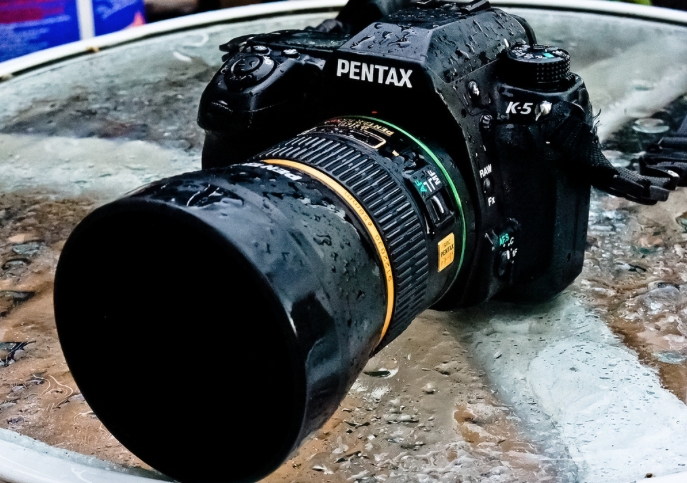
It almost goes without saying that you probably don’t want to treat your $1,500 camera to a swim in a lake, except plenty of photographers fall foul of this by putting all their faith in the matra of “I’ll just be really careful.”

water-logged camera

It only takes a wrong foot on an algae-covered stone to send you and your kit deeper than you were hoping for. So, waterproof kitbags are a must (as are waders to keep yourself as bone dry as possible.)

[su_note]Eager to go on your own photography adventure? Students enrolled in the degree and conservatory programs at NYFA’s Photography School get to go on a one-week photography expedition as part of their coursework. Learn more by clicking here.[/su_note]

4K UHD TV: How To Prepare For The New Standard

4K comparison chart

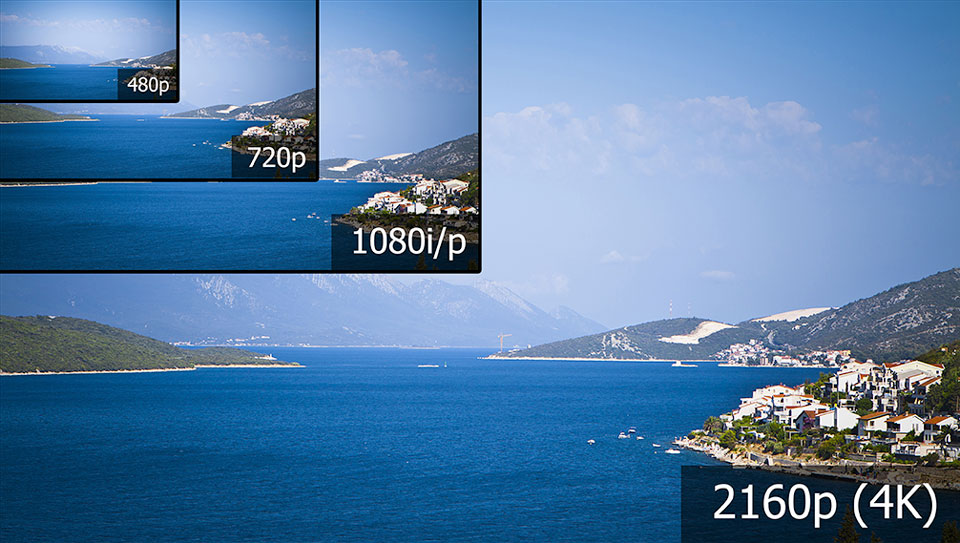
The latest HD television technology is called 4K, or Ultra High Definition (UHD), sometimes also called 4K UHD. Previously, there were three ways to describe definition in TV: Standard Definition (480p/540p), High Definition (720p), and Full High Definition (1080i/p). By contrast, UHD is 2160p. Each UHD TV has a minimum resolution of 3,840 pixels wide by 2,160 pixels high. Essentially, a UHD TV has about 8 million more pixels than a 1,080p HD television.

More Pixels, More Problems?

While more pixels result in a better picture, most broadcasters and streaming services have not yet converted. Why? Because 4K video takes up much more space on a hard drive, and streaming it eats up a large amount of bandwidth—in fact, people who wish to stream 4K content like House of Cards on Netflix will need a 25mbps download speed that many viewers don’t currently have. While there has been talk of broadcasting the 2016 Olympic Games in UHD, the current options for true UHD content are limited to some content on a few streaming services, mainly Netflix and Amazon.

Is Upconverting The Answer?

Despite the limited programming currently available for UHD, 4K televisions are still flying off the shelves. While there will be more shows available in the future, another selling point is “upconverting”—changing an HD 1080p signal, for example, into a 4K image. This is done by using additional pixels to recreate the fewer-pixeled original image. To do this, the television guesses at what should go in those extra pixels; often the result is an image slightly sharper than 1080p, but still softer than true 4K UHD. So while upconverting results in a good picture, and possibly a better picture than you would have had with regular HD, most people won’t reap the full benefits of their new 4K sets until they watch UHD programming.

What Does This Mean To My Future Journalism Career?

When you graduate and begin working in the field of broadcast journalism, presumably some time in the next few years, you may work for a broadcaster that is making the switch to 4K UHD. If not, it’s likely your employer will do so eventually. In the meantime, UHD TVs and cable/satellite providers will be upconverting your video.

So I Should Get Ready for My 2160p Closeup?

Yes, but not just you. Remember that everything shot in 4K and, to a lesser extent, upconverted to it, will be seen in greater detail. If you currently intern at a TV station, some of the journalists you work with might remember the transition from standard definition to HD several years ago. At that time, many on-air reporters and anchors were advised to rethink their makeup strategies. Some stations even hired skincare experts to advise on-air talent how to improve their look in HD.

While you don’t need to do anything that extreme, you should be prepared for a very sharp picture if you plan to work on-air. When shooting video for class, experiment with closeup shots in different angles and lighting situations, so you can get an idea of how you look your best. You can also try different kinds or amounts of makeup. If you can borrow a 4K UHD camera, you’ll have an even better idea of how things look in the new medium.

Practicing Recording Video in 4K

Shooting video in UHD (if you have the opportunity) is a good idea even if you don’t plan to be in front of the camera yourself. Future photographers and editors will need to know what works and what doesn’t when shooting in 4K. A few years from now, you might be capturing video both indoors outdoors, at varying times of day or night, in varying weather conditions. You’ll need to use the right lighting techniques and camera angles to capture images for UHD. Remember that too-harsh lighting, combined with too many pixels, can result in an image that’s either too blurry to see clearly or downright blinding to view.

If you don’t have access to a UHD camera, see if your school has a 4K TV where you can stream UHD, so you can see examples of video shot in 2160p. Also check your phone, or your friends’ phones—many new cell phones can now shoot 4K video. While most phone cameras won’t have half the features of a dedicated video camera, you may get some ideas about shooting in UHD.

Don’t Forget To Prepare For Space/Bandwidth Constraints

Remember that whether you take video with a dedicated video camera or a cell phone, you’ll need a decent amount of storage space for any video longer than a few minutes. Because UHD uses so many pixels, it uses a lot more storage space than HD. If you can shoot in 4K, consider investing in a larger memory card than what you have currently.

Also be prepared for slow upload/download speeds when working with UHD in a future broadcast journalism job. Hopefully this will improve as internet speeds become faster. However, after graduating, you may work at a station that’s still improving its technology for 4K or waiting for its ISP to offer higher speeds. This might mean that you’re asked to upload only a few minutes of video at a time, instead of sending back fifteen minutes of cover video for the producer to pick through. You may also be required to do more editing in the field so you can just send back the final 30- or 60-second package.

[su_note]Learn more about the School of Broadcast Journalism at the New York Film Academy by clicking here.[/su_note]

5 Performances By Child Actors That Every Actor Can Learn From

Child actor

Sometimes good things come in small packages, both in terms of gifts and art. In the case of these five examples, a great performance came from a young actor. There is something special about a child acting. They have such active imaginations that they are able to live naturally under imaginary circumstances with far less effort than their adult counterparts. In the performances that follow, these kids were acting alongside established Hollywood stars and Academy Award-winners and holding their own on the screen. Here are five child actors who turned in performances that every actor can learn from.

1. Jodie Foster – Taxi Driver

Jodie Foster has had a long and successful career in Hollywood and it all started back in 1976 with her breakout role in Taxi Driver. Foster was only 14 years old when she played a child prostitute opposite Robert De Niro but she definitely holds her own. The vulnerability and disconnect that the young Jodie Foster brought to the character of Iris is tragic and uncomfortable to watch at times. She was recognized with an Academy Award nomination for Best Supporting Actress for her efforts.

2. MacCauley Culkin – Home Alone

Home Alone is both a holiday classic and a hilariously campy film, but underneath the charm, MacCauley Culkin delivers a devilishly good performance. Culkin plays Kevin, a young boy who is accidently left behind by his family, with gusto. He is at once funny, cute, and wildly intelligent for his age. There is a great montage of Kevin enjoying his newfound independence but the real comedy and drama is saved for the closing thirty minutes in which Kevin evades would be thieves.

3. Haley Joel Osment – The Sixth Sense

This movie is famous for bringing audiences the most quotable quote of the last few decades: “I see dead people.” Not coincidently, the quote was delivered by Haley Joel Osment, whose honesty and fear made the moment memorable. As a troubled boy with supernatural powers, Osment is eerie and chilling, yet sympathetic, a hard balance to strike for any performer. Watch to the end for an all-time twist.

4. Dakota Fanning – I Am Sam

At only seven years old, Fanning starred opposite Sean Penn in the heartbreaking film I Am Sam. Penn is a mentally challenged man struggling to raise his daughter and Fanning is just beginning to realize her situation. Despite her growing intelligence and her father’s inability to manage both of their lives, Fanning’s character is loyal and loving toward her father to the end. Fanning herself is bright and cheerful with an emotional depth that earned her a SAG nod. No small feat for a seven-year old.

5. Quvenzhané Wallis — Beasts of the Southern Wild

At NYFA, we always recommend that actors study the craft of acting before embarking on a professional career, but Wallis didn’t take our advice. At 6 years of age, Quvenzhané made her screen debut as Hushpuppy in the magical fantasy Beasts of the Southern Wild. Wallis is composed and commanding in her performance as the lost girl in search of her mother and acting didn’t go unnoticed. At the 2013 Academy Awards, Quvenzhané Wallis became the youngest Best Actress nominee in history. She was nine years old at the time of her nomination.

Actors old and young can learn from each other. Technique develops with experience but there is something to be said for an active imagination and intuitiveness of camera. Next time you tackle a role, bring out your inner kid for a natural and inspiring performance.

Stanislavski In 7 Steps: Better Understanding Stanisklavski’s 7 Questions

Konstatin Stanislavsky

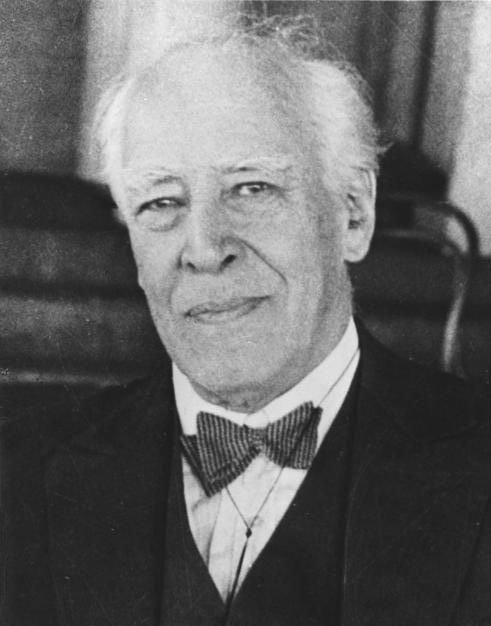
There are so many different acting techniques and books and teachers that finding a process that works for you can be confusing. Ironically, most acting books and teachers use similar principles as basis of their pedagogy; Stanislavski’s system. This is because Constatin Stanislavski is considered the father of modern acting and every acting technique created in the modern era was influenced by “Father Stan.” For young actors, understanding of Stanislavski’s seven questions is an invaluable foundation upon which to build a character.

1. Who am I?

Start with the basics and then fill in the gaps with your imagination. Pick apart the script to find out what type of person your character is; what they look like, what they believe, how others describe them and so on. Think about your character’s past and the significant events/people that influenced them and made them who they are in the script.

2. Where am I?

The script will usually tell you where you are but the important thing for an actor is to consider how the character feels about the place they are in. Characters act differently in public than they do in private. People move differently when they are cold vs. when they are too hot. The space your character occupies can determine how they behave during a scene.

3. What time is it?

Year, season, month, day, and time of day should all be described. Then, think about how the specific time of the play changes the character’s action. If it’s set in Victorian England, voice and proper etiquette will be different than San Francisco in the 1960s.

4. What do I want?

This is a character’s primary motivation for everything they do in a scene. All actions should be executed with the goal of getting what you want from the other characters in the scene. This is also called a character’s objective.

5. Why do I want it?

There must be a driving force behind your objectives on stage and on screen and that is your justification. We all having reasons for doing what we do and characters are no different. Give your character a convincing reason for acting and you automatically generate high stakes which leads to tension.

6. How will I get what I want?

Use your dialogue, movements, and gestures to try to influence the other characters to give you what you want i.e. accomplish your objective. This is also called a character’s tactic. If one tactic fails, try a new one and see if that works.

7. What must I overcome to get what I want?

There is always something stopping you from achieving your objective. Usually, there is someone or something in the outside world impeding a character’s advancement and also some internal conflict with which they struggle. Find what it/they are and fight against them with the scene. This is also called a character’s obstacle.

These seven simple questions can provide hours of work for an actor to answer fully. The flip side is that an actor who puts in the time and energy will inevitably have a greater understanding of their character and their personal acting technique. Take them, learn them, and think about them. That is why Stanislavski asked them.

[su_note]Learn more about the School of Acting at the New York Film Academy, with campuses in New York, Los Angeles, and Miami.[/su_note]

Cinéma Vérité Vs. Direct Cinema: An Introduction

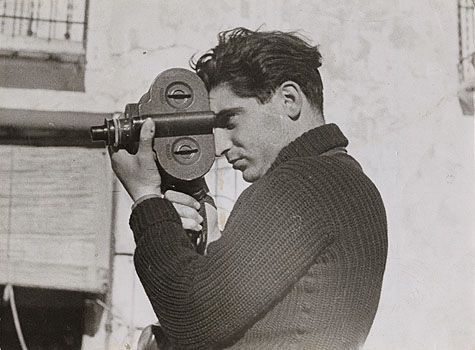
Robert Capa uses a hand-held camera

From its very beginnings in 1877 when Eadweard Muybridge took sequential photographs of moving horses and animated them with the zoópraxiscope—a device he invented two years later to project the images—documentary film has taken many forms and adopted numerous styles and techniques. Most notably, was when the Lumiére brothers invented the first movie camera in 1895 that could hold fifty feet of film stock, with which they captured a train pulling up to a station. As a result, the concept of unedited documentation of real-life situations referred to as “actualities” came about. Today, the two most common methods used in the genre however, are ‘direct cinema’ (the more commonly recognized, ‘standard’ method, if you will) and ‘cinema vérité.’

Both practices were quite revolutionary in their time and were developed during the same historical period in the early ‘60s—a period where documentary cinema had become more comparable to highly edited post-World War II propaganda than portrayals of real events. Developments in technology like smaller and lighter cameras that used 16mm film stock (as opposed to its 35mm predecessor), and portable sync sound allowed for a much less obtrusive way of filming events on site as they happened. The major film crews could be significantly downsized, editing became much more unnecessary and the hand-held cameras could ensure a closer, more authentic look at the subjects in question. Although the two similar techniques came about with synonymous ideologies about championing realism in film, they do have some subtle, yet important differences.

The Maysles brothers, Albert and David Maysles of the United States were most well-known for developing direct cinema. Three of their most popular works in the genre were Salesman (1969), Gimme Shelter (1970), and Grey Gardens (1975). Rather than planning a scene they wanted to shoot, the brothers would let the story unfold organically as the camera rolled. They believed the documentarian was an objective observer, a completely invisible passivist as opposed to a director or participant—a noteworthy sentiment that sets the genre apart from cinema vérité.

French for “film truth”, cinema vérité was first developed by French ethnologist and filmmaker, Jean Rouch during the early 1960s and brought to documentary filmmaking a natural dialogue and authenticity of action. But unlike its direct counterpart, the philosophy behind this technique was that the filmmaker actively participates in the film as a subjective observer where necessary; combining observational AND participatory filming in the same breath. Essentially, there is an awareness of the camera that is filming the scene, thus establishing a connection between the cameraman/filmmaker and those who are being filmed. It can also involve stylized and staged set-ups and the degree of intervention is greater than in direct cinema, with the filmmaker’s subjective involvement evoking provocation—something critics point out goes against the whole foundation of documentary as a means to portray uninterrupted truths. In its defence, famous vérité filmmaker Dan Kraus once said “no documentary can ever show you the truth, because there are multiple truths, but vérité can at least relay the truth as seen by a single observer…” Similarly, Rouch’s view about the camera provoking subjects was that provocation reveals people’s true selves as the creatures of fantasy, myth and imagination, which he believes constitutes the most authentic self.

One of the earliest and most widely known of Rouch’s films using vérité was Chronicle of a Summer (1960), which he did with fellow French filmmaker Edgar Morin. By gathering a number of Parisians, including a few supporters of a group with socialist ideologies, either through one-on-one interviews or group discussions, the film addresses topics ranging from happiness and love to colonialism and racism. True to the active role of vérité filmmakers on-camera, the action of the characters in the film seem to always be a response to an impulse by the leader of the conversation or the interviewer. Both Rouch and Morin play with their own roles within the film and are never detached or disengaged from the process of filming. They even included responses from all of the characters in the edited film after showing them the original; allowing for the luxury of self-representation in all parties that resulted in a sense of equality never achieved in direct cinema.

In comparison, both direct cinema and cinema vérité aim to uncover truth in two different ways. The former hopes to unveil truth through the camera’s observation of events and subjects; the latter uses any means possible to seek out truth and is intrinsically an internal process being gradually revealed. Nevertheless, documentary is rarely a matter of pure, untouched observation, but within both methods lies an opportunity for revelation—regardless of the degree of mediation by both the camera and the filmmaker. As such, they are viewed equally as two alternative methods of documentary filmmaking whose use of particular cinematic philosophy and new technology had a huge influence on many generations of filmmakers which is still felt today.

[su_note]Learn more about the School of Documentary Filmmaking at the New York Film Academy by clicking here.[/su_note]
Deeper Into The Method: 5 Contemporary Actors That Took Method Acting To The Limit

“My dear boy, why don’t you just try acting?”

A famous quip from Lawrence Olivier regarding Dustin Hoffman’s dedication to method acting on Marathon Man, the merits of adamantly sticking to character even when the cameras aren’t rolling are hotly debated in acting school.

Actors getting into method acting

Somewhat disappointingly, the exchange between the two great actors was revealed by Hoffman himself to be not quite accurate, but it doesn’t detract from the fact that sometimes, a performance requires a little something extra from the acting talent.

Here’s five notable examples of roles that took a lot out of the people behind them, whether on a voluntary basis or otherwise. And be sure to check out our piece on the history and legacy of method acting as well as our preceding article on how actors like Marlon Brando used method acting.

Heath Ledger – The Dark Knight

Ledger’s penultimate performance before his untimely death is as enigmatic as the character he played.

In preparation for his turn as The Joker in the 2008 film The Dark Knight, Ledger is widely known to have put himself through the wringer to bring something original to the role…and the hard work paid off.

It’s well known that the Oscar-winning actor locked himself in a hotel room for an entire month, rambling and laughing to himself as he developed the character (it’s easy to imagine hotel staff avoiding that particular corridor in the small hours of the morning.)

It’s also widely reported that during this time he kept a scrapbook diary, also put together while in character. What isn’t fully known, however, are the exact contents of the diarythe closest the public have ever gotten to seeing what the troubled actor put into it can be seen only in this clip:

It’s clear to anyone who has seen the resulting movie that Heath gave his all to the character and performance. To what extent that contributed to the factors surrounding his tragic passing is up for debate, and probably always will be.

Robert De Niro – Cape Fear

Putting yourself in isolation for weeks to develop a character is one thing, but having extreme dental work performed is another thing altogether…

… and that’s exactly what Robert De Niro did for his terrifying role as Max Cadyln in the 1991 Cape Fear remake. Not only did he undergo extensive training to build muscle and get his body fat down to only four percent, but he also paid $20,000 out of his own pocket to have his teeth ground down to bring a more ominous look to his character.

Christian Bale – The Machinist

As well as putting on a huge amount of mass to play Batman in the aforementioned Nolan franchise, Christian Bale had also been to the other extreme less than two weeks prior to donning the cape and cowl.

For The Machinist, Bale dropped 63 pounds to achieve the worryingly skeletal figure that can be seen in the film. Interestingly, this was almost an unnecessary devotion on Bale’s part—the weights mentioned in the movie (and written on the bathroom wall) were based on screenwriter Scott Kosar’s own weight, which were comparatively tiny given Kosar is only 5’6”. When it came time to change them after casting was complete, the 6’0” Bale insisted the figures were to be kept as written in an attempt to match them.

In reference to the above scene, 121 pounds at 6’0” is so underweight it only just appears at the bottom of the BMI scale.

Bale gorged on pizza and ice-cream to get up to Batman proportions just six weeks later.

Joaquin Phoenix – I’m Still Here

It takes a special kind of actor to put their own sanity and health on the line for the sake of character immersion, but it’s on another level still to purposefully put your entire career in jeopardy solely to fulfill a prank.

In 2009, Phoenix publicly announced a surprise retirement from his exceptionally successful acting career…to focus on becoming a rapper.

https://www.youtube.com/watch?v=RRb_3hCa72Y

As many suspected, it was all an elaborate ploy feeding into a mockumentary centered around the idea, but one which he kept up in his real life much to the confusion of everyone not in on the joke who were beginning to believe he was genuinely attempting a woeful career change.

The project very nearly killed his credibility and the acting career he pretended to give up, but after taking a genuine break following the big reveal, he came back swinging with 2012’s The Master.

Daniel Day-Lewis – Everything He’s Ever Been In

Possibly the most famous method actor of them all, we could fill an entire post full of examples where Day-Lewis delved so far into his character that the reclusive actor himself practically stopped existing for the duration of the shoot. Essentially, on any of his carefully chosen projects, there is only the character.

And not only does he never break character under any circumstance while on set, but he even follows through this devotion long before the cameras start rolling; in preparation for Lincoln, he demanded a full year of preparation to shut himself away, read every book written about Honest Abe and become the former President.

https://www.youtube.com/watch?v=qiSAbAuLhqs

For The Last of the Mohicans, he learned to live off the land and did so for lengthy spells in the run up to filming. For My Left Foot, he insisted on retaining his character’s severe paralysis and needed to be moved in his wheelchair between takes (much to the chagrin of the crew.)

But perhaps the biggest example of this is the one scenario in which Day-Lewis was finally forced to break his devotion to the role. In preparation for his role as Bill the Butcher in Gangs of New York, he spent some time before filming training as an actual butcher and then proceeded to stay in character as usual while filming during a particularly brutal New York winter.

Refusing to wear a warm coat unbefitting of the movie’s era, he developed pneumonia. Naturally, he refused modern medication to treat this right up until practically arriving at death’s door.

If that isn’t dedication to a role, we don’t know what is.

[su_note]Learn more about the School of Acting at the New York Film Academy, with campuses in New York, Los Angeles, and Miami.[/su_note]

The Upcoming FCC Spectrum Auction: How The Broadcast Landscape Is Changing

FCC spectrum allocation
It’s no secret that the way we watch things is changing at a rapid pace. While 77% of adults say they regularly watch TV via cable or satellite, in the past decade, TV streaming services have gone from largely nonexistent to almost half (46%) of American households using services like Hulu and Amazon Prime, with that number jumping up to 62% when we look at millennials, according to Nielsen.

Broadcasters once had a monopoly when it came to TV news. Increasingly they are one source among many with the proliferation of streaming news and internet news radio. So what does this mean for how the FCC currently reserves spectrum space and the amount is reserves for TV stations?

What is the Spectrum Auction?

According to the FCC, the broadcast spectrum Incentive Auction was planned to address the nation’s changing media needs as the amount of spectrum space reserved for television begins to become obsolete as less and less Americans watch TV via cable or satellite. As the use of wireless devices (mainly cell phones and routers) has increased exponentially in the past ten years, the available wireless spectrum remained static—there is only a finite amount of spectrum. Broadcasters, like TV and radio stations, as well as wireless providers like Verizon, AT&T, and Sprint, all have a license with the FCC to broadcast on a specific frequency; each can use a limited amount of spectrum in its region.

Why the Auction?

Wireless carriers have pressured the FCC for years to allow them to broadcast on the 700MHz frequency in the name of better coverage for cell phone users. In May of 2014, the FCC adopted a Report and Order, setting up rules for the auction, which is expected to be held in 2016. Currently, broadcasters can apply for a “reverse auction” where they volunteer to either stop using the frequency, or move to either a Low-VHF channel or a High-VHF channel (depending on where the broadcaster is starting from) in exchange for financial incentives. (VHF stands for “very high frequency,” and refers to the area of the spectrum used by a broadcaster.) In some cases, broadcasters will share spectrum space with another broadcaster. This gives other wireless users the opportunity to bid on new frequencies or shares of spectrum.

Can Broadcasters Opt Out?

Broadcasters that don’t want to move are not required to do so. Participation in the auction is voluntary and requires an application with the FCC. Keep in mind that most radio and TV stations are owned by larger conglomerates that will most likely make the decision of whether or not to participate.

If you graduate and begin a job in broadcast journalism in the next year or two, you may find your TV station is in the middle of repackaging. Repackaging, sometimes called repacking, refers to the process planned to follow the incentive auction, where the FCC reorganizes the stations remaining on-air so they take up less space on the UHF (Ultra-High Frequency) band. This frees up space for cell phone providers, while allowing TV and radio stations to continue broadcasting with a slightly smaller area of coverage.

It’s important to note that other nations are already moving in this direction, but their focus has been on radio rather than TV. AM (or medium wave) radio was the first target in Europe. The assumption was that you can still listen to AM “stations” via a mobile device or website. Now, in Norway, FM stations are scheduled to go off-the-air too.

How Does Participating in the Auction Affect Broadcasters?

Choosing to stop broadcasting entirely probably strikes most broadcasters as an awful idea, or a sign of failure. But this is the digital age, and many stations are seeing viewers move online. For small, independent stations with very low on-air viewership, especially those struggling financially, going off the air could be an opportunity. The organization may have to give up its call sign, but it can rename itself and produce packages for its website. The financial rewards from the auction could even allow the organization to improve its quality of production by buying new equipment, investing in social media marketing, etc.

What About Repackaging and Sharing Space?

Stations that apply for repackaging will most likely lose some coverage of their current area. However, the FCC rules specify it won’t allow a station to reduce its population served by more than .5%, so these changes should only result in minor audience losses. Viewers watching on cable will not be affected.

It’s important to remember that even when .5% equals a large number of viewers, all is not lost. Viewers who lose the station’s on-air signal can still watch video on its website, as most broadcasters post at least their most popular stories online and on social media.

What Can You Do?

Think about ways you could use digital strategy as a journalist, and how these might become more important if your future employer chooses to repackage. If you currently have an internship with a TV or radio station, ask if any decisions have been made about applying for the auction. If you learn that your station is considering applying, ask what digital strategies will be used to make the transition smooth for viewers.

Technical Considerations

Aside from the intentional shrinking of the audience, there will likely be technical difficulties during the transition. Part of your digital strategy should include having social media messages ready to go if your station temporarily goes dark (“We are currently experiencing technical difficulties, but will be back on the air soon. In the meantime, watch video from this morning’s newscast here….”). You’ll also need planned responses to people tweeting “I can’t watch your station any more, you jerks!” (“We’re sorry our signal no longer reaches you, but you can still watch our most recent newscasts on our website at….”)

Considerations for All Journalists

Whether you work for a station that repackages or not, a solid digital strategy will help you reach viewers as they spend more time online. This means considering factors such as length of packages, whether you should add more in-depth coverage of a topic online, and how you engage with viewers on social media. When you’ve developed a plan to reach viewers both online and on-air, you’ll be better prepared for a job in broadcast journalism, and if you work for a broadcaster that repackages, you’ll be better able to transition smoothly.

[su_note]Learn more about the School of Broadcast Journalism at the New York Film Academy by clicking here.[/su_note]